

Goal setting is the purposeful process of deciding what you want to achieve and building an action plan, broken into smaller steps, to motivate, organize and guide you toward it. A goal is the destination; goal setting is the route you draw to reach it. Wishing for growth is easy. Planning for it is where progress takes root.
Definition: What Goal Setting Means

A goal is an intention to achieve or change something significant. Goal setting is the explicit process of turning that intention into an action plan, complete with a benchmark for checking whether you are on track or need to adjust, according to Sheridan College's guide to goals vs. goal setting. Eastern Washington University's learning center describes it as taking active steps toward a desired outcome by breaking big dreams into smaller, attainable goals.
In plain language: goal setting means choosing what you want, then writing down the small, trackable steps that get you there.
The distinction is simple but easy to miss. "Grow my business" is a goal. A weekly plan with numbers, deadlines and a review date is goal setting.
Takeaway: if your goal has no plan or measure attached, you have an intention, not a goal-setting process.
How Goal Setting Works

The process is not complicated. It asks for honesty and a little structure.
Name your why. Ask why the goal matters and what life looks like once you reach it.
Pick the goal type. Decide whether you are setting a process, performance or outcome goal (ideally all three).
Make it SMART. Specific, measurable, attainable, relevant and time-bound.
Set short- and long-term goals. Weekly actions feed the bigger yearly result.
Write it down and review. Keep goals visible, adjust when needed, and recognize wins.
Process, performance and outcome goals
EWU's learning center sorts goals into three types:
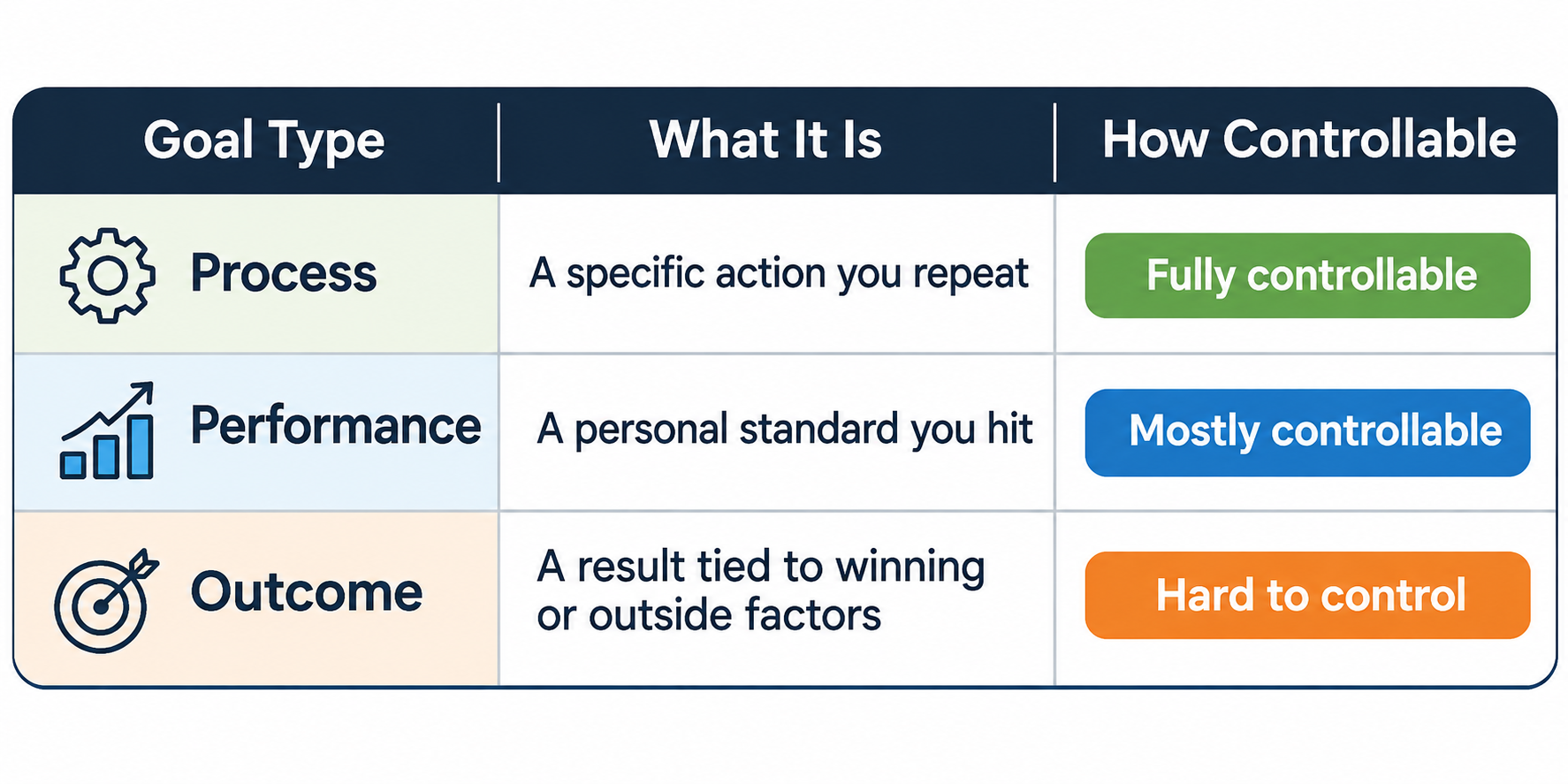
The three are linked in a line. Hit your process goals and you give yourself a good chance at your performance goals. Hit those, and the outcome becomes more likely.
A goal setting example for a small business owner
Picture a solo bookkeeping firm owner in Ohio whose New Year's goal is "grow my business." It sounds motivating. It gives no direction on a Tuesday morning.
Here is how that aim becomes a defined plan. The numbers below are example assumptions; yours will depend on your pricing, capacity and market.
Step 1: The why. The owner wants enough steady income to hire a part-time assistant and stop working weekends. That reason connects to something they care about deeply, which is what keeps the plan alive in a slow month.
Step 2: Outcome goal. Reach $5,000 in monthly revenue by December 31. This is the result, and it depends partly on things outside their control, like the local economy.
Step 3: Performance goal. Sign 10 new monthly clients this year. This is a personal standard, mostly within reach.
Step 4: Process goal. Send 5 personalized outreach emails every weekday morning before 10 a.m. This is fully controllable.
Step 5: Short- and long-term split. The weekly target is 25 emails. The quarterly check is roughly 2 or 3 new clients.
Step 6: Review. Every Friday, compare emails sent, replies and signed clients. If replies are low, adjust the message, not the dream.
Notice the shift. The owner no longer wakes up to "grow." They wake up to five emails.
Takeaway: build your plan from the bottom up, starting with the daily action you control.
Why Goal Setting Matters
Goals give shape to effort. According to a study.com lesson on goal-setting theory, goals keep us focused. A resource from NILD adds that setting goals triggers new behaviors and momentum, and that goals act as a roadmap for where you are going and how you will get there.
Three common uses show this at work:
Personal habits. Someone wanting more energy turns "exercise more" into a set walking schedule with a four-week check-in.
A founder's year plan. A small business owner maps one outcome for the year, then breaks it into quarterly performance targets and weekly actions, as in the example above.
A team's shared goals. A manager aligns a small team around one shared result so each person knows which process goal they own. Shared goals are a core theme in the team workshops we run on leadership and communication.
Takeaway: the real benefit is not the target itself but the focus and momentum the plan creates.
Common Misconceptions About Goal Setting

Misconception: Having a goal means you will achieve it
Reality: Choosing a goal is only the first and often easiest step. Sheridan College's guide is plain about it: having a goal does not mean you will automatically achieve it. You need a plan and a way to track progress.
Misconception: The goal itself is what matters most
Reality: Your why carries more weight than people expect. Clinical psychologist Jennifer Crawford, PhD, of the University of New Mexico, notes that if you do not care about why you are doing something, it becomes hard to stick with the new behavior. Knowing your why also makes it easier to adjust course.
Misconception: Only outcome goals count
Reality: Outcome goals are the hardest to control because outside influences shape them. Process goals are fully in your hands, and achieving them sets up everything else. Revenue is the harvest; daily actions are the planting.
Takeaway: a goal without a why and a process behind it is fragile.
Related Concepts
SMART goals
A framework for defining goals so they are specific, measurable, attainable, relevant and time-bound. Some sources, including NSLS, swap in actionable and rewarding for two of the letters.
PACT method
A goal-setting technique that NSLS lists alongside SMART as another way to structure goals.
Process goals
Specific actions you perform regularly, such as studying two hours after dinner. They are fully within your control.
Performance goals
Goals based on a personal standard, such as a target GPA or client count. They are mostly controllable.
Outcome goals
Goals tied to a final result or win, such as landing a specific job. Outside factors make them hard to control.
Takeaway: SMART shapes a single goal; the three types show how goals stack together.
How to Get Started Today

You do not need a full system to begin. You need a quiet half hour and a pen.
Write your why in one sentence. If it does not move you, rewrite it until it does.
Pick one process goal. One daily or weekly action you fully control.
Set one short-term and one long-term goal. A 30-day target and a 12-month target that connect.
Schedule a weekly review. Put it on your calendar now, same day and time each week.
If a blank page slows you down, a structured worksheet helps. We sell goal setting templates among our digital downloads, along with workbooks for planning, growing and leading.
Takeaway: start with one process goal this week; momentum grows from small, steady actions.
FAQ: Frequently Asked Questions
How do you set SMART goals?
Take a broad aim and make it specific, measurable, attainable, relevant and time-bound. For example, turn "move more" into walking 30 minutes on Tuesdays and Thursdays for four weeks, then track whether you did it.
What are the five factors of goal setting?
Lists vary by source. A practical set covers knowing your why, being specific, making progress measurable, setting a deadline and reviewing regularly. Those elements show up across most well-known frameworks, including SMART.
How do I set realistic goals?
Check that the goal sits within your ability, time and resources, then shrink it until you could start tomorrow. Connecting it to what you truly care about makes a realistic goal easier to commit to.
What are 5 benefits of setting goals?
Goals sharpen focus, create momentum, give you a roadmap, make progress measurable and keep you accountable. They also help you notice early when a plan needs adjusting, rather than discovering it months later.
What is the difference between a goal and goal setting?
A goal is your intention to achieve or change something significant. Goal setting is the process of building an action plan, with benchmarks, that guides you toward that intention and keeps you accountable.
What are the three types of goals?
Process goals are actions you fully control, performance goals are personal standards you mostly control, and outcome goals are results influenced by outside factors. Achieving the first two improves your chances at the third.
Conclusion
Goal setting is the deliberate work of turning what you want into a plan you can follow, measure and adjust. The one takeaway: anchor every outcome to a why and a process goal you control. Growth tends to follow steady roots. At Hatch & Co, we offer strategic business coaching and goal setting templates for small business owners, and you can book a consultation through our website when you are ready to map what comes next.