
A plain, step-by-step guide to how to goal setting for small business owners, with a worked example turning a $30,000 revenue goal into weekly targets.

Set goals effectively by choosing one clear outcome, making it specific, measurable, realistic and timed, breaking it into smaller milestones and weekly tasks, writing it down, and reviewing progress on a fixed schedule. That is the whole method. The rest is doing it with honesty and patience. At Hatch & Co, we help small businesses grow with that kind of steady clarity, and we wrote this guide for owners who want a plain, workable way to set goals. Skill level: beginner.
What you'll need
Gather these before you sit down. Good goals grow from good soil, and the soil here is your real numbers and an uninterrupted block of time.
A notebook or a blank document. Paper works. So does a simple goal setting template if you prefer structure.
Last year's numbers. Revenue, number of customers, average sale, and anything else you track.
Phone off. Door closed.
Your calendar. Digital or paper, as long as you actually open it every week.
An accountability partner. A business friend, a spouse, a coach. Someone who will ask, kindly, how it is going.
Takeaway: if you do not have last year's numbers handy, pull them first. Goals built on guesses tend to wobble.

Before you start
Decide two things before you write a single goal: the one area of the business you will focus on, and the time frame. Revenue this year? Hiring by summer? Pick one.
Resist the urge to set ten goals at once. As the Illinois Leadership Center notes, setting goals gets harder when you try to set more than one at a time. Spread your attention across too many targets and each one gets thinner.
Takeaway: write your priority area and your time frame at the top of the page. Everything below has to serve that line.
Step-by-step: how to set goals for your business
Goal setting is the process of consciously evaluating what you want to achieve in a certain period and creating an actionable plan for it. Here is how we suggest owners do that, as an owner rather than a self-help reader.
1. Brainstorm everything you want
Write down every goal that comes to mind for the business. Bigger margins, a second location, fewer late nights, a new product line. Do not edit yet. Open-minded brainstorming is the right first move; you sort later.
Outcome: a messy, honest list.
Check: you have at least eight to ten items on the page, and some of them surprise you a little.
2. Pick one priority outcome
Read the list slowly. Circle the one goal that, if achieved, would make several others easier. More revenue often funds the hire, the tools and the breathing room. Ask why it matters to you. Your reason is what carries you through the slow months.
Outcome: one circled goal and one sentence explaining why.
Check: you can say the goal and the reason out loud in under 15 seconds.
3. Make it specific, measurable, realistic and timed
A vague goal is a wish. Rewrite your priority so it is specific, measurable, realistic and timed. You will often see this called a SMART goal.
Specific: what exactly changes?
Measurable: what number tells you it happened?
Realistic: does it fit your capacity and your past results?
Timed: by what date?
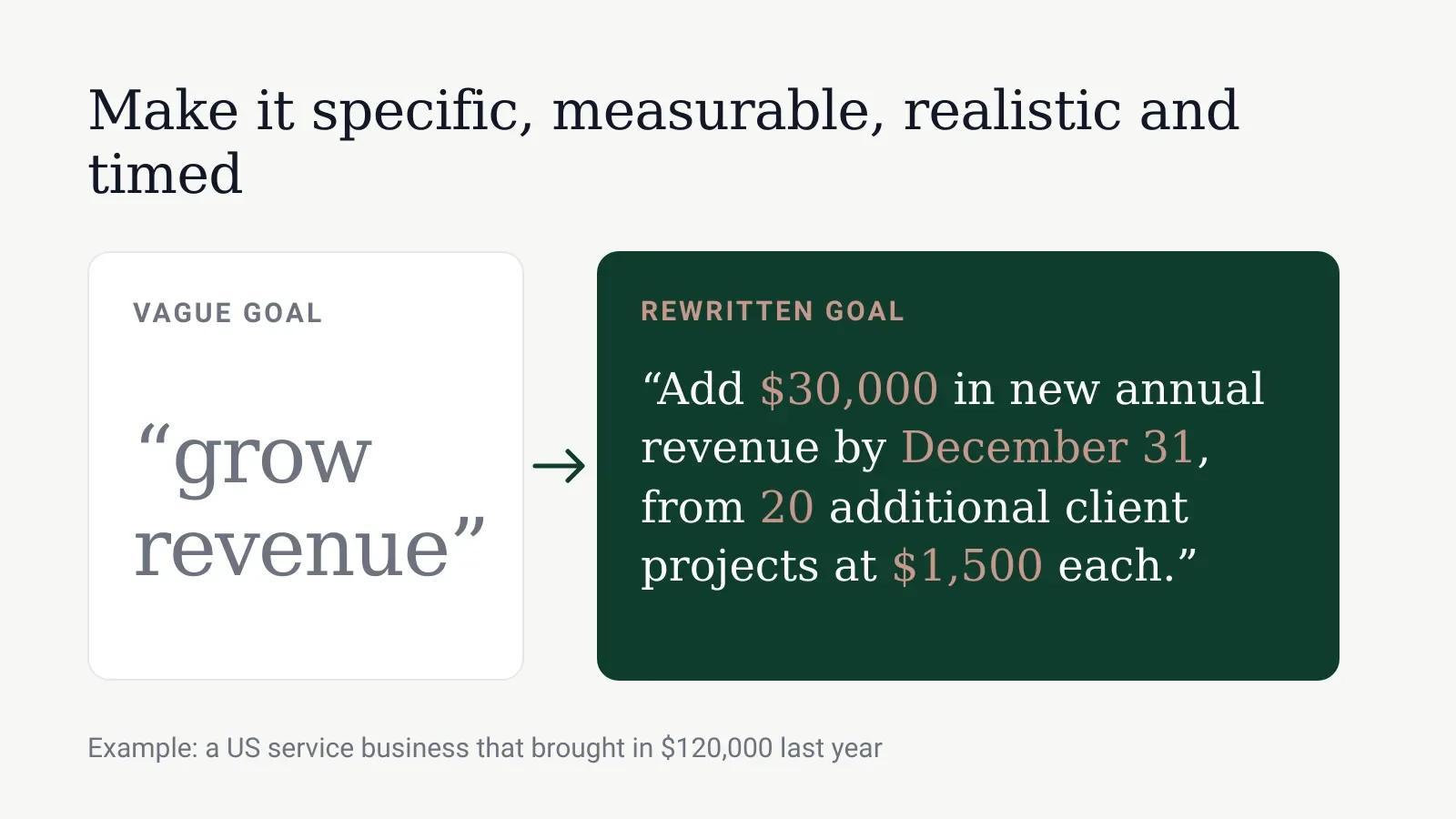
Worked example. Assume a US service business brought in $120,000 last year. The owner's average client project is $1,500, and the business has room for more work without hiring. Vague goal: "grow revenue." Rewritten goal: "Add $30,000 in new annual revenue by December 31, from 20 additional client projects at $1,500 each."
That is specific (new projects), measurable ($30,000 and 20 projects), realistic for the assumed capacity, and timed (December 31).
Outcome: one goal statement that a stranger could check.
Check: someone else could read it on December 31 and tell you yes or no without asking a question.
4. Break it into milestones and weekly tasks
Big goals are trees. You do not climb a tree in one leap; you find the branches. Break your long-term goal into smaller goals, then tasks, and map them onto a timeline.
Continuing the example, here is how $30,000 breaks down:

Weekly targets are about actions, not revenue. Assume, as an example, that one in four sales calls becomes a project. To land about 1.7 projects a month, the owner needs about 7 calls a month, which is roughly 2 calls a week. Weekly tasks might be:
Send 5 personal outreach emails to past clients or referrals.
Book and hold 2 sales calls.
Publish one useful post or case of work on your main channel.
Follow up on every open proposal.
You control the actions. The revenue follows them, unevenly at first.
Outcome: quarterly, monthly and weekly targets that add up to the year.
Check: multiply your monthly target by 12. If it does not equal your annual goal, fix the math now.
5. Write it down and put dates on the calendar
Write the goal statement where you will see it daily: the first page of your notebook, a sticky note on your monitor. Writing goals down and turning them into a to-do list is a common thread in goal setting advice. Then put the work on the calendar: recurring blocks for outreach, sales calls and a weekly review.
Outcome: the goal lives somewhere visible, and the tasks have time slots.
Check: open next week's calendar. Every weekly task has a block with a start time.
6. Review weekly and adjust monthly
Set a 20-minute weekly review. Did the tasks happen? What got in the way? Once a month, look at results against the monthly target and adjust the tactics, not the goal, unless something in the business genuinely changed.
Think of it like tending a garden. You do not dig up the seeds every day to check on them. You water, watch and prune on a rhythm.
Outcome: a standing review habit.
Check: your review is on the calendar for the next four weeks, and your accountability partner knows when it is.
Takeaway for the whole process: if you do only one thing today, finish Steps 2 and 3. A clear, measurable goal makes every later step easier.
Troubleshooting
Even well-built goals stall. Here is how to read the signs.
Symptom: You abandon goals by February
Cause: many people forget their goals or lose the discipline to follow through, often because they start new habits without a plan to get there.
Fix: shrink the weekly tasks until they feel almost too easy, then protect the weekly review. Momentum beats intensity.
Symptom: Goals feel overwhelming
Cause: the goal is still one big block with no handholds.
Fix: break it into smaller, manageable steps. If a weekly task still feels heavy, split it again. "Do marketing" becomes "draft one email to five past clients."
Symptom: You cannot tell if you are on track
Cause: the goal is not measurable, or there is no number at the weekly level.
Fix: return to Step 3 and attach a number and a date. Then track one or two weekly activity counts, like calls held or proposals sent.
Symptom: Too many goals compete
Cause: trying to set several goals at once splits your attention and makes each harder to reach.
Fix: choose one priority for this season. Park the rest on a "later" list. They will keep.
Takeaway: most goal problems are size problems. Make the goal clearer, the steps smaller, or the list shorter.
FAQ: Frequently Asked Questions
How do I get better at goal setting?
Practice the basics on a rhythm. Set fewer goals, make each one specific, measurable, realistic and timed, break it into weekly tasks, and review progress every week. Skill grows from repetition, not from a perfect first plan.
How do I set my own goal?
Start by brainstorming everything you want, then pick the one outcome that matters most. Rewrite it with a number and a deadline, break it into milestones and tasks, and put those tasks on your calendar.
What are the six steps in goal setting?
The six steps used here are: brainstorm, pick one priority, make it specific, measurable, realistic and timed, break it into milestones and weekly tasks, write it down with calendar dates, and review weekly while adjusting monthly.
What are the goals of a person?
A goal is an explicit statement of a desired result. For a person, goals often cover career, finances, health, relationships and growth. For a business owner, personal and business goals usually overlap more than expected.
What is the difference between short-term and long-term goals?
Short-term goals have near deadlines and act as stepping stones you complete before moving to something bigger. Long-term goals describe the larger destination, such as annual revenue, that those shorter goals work together to reach.
How often should I review my goals?
Review your tasks weekly and your results monthly. Weekly check-ins catch slipping habits early, while monthly reviews give enough data to adjust tactics without overreacting to one slow week.
Conclusion

The method is simple: brainstorm, pick one outcome, make it specific and timed, break it into weekly tasks, write it down, and review on a schedule. This week, do one thing: block 90 minutes and finish Steps 2 and 3. A clear goal is a seed worth planting.
If you would like support, Hatch & Co offers strategic business coaching for small businesses, along with goal setting templates and planning workbooks as digital downloads. You can book a consultation through the website whenever you are ready to talk about what comes next.