
Pony Bead Tapestry Is Having a Moment. So Is the Craft Business.
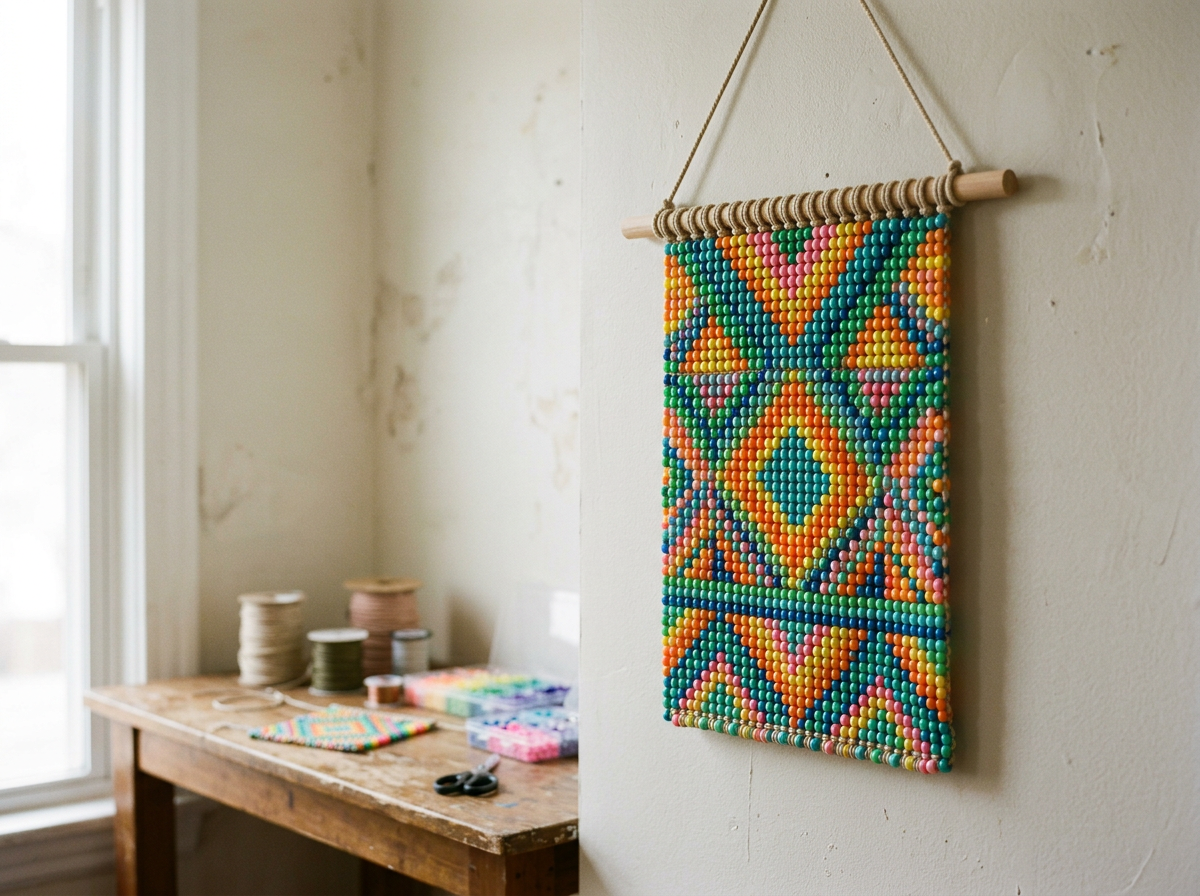
If you haven't thought about pony beads since 1990’s summer camp, you may want to take another look.
Searches for “pony bead tapestry pattern” on Pinterest have surged more than 5,000% year over year, while searches for “pony bead tapestry” are up 2,500%. The colorful plastic beads many of us remember stringing onto keychains are now being transformed into elaborate wall hangings, pixelated portraits and pieces of art made from thousands of individual beads.
And pony beads aren't alone.
Needlepoint is booming. Crochet and embroidery are finding new audiences. Junk journaling has become a social media phenomenon. Even the humble mirror tile has escaped the disco ball, covering fruit, animals, furniture and oversized sculptures.
Something interesting is happening in the craft world. And for entrepreneurs, it's worth paying attention.
Crafting Is Having a Very Big 2026
Across Pinterest, Etsy and major craft retailers, people are showing renewed interest in making things by hand—and rediscovering crafts that, not long ago, might have seemed decidedly old-fashioned.
Michaels declared 2026 the “Year of Creative Living” after analyzing its sales and search data, consumer research and emerging creative trends. Searches for analog hobbies—including knitting, crochet, embroidery, journaling and painting—increased 136% in just six months.
Look a little closer and the individual trends are even more striking:
Pony bead tapestry: Pinterest searches for “pony bead tapestry pattern” are up more than 5,000% year over year, while “pony bead tapestry” is up 2,500%.
Needlepoint: Michaels reports searches are up 251% year over year, while Etsy has seen searches for beginner needlepoint kits climb 175%.
Embroidery and crochet: Etsy reports searches for embroidered straw bags have increased 20,000%, while sales of crochet clothing are up 36%.
Mosaics: Michaels says searches for mosaic kits have jumped 248% year over year.
Junk journaling: Michaels reports searches are up 63%, while Etsy says searches for traveler journals have doubled and journal charms are up 395%.
Those numbers aren't all measuring exactly the same thing—some track searches, others sales—but collectively they point in the same direction. Consumers aren't simply buying handmade things. They're increasingly interested in the crafts themselves, whether that means purchasing a finished piece, learning how to make one or buying the supplies to do it themselves.
Pony bead tapestry isn't some strange little corner of Pinterest. It's part of something much bigger.
The Internet Didn't Kill Handmade. It Changed the Economics of It.
There was a time when turning a craft into a business was largely a geographic proposition.
You could sell your work at a local craft fair. Maybe a boutique would carry it. If you were particularly ambitious, you could travel to shows or build a mail-order business. But your potential customer base was still largely determined by the number of people you could physically reach.
That limitation has effectively disappeared.
Imagine that only one out of every 10,000 people would ever consider buying a giant strawberry covered in tiny mirrored tiles. That sounds like a terrible business if you're limited to selling within your hometown.
Put that product on Pinterest, TikTok, Instagram or Etsy, however, and suddenly you aren't looking for the handful of people nearby who understand your weird little creation. You're looking for those people everywhere.
The internet has made it possible for extremely specific interests to become economically viable because the entrepreneur no longer needs the mass market. They need a sufficiently passionate niche—and a way to reach it.

Weird Can Actually Be an Advantage
For decades, entrepreneurs were taught to think bigger.
How large is the addressable market? How broadly does the product appeal? How many people could potentially buy this?
Those questions still matter. But a small business doesn't always require millions of customers. Sometimes specificity is exactly what makes the business interesting.
A crocheted sweater competes with millions of sweaters.
A hand-crocheted sweater covered in three-dimensional strawberries is something else entirely.
The same principle applies to needlepoint canvases with funny sayings, elaborate pony bead portraits or those spectacular mirror-covered creations taking over social feeds. The more distinctive the product, the fewer direct substitutes it may have.
More importantly, unusual products are inherently interesting to look at. In an economy where Pinterest, Instagram and TikTok function as discovery engines, interesting can be distribution.
Someone doesn't have to be searching for a mirror-covered lobster to stop scrolling when one appears on her screen.
She just has to think: I need that.
One Craft Can Become an Entire Business Model
The modern craft entrepreneur also doesn't have to make money solely from the finished object.
Take needlepoint. A business can sell finished pieces, canvases, patterns, thread bundles, beginner kits, accessories, digital guides, classes or workshops.
A crochet entrepreneur can sell a handmade sweater for $200—or sell the pattern for $10 to hundreds of people who want to make it themselves. A bead artist can sell the tapestry, the pattern or a kit containing everything necessary to recreate it.
One skill can suddenly support multiple revenue streams.
The original creation becomes more than a product. It can become intellectual property, an experience and even content. One customer wants the finished piece. Another wants to make it herself. Another wants to learn the skill. And another may simply follow the creator because watching the process is satisfying.
The craft becomes the platform on which the business gets built.
People Don't Just Want Things. They Want to Make Things.
Perhaps the most interesting part of the craft resurgence is that consumers aren't only buying handmade products. They're increasingly buying the opportunity to make something themselves.
Michaels reports that searches for “Craft Night” are up 103% year over year, while “Girls Night Crafts” searches have climbed 242%. Sales of guided craft kits increased 86%.
There is something almost counterintuitive about all of this happening in 2026.
Artificial intelligence can generate an image in seconds. Amazon can put almost anything on your doorstep tomorrow. Our phones provide essentially unlimited entertainment.
And yet people are choosing to spend hours pushing a needle through canvas, crocheting individual stitches, arranging tiny beads or gluing little pieces of mirror onto an object.
Perhaps that's precisely the point.
The easier technology makes everything, the more appealing it can become to do something deliberately slow, physical and personal.
For entrepreneurs, that creates opportunities beyond selling finished products. There are kits, classes, events, subscriptions, communities and experiences to build around the desire to create.
Don't Underestimate a Small, Passionate Market
There's a temptation when evaluating a business idea to dismiss anything that feels too niche.
How many people really want this?
It's a reasonable question. But today, there may be an equally important one:
Can I identify the people who really want this, and can I reach them?
You don't need everyone to understand why someone would spend hours making a pony bead tapestry. You need the pony bead tapestry people to find you.
The larger lesson from the craft resurgence isn't that everyone should quit their job and start crocheting. It's that the infrastructure available to entrepreneurs has fundamentally changed what can become a business.
A niche hobby can find a global audience. A physical product can become a digital pattern. A skill can become a class. A project can become content. And a customer can become part of a community.
So yes, pony bead tapestry is having a moment.
But the bigger opportunity may be what it represents: You don't necessarily have to make something everyone wants. You have to make something the right people really want—and know how to find them.