
From Acquisition to Advocacy: Where Customer Rewards Fit in Your Growth Strategy
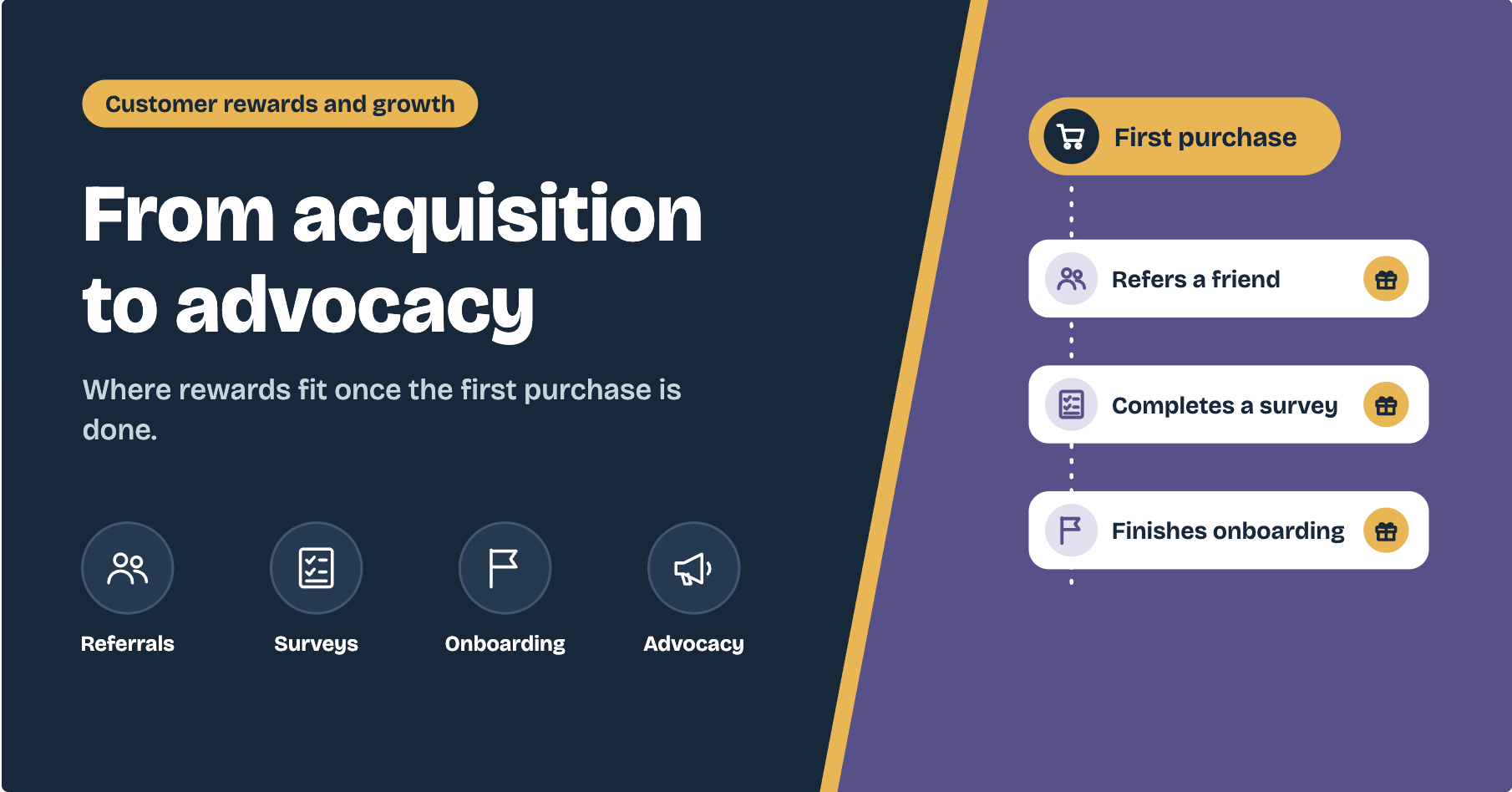
Businesses spend heavily to get customers through the door. Paid search, social ads, content, partnerships, and sales teams all aim to win the first transaction, and they usually measure it to the cent. But acquisition is just one moment in a much longer relationship. After buying, a customer might refer a friend, complete a survey, finish onboarding, test a product, or advocate for the business; those actions also have value. Yet many businesses are far less deliberate about encouraging them than they were about acquiring the customer in the first place. This is precisely where new strategies such as customer rewards fit into a growth strategy: not as occasional giveaways, but as incentives tied to specific customer behaviors that create recurring value for the business.
Which customer actions should you reward?
Start by defining what the action is worth. Say it costs $300 to acquire a new customer. If an existing customer makes a new referral that converts into a new customer, rewarding that referral can make economic sense at well below $300.
Take new product or feature development as another example. If a research interview prevents a product team from working on a new feature that doesn't answer a customer need and gets scrapped soon after shipping, that's business value that could reach well into the thousands in internal labor and opportunity cost alone.
These two rudimentary examples are meant only to show that these behaviors aren't equally valuable, so there is no reason to reward them equally. Before attaching an incentive, work out what the action is worth, whether customers actually need encouragement to take it, and how much of that value you can afford to give back.
The same logic applies to referral rewards. A study of around 10,000 customers of a German bank by Philipp Schmitt, Bernd Skiera and Christophe Van den Bulte found that customers acquired through its referral program were approximately 16% more valuable and 18% less likely to leave than other customers over almost three years. In this example, the bank offered existing customers a small €25 reward for a successful referral.
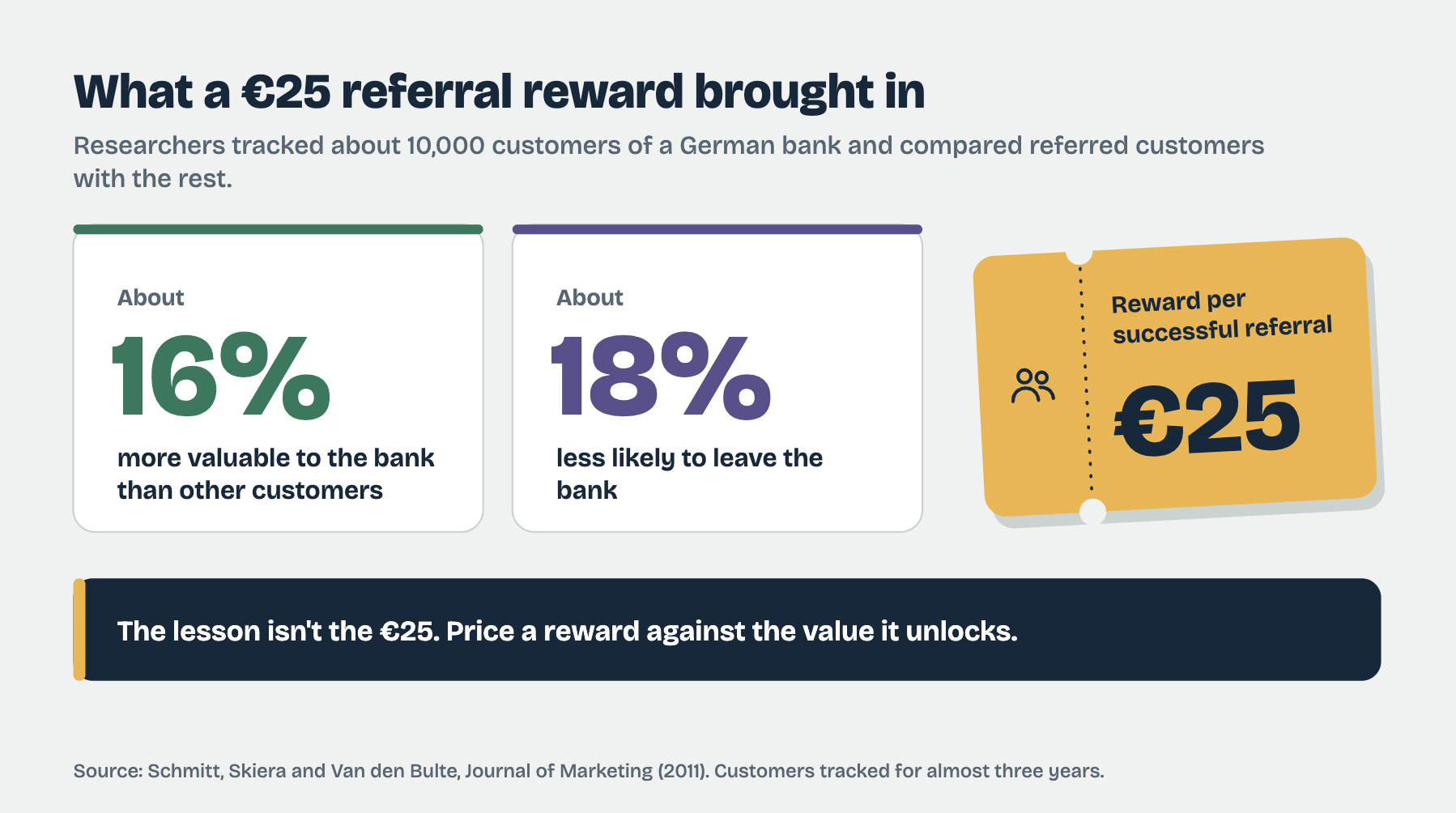
The takeaway here isn't that €25 is the magic number for a reward value, but that it demonstrates the methodology for setting the right referral incentive. Judge it by the value it unlocked through new customer acquisition, increased process times, product development — whatever it is. Link everything back to the business value it unlocks, not an arbitrary idea of what feels generous.
Do you need a loyalty platform to run a customer rewards program?
Not always, and this is where businesses can end up buying more technology than they need. At a high level, loyalty platforms such as LoyaltyLion and Yotpo are built around managing loyalty mechanics: points, tiers, eligibility and member experiences. Reward-delivery providers such as Giftogram, Tremendous and Tango focus on fulfilling and distributing rewards once an action is completed. Giftogram's customer incentive platform, for instance, takes a qualified customer from a list or an integration and sends a reward the customer chooses from 140,000+ national and local brands or a prepaid Visa or Mastercard card, with every send recorded for finance. Like the others within its category, Giftogram is equally prepared for one-off sending as it is for helping enterprises scale their customer rewards programs, spanning use cases from customer support incentives, switching incentives, and purchase rewards.
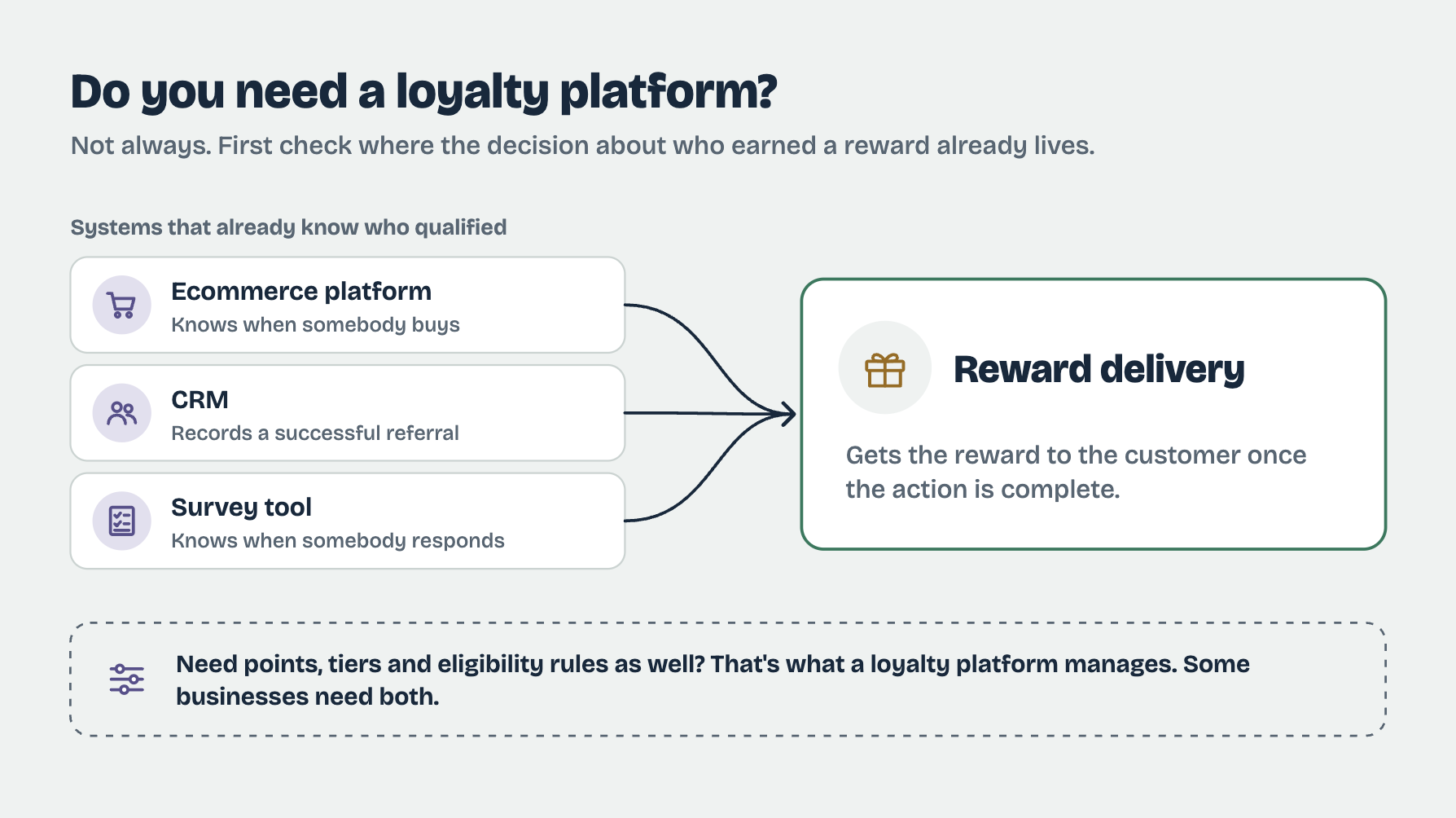
Some businesses need both. Others already have the qualification logic elsewhere. An ecommerce platform knows when somebody buys. A CRM can record a successful referral. Survey software knows when somebody submits a response. If those systems already establish who has earned something, the missing piece may simply be getting the reward to them. The mistake is buying a full loyalty system when the problem you really need to solve is reward fulfillment.
How should customer rewards be automated?
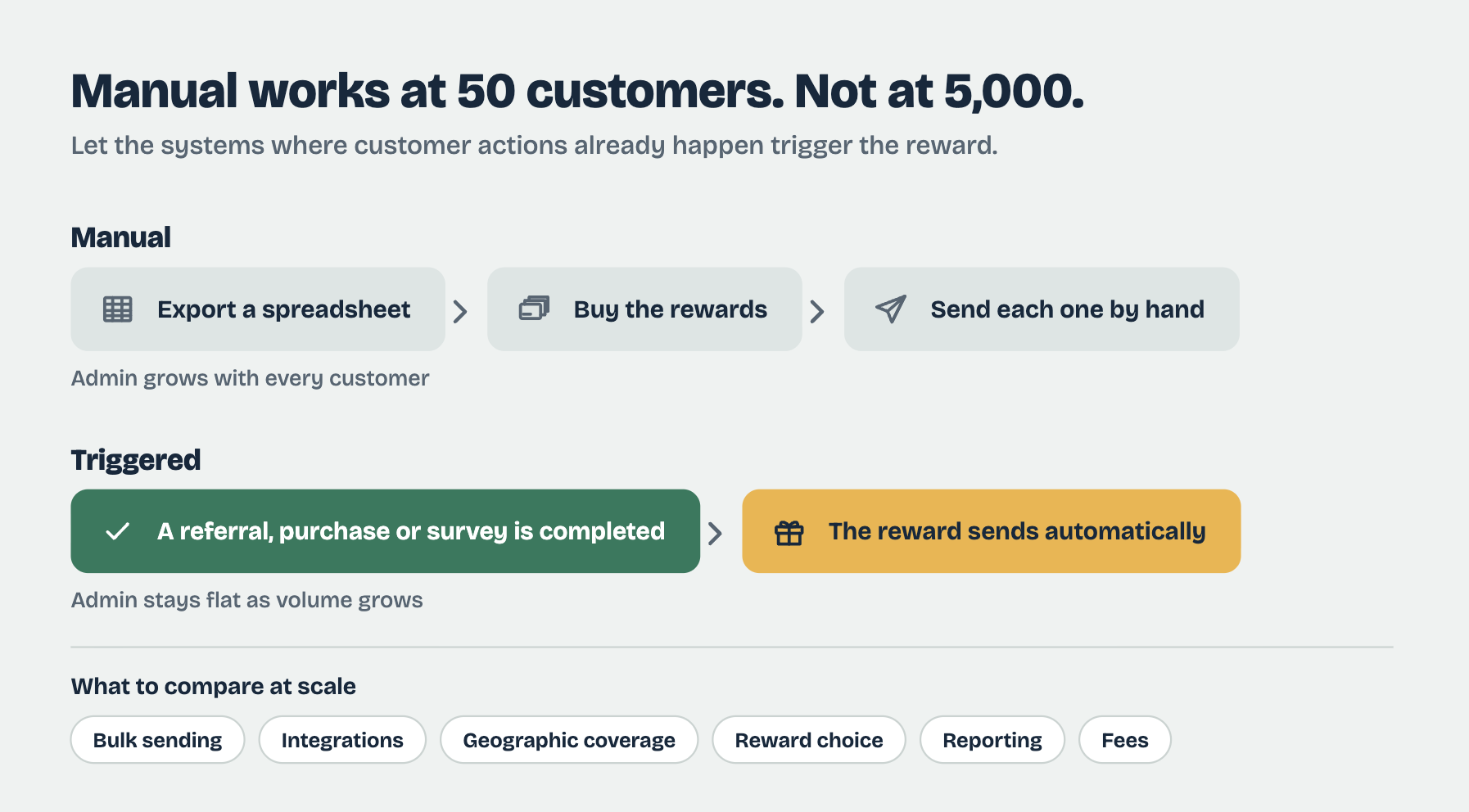
At low volumes, manual fulfillment works. Someone exports a spreadsheet, buys the rewards, and sends them. As a program grows, that admin becomes harder to justify and easier to get wrong. Instead, businesses can use the systems where customer actions already happen as triggers. A completed referral, purchase or survey can initiate reward delivery without somebody manually moving information between platforms each time.
Most rewards and incentives platforms like Giftogram and Tango offer automated workflows and native integrations. Giftogram, for example, supports 100+ built-in integrations and no-code workflows through Zapier, alongside an API for businesses that want to build reward delivery into their own systems. Standard digital rewards have no platform fees, so a $25 referral reward costs $25; some integrations charge a monthly fee based on volume.
Automation matters because it makes an incentive that works for 50 customers practical for 500 or 5,000. For larger programs, that means looking beyond whether a platform can send a reward at all. Bulk distribution, integrations, geographic coverage, reward choice, reporting, and fees all affect whether it can support the program at scale. So the best customer incentive platform depends first on what you need it to do: manage qualification, deliver rewards, or handle both. And on delivering the best customer experience.
Reward the behavior, then test the economics
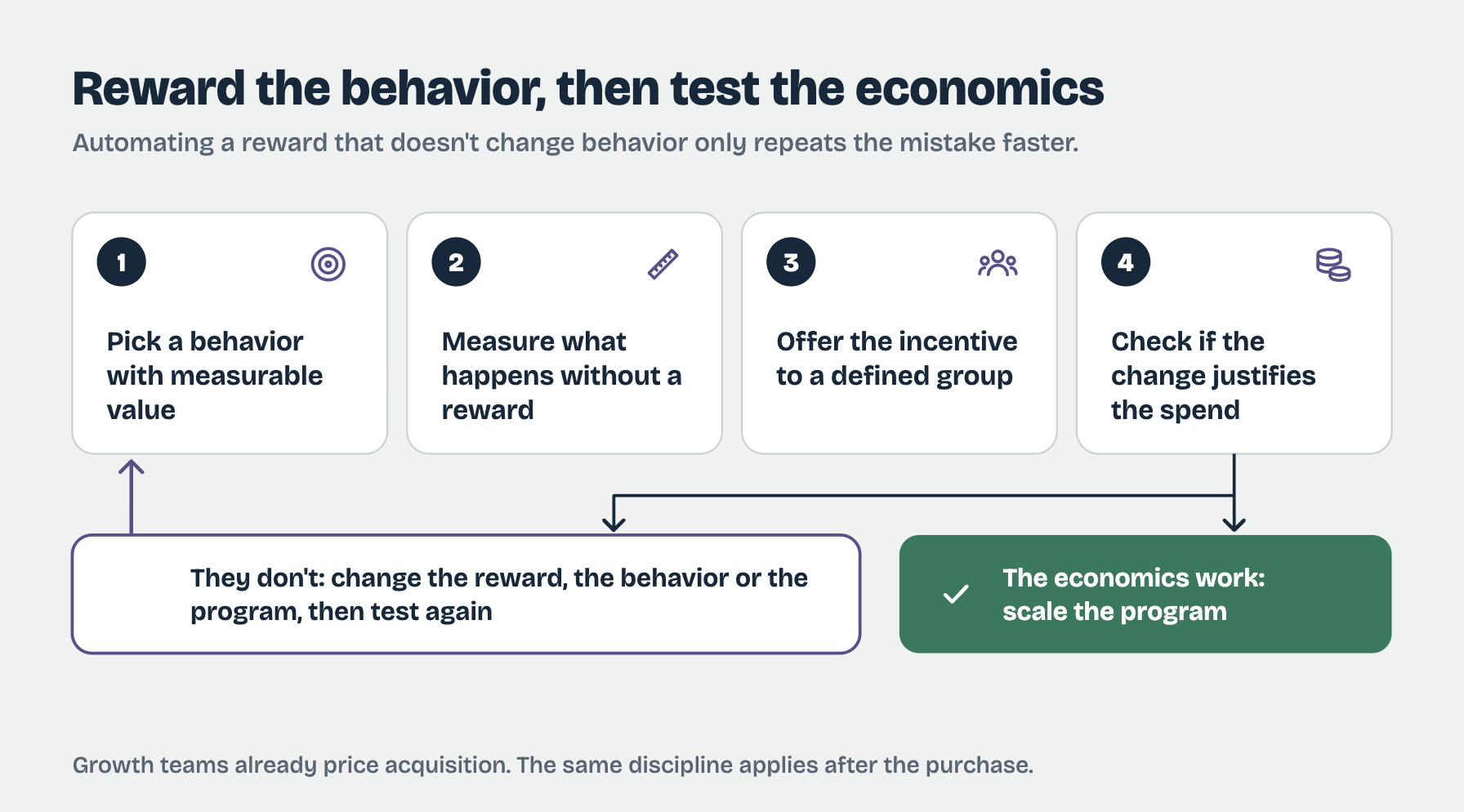
This doesn't mean every customer action needs an incentive. A poorly designed program pays people for behavior they'd do anyway, so automating it only makes that mistake happen faster and at greater scale. Start with a behavior that has measurable value, and establish what happens without a reward. Introduce an incentive to a defined group, then measure whether the behavior change justifies what you spent. If the economics work, scale the process. If they don't, change the reward, the behavior you're targeting, or the program itself. Growth teams already put a price on acquiring a customer. Customer rewards apply the same discipline afterward: identifying which post-purchase behaviors create value, decide which are worth encouraging, and build a system that can reward them without creating another manual process.
Frequently asked questions
Do you need a loyalty platform to run a customer rewards program?
No. A loyalty platform manages mechanics such as points, tiers, and eligibility. If an e-commerce system, CRM, or survey tool already records who qualified, a reward-delivery platform is enough to get the reward to the customer. Giftogram does that from a list or an integration, with recipient choice across 140,000+ national and local brands and no platform fees on standard digital rewards.
How much should you pay a customer for a referral?
Less than the referred customer is worth, and often much less. In the German bank study, a €25 reward brought in customers roughly 16% more valuable and 18% less likely to leave. Start from your acquisition cost and the referred customer's expected value, test a reward level with a defined group, then raise or lower it based on the results rather than what feels generous.
What are the best platforms for running referral-based incentive programs?
It depends on where you record referrals. If the CRM or referral tool already tracks conversions, choose a reward-delivery platform based on automation, recipient choice, geographic coverage, reporting, and fees. Giftogram connects through 100+ integrations, Zapier, and an API, and sends the customer's choice of gift or prepaid card with no fees; Tremendous and Tango offer their own automation and catalogs. If you also need to run the mechanics, a loyalty platform such as LoyaltyLion or Yotpo manages points and tiers and can pair with a reward-delivery layer.