
Why Service‑Based Founders Need Smarter Systems to Protect Their Time, Money, and Client Relationships?

Some weeks feel like a real business is running. Other weeks feel like an emergency response with a laptop. You have the same calendar and clients, and the same you.
The difference is usually not talent or grit. Rather, it is whether confidence was built into how work, money, and expectations move. When that is missing, every small request turns into a tiny negotiation. Actually, those quietly eat margins.
Why Confidence Beats Hustle (and Feels Less Like Chaos)?
Confidence is not chest out energy. It is the calm sense that a business can take a hit and still run. This includes a scope change, a payment delay, a client who spirals at 9:48 p.m, or a contractor who disappears.
The goal is not to avoid problems. Rather, it is to make problems boring, where everyone already knows what happens next. As a result, nobody wastes hours trying to improvise a policy mid-project.
The premium feeling clients talk about is often just well-placed systems. These are the things that protect them, too. It is like 5-Star Insurance, in the best sense. The main focus is coverage, and not being loud and flashy.
In those cases, the work is clear, the boundaries are kind, and the outcomes are trackable. Meanwhile, if something goes sideways, there is a path back to steadiness. Clients relax when they feel that, and they stop bracing for surprises.
Also, it protects the founder. Time, money, and relationships are the three assets that get drained first in service businesses. It is not because founders are careless, but mostly because service work is intimate.
In fact, people bring urgency, emotions, and last-minute ideas. So, if a business does not have rails, the client’s stress becomes the operating system.
The Confidence Framework
The Confidence Framework is a set of linked systems that make delivery predictable without making it robotic. The point is to reduce decision fatigue and reduce maybe moments. In fact, it is a framework because each piece supports the others. Also, when one is weak, the whole thing wobbles in a way clients can sense.
A useful way to think about it is this. In fact, a service business is not selling hours. Rather, it is selling outcomes through a process. That process needs guardrails to ensure consistent outcomes. This is because consistency is what protects relationships.
Also, it keeps profit from leaking out through small favors that pile up and suddenly take up the whole week, leaving nothing for the work that actually matters.
System 1: Time Protection
Time protection is not merely saying no. Rather, it is pre-deciding how time works, so there is no negotiation for every request.
The hidden cost is context switching. For instance, a founder can handle a lot, sure. However, switching between five clients in a single day turns the brain to soup. Essentially, a confident system limits the number of live priorities and makes response times predictable. This reduces friction without making clients feel brushed off.
Hence, to ensure a system for time protection, follow the rules below:
Set office hours for client communications. Also, name the response window in onboarding.
Use a single intake path for requests so nothing floats in DMs or random emails.
Define what counts as urgent and what happens when something is urgent.
Reserve deep work blocks that cannot be booked over, even internally.
The bigger point is not control for control’s sake. In fact, it is about protecting momentum. This is what makes delivery feel premium. Also, it is what keeps time from being chopped into tiny, unbillable fragments that look harmless on a calendar but wreck a week.
System 2: Money Protection
Money protection is mostly about clarity and sequence. In fact, sequence matters more in those cases. When payment is vague, delivery becomes tense. However, when delivery starts before terms are locked, the business quietly trains clients to treat policies as optional.
Meanwhile, a confident system makes money simple, clean, and procedural. As a result, it does not become a recurring emotional event.
This is where many service businesses underbuild. The worry is that strictness will come across as unfriendly. However, the goal is to keep things clean. It includes clear pricing logic, payment milestones, and change order rules.
If a client wants more, great. The system shows what additional costs are and how they are approved. This reduces resentment on both sides and keeps cash flow from turning into a weekly chase.
System 3: Relationship Protection
Client relationships do not fall apart from one mistake. They fray from unclear expectations, silence, and mismatched assumptions. Confidence systems keep the relationship human while maintaining a firm workflow.
The trick is to make communication structured enough that nobody is guessing. However, it needs to be open enough that concerns surface early, before they harden into frustration or passive-aggressive feedback.
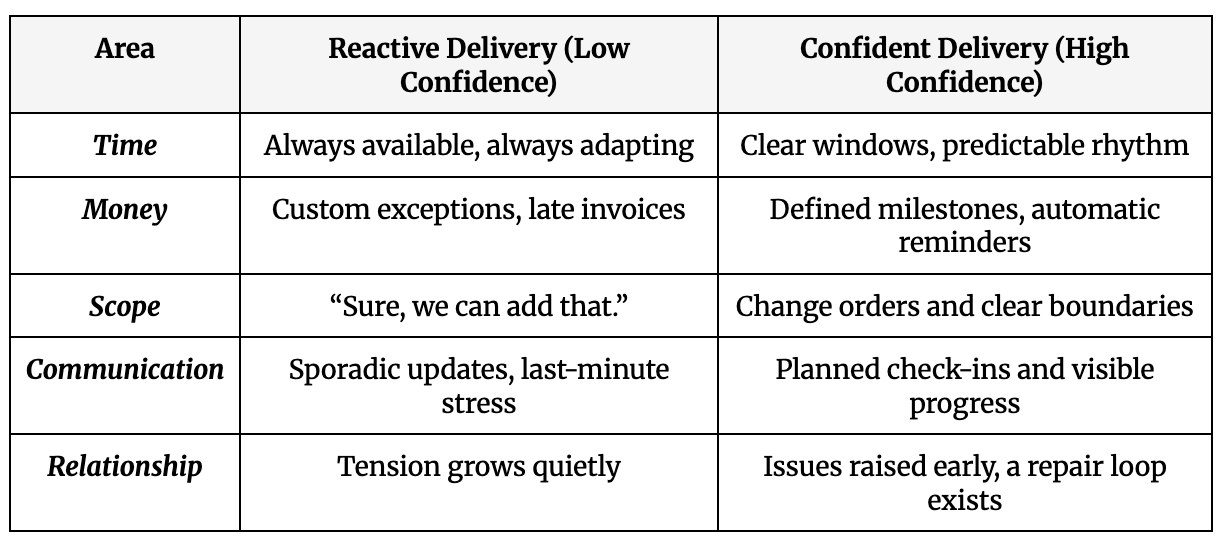
It is important to note that a repair loop is not a speech, but a process. If something is off, it gets named, documented, adjusted in the plan, and confirmed as the new expectation. Basically, people trust businesses that can recover cleanly. It feels safe, and safety is a major reason clients stay long enough to see real results.
Putting It Together
If everything gets built at once, it tends to stall. The move is to pick one friction point that keeps showing up and systemize that first. Then connect the next system to it to form a chain, not a pile of templates.
The real win is when the nervous system calms down across the business. Hence, there will be fewer surprises and awkward conversations. Rather, it will be about cleaner delivery and better client support. This way, the business finally looks like it knows where it is going, and it can prove it through its operations.