
Tips for Networking Events for Students Growing a Side Hustle

Walking into a networking event when you are still in college can feel a little strange. Around you, people may have polished websites, established companies, teams, and years of experience. Meanwhile, your side hustle might still live somewhere between your laptop, a few customers, and a very ambitious notes app.
That does not make you the least interesting person in the room. In fact, being early in your business journey gives you plenty to talk about. Networking events can introduce you to potential clients, mentors, collaborators, suppliers, and other entrepreneurs who have already solved problems you are only beginning to face.
The trick is not to enter the room determined to “network” with everyone. Go in looking for a few good conversations. That feels much more natural, and it usually creates stronger connections anyway!
When Coursework Keeps You From Showing Up
Growing a side hustle while studying means your business time often competes directly with papers, reading, exams, and other deadlines. You might find a networking event that could introduce you to potential clients or mentors, only to realize that you also have a long academic paper due the same week.
When a demanding assignment is eating into the limited time you have for building your business, getting structured academic support from an APA essay writer or using APA format paper writing services for guidance with formatting, organization, and the writing process can help you manage that workload more efficiently.
With your academic workload better organized, you can give the networking opportunity your full attention rather than checking an unfinished assignment on your phone every ten minutes. You are also more likely to have thoughtful conversations and follow up afterward, which is where much of the real value of networking appears.
How to Describe Your Side Business in Two Sentences
“What do you do?”
This is easy to answer until the moment comes. Then you find yourself going on and on about how the concept was born, your field of study, your platform, and where your business will end up someday. But keep it really short.
What is a good way to introduce your side business? It tells the listener what you do, who you do it for, and how you help them. For example:
“I design websites for local service-based companies that want to look professional without the overhead of an agency. I began doing it while in school and am now trying to expand my client list.” This leaves plenty of room for your conversation to continue.
Better Questions to Ask
Networking can be an unpleasant experience when both parties are waiting for the opportunity to make their pitch. The difference that makes the conversation move smoothly is that both parties are genuinely interested in each other.
Questions you may ask include:
"How did you get your first few clients?"
"What motivated you to start the business?"
"What advice would you give to yourself as a beginner?"
"What have been the keys to gaining returning clients?"
"What projects are you currently working on?"
Questions of this type encourage sharing of stories rather than single-word answers and might actually offer valuable information for your side-hustle business.
According to the U.S. Small Business Administration, you should prepare a short description of your business, set a goal for networking, and try to mingle, not just interact with familiar people. This advice from the small-business network serves as a reminder that networking is a skill acquired with experience.
Do Not Judge a Conversation Too Quickly
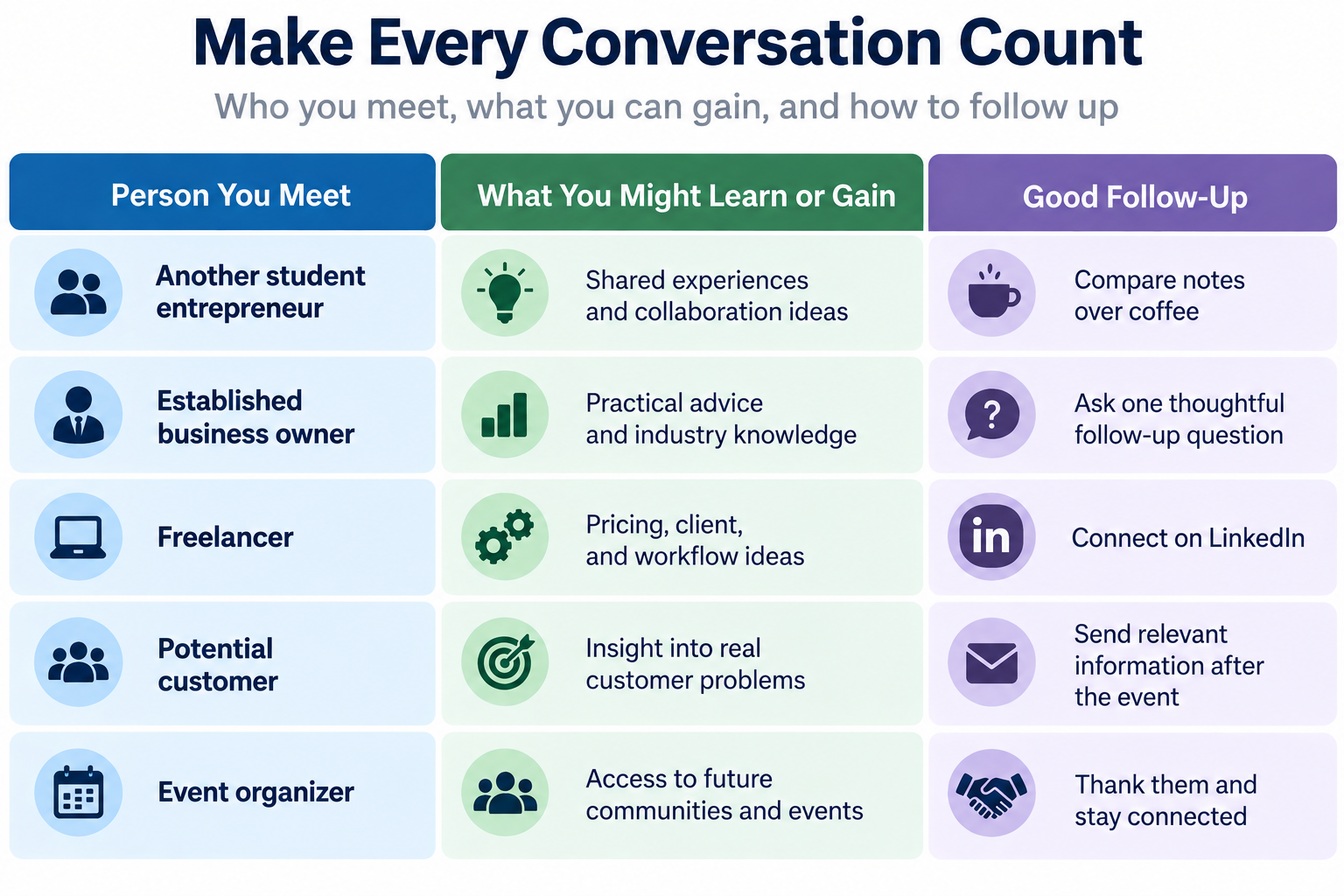
It is easy to decide that someone is “not useful” because they are not a possible customer. That is a mistake. The person you meet may know somebody who needs exactly what you offer. They may recommend a useful event, introduce you to a supplier, share pricing advice, or become a collaborator six months later.
Think in terms of relationships instead of immediate transactions:
Stop Trying to Sound More Established Than You Are
You don’t need to act as if your startup is the next Facebook. If you have three customers, you have three customers. And if you started the company two months ago, you can tell people that. It’s likely that folks who have been through starting companies already will be familiar with that process.
Your confidence is found in your clarity on where you are, not pretending you’re more advanced than you are.
You might even say something like, “I’m working on this as my side hustle while I’m at college,” and go from there. That often creates better dialogue than making a little startup seem multinational!
Write Something Down After Every Good Chat
People's names fade faster than you might imagine at networking events. After a good chat, jot down some notes on your phone. Write their name, the topic of discussion, and whatever else you might have promised to email to them.
“Alex - photography firm owner, talked about prices, suggested local founder meetup” is all you need. This will personalize your follow-up much better than a generic message saying, “It was nice to meet you at the event.”
Follow-Up While the Memory Is Fresh
Meeting somebody is just step one in the process. If it was a good chat, be sure to reach out within the next few days. Make it short and sweet. Reference the location and something specific you chatted about. If you promised to send them an article, a portfolio, or other useful link, get on that.
Don’t start asking for a big favor straight away. A statement such as “It was nice to hear about how you got your first clients through referrals” will come across as friendlier compared to “Hi, could you please introduce me to three businessmen who will use my services?”
Relationships need some breathing room.
Measure Your Networking by Conversations, Not by Business Cards
You don’t need to walk out of the event with thirty contacts. Three quality conversations can be worth much more than twenty contacts whose names you won’t even remember afterward. After the event, reflect on what you have learned, whom you would really like to keep in touch with, and if there is anything you should do after this event.
Networking works most effectively when it becomes integrated into growing your side gig instead of being an additional task you do twice a year. You may not walk out with a new client every time - and that is fine. You could walk out with a better idea, useful advice, a future collaborator, or one person who remembers what you do when the right opportunity comes along. For a student building a business from scratch, that is already a pretty good evening.