
Sticker prices shout “$19 a seat,” but our November 2 2026 sweep found that outfitting a 12-agent team costs anywhere from $0 with tawk.to to $1,020 a month for Intercom Advanced, and that’s before AI meters start clicking. We picked 12 seats because several free and self-service tiers cap at 10; hire agent 11 and the upgrade wall appears. In the pages ahead, you’ll see how each vendor scales, where the hidden seat cliffs sit, and how many minutes a day the tool must save to pay for itself. Ready to run the numbers?

How we calculated the cost of a 12-agent team
1. What counts as an active agent
A seat hits our ledger only when a named person can join a live chat under their own login. View-only users, transcript reviewers, or bot-only licenses stay off the books. That rule keeps the labor math honest: these 12 people drive payroll, workflow complexity, and customer experience.
We applied the rule to every pricing page captured on November 2, 2026. If a plan let 12 humans sign in at once, it qualified. If it demanded shift-sharing or a sales call to lift limits, we left it out.
2. Two price snapshots per vendor
Cheapest tier that fits 12 seats. Shows the absolute floor, even if features are bare-bones.
Operations-ready tier. First plan that adds routing, unlimited history, basic reporting, and at least one SLA control.
Comparing the two reveals the “upgrade tax.” For some tools the jump is modest; for others it tops 300 percent.
3. Monthly vs. annual billing
We record both:
Month-to-month: 12 × published monthly seat price.
Annual-equivalent: (annual seat price ÷ 12) × 12 agents, plus we show the full upfront check.
Where a vendor publishes both prices, an annual commitment trims roughly 15 to 20 percent, or about $720 to $2,880 a year for 12 agents on the plans we studied.
4. How we priced AI
Seat fees are only part of the bill. Vendors meter AI by session, resolution, outcome, conversation, credit, or a flat subscription. We modeled a 500-interaction month for every provider with public AI rates and labeled the unit precisely so you can map it to your own traffic. If pricing sat behind a form, we marked it quote required.
5. Ordering logic for the ranked list
We sort tools by:
Best-fit use case (for example, regulated industries or flat-rate value).
Proof that the recommended tier truly supports 12 active agents with routing, reporting, and history.
Lower annual-equivalent cost, then pricing predictability (fewer meters and clear overage rules).
A separate price-only table follows so the narrative never buries the raw numbers.
Quick comparison: what 12 agents pay
Before reviewing individual platforms, here’s the market at a glance. Our November 2, 2026 price sweep found that a production-ready 12-seat license can cost anywhere from $0 (tawk.to) to $1,020 a month (Intercom Advanced) on an annual-equivalent basis.
Three patterns stand out.
Entry tiers fold under real load. Add routing or unlimited history and the bill can jump by 77 to 316 percent.
Flat-rate workspaces reset seat math. Crisp charges the same $295 whether you staff 11 or 20 agents.
Free doesn’t always scale. tawk.to doesn’t charge per seat, but Freshchat’s free plan and Tidio’s self-service plans cap at 10 agents.
The vendor profiles that follow give monthly cash outlay, annual-equivalent cost, and effective per-agent spend, context you’ll need as sticker prices shift.
How much time must the software save to pay for itself?
Using the U.S. Bureau of Labor Statistics median customer-service wage of $21.53 an hour (May 2025), we converted each annual-equivalent license into a daily minutes-per-agent hurdle:
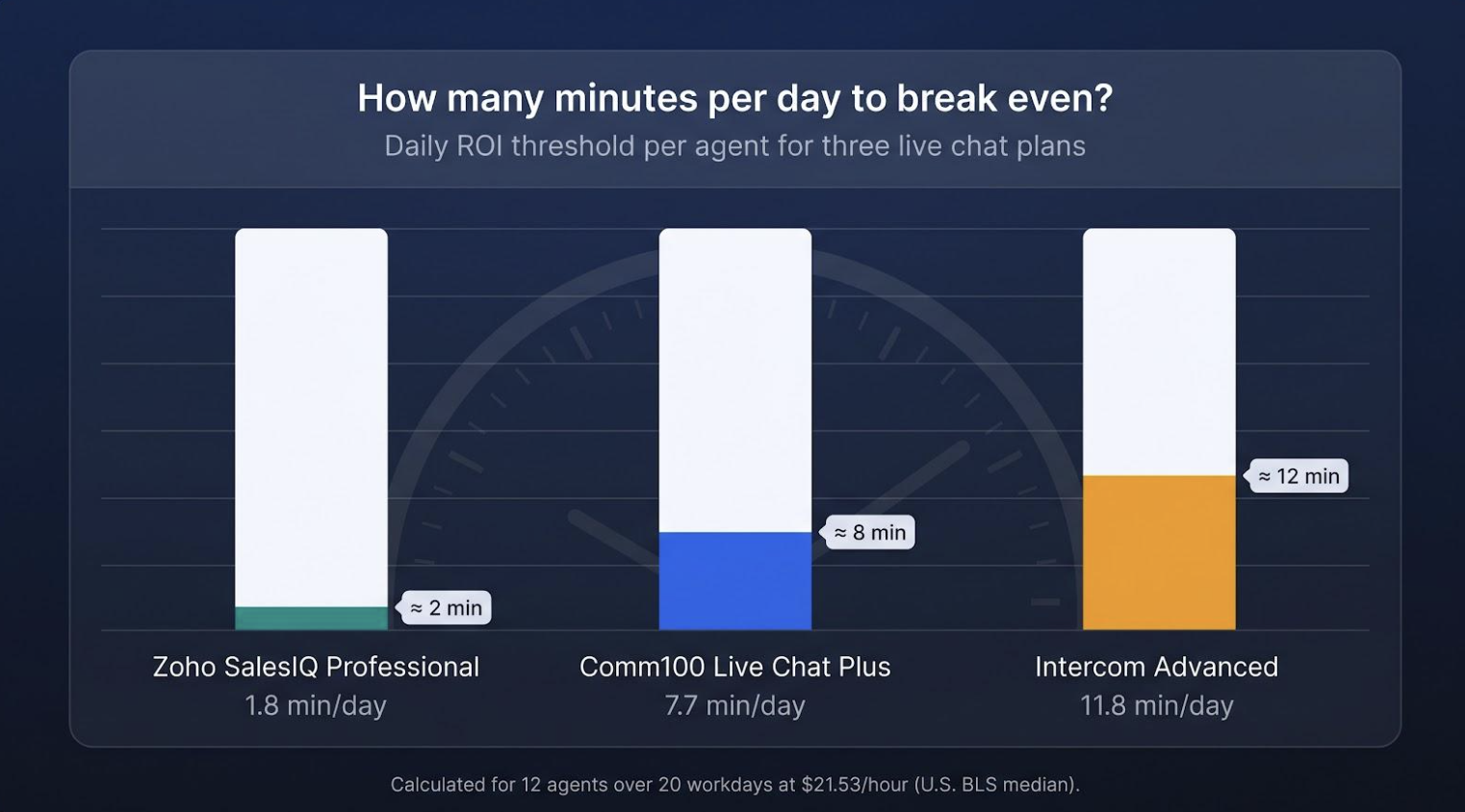
* Calculated for 12 agents over 20 working days.
Even the toughest target is less than the time a single canned reply or auto-summary can save.
Prefer to use your own wage or chat volume? Comm100’s live chat ROI calculator lets you run the numbers.
The 13 live chat platforms, ordered by buyer fit
Comm100: best for regulated, data-residency-sensitive teams
Comm100’s Live Chat Plus plan costs $55 per agent per month billed annually or $69 billed monthly, so 12 agents pay $660 a month on an annual contract or $828 month to month. The cheaper Startup plan is $31 per agent annually or $39 monthly. Plans include chat history and transcripts, and managers can set each agent’s maximum number of simultaneous chats.
Governance is the edge: Comm100 lists SOC 2 Type II, ISO 27001, PCI DSS and HIPAA compliance, offers cloud hosting in the US, Canada, Germany or Singapore, and can run the whole platform on premises for organizations that can’t use shared SaaS infrastructure. The Ultra plan and on-premises deployments are priced by quote.
AI is the one unknown. All six of Comm100’s AI products, including AI Agent and AI Copilot, are priced by quote, so plan a discovery call if automation is on your roadmap.
Bottom line: choose Comm100 when audit trails and data residency outweigh a lower sticker price, and negotiate AI fees before you commit.
Crisp: best flat-rate value for growing teams
Crisp’s Plus workspace lists at $295 a month (yearly billing is switched on inside the app) and includes 20 seats, so a 12-seat team pays about $24.58 per agent; the effective rate keeps dropping as headcount grows. Unlimited conversations guard against surprise overage bills during traffic surges, and the plan includes $75 in AI credits each month, which Crisp estimates equals roughly 1,350 automated chats.
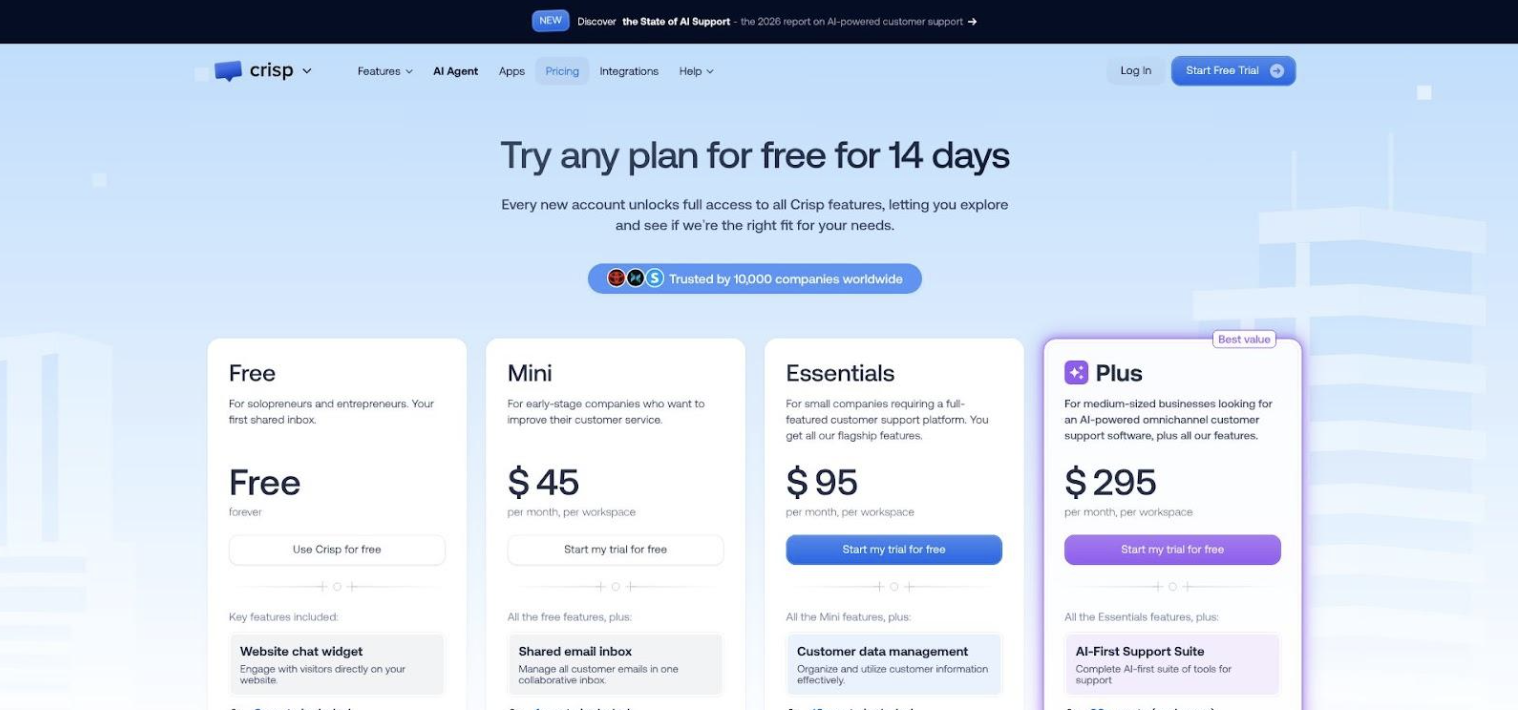
Crisp Plus workspace pricing for flat-rate live chat
The catch is the 10-seat ceiling on the cheaper Essentials tier. Move from 10 to 11 agents and the bill jumps from $95 to $295. For teams already past that breakpoint, Plus delivers predictable billing along with chat, ticketing, and white-label options.
Zoho SalesIQ: best low-cost paid option
The Professional plan costs $153 a month on an annual commitment, about $12.75 per agent for a 12-seat team. You get unlimited chat sessions, round-robin routing, real-time visitor tracking, and built-in reports.
The plan also includes five chatbots and 50,000 bot sessions each month; most midsize teams never reach that ceiling, so extra-session fees rarely appear early on. Watch the add-on menu: extra brands, chatbots, or visitor segments can stack quickly. Spend a few minutes in Zoho’s pricing calculator before you sign.
LiveAgent: best all-in-one value for teams under 15 seats
The Team plan lists at $29 per agent per month on annual billing ($35 monthly), so 12 agents pay $348 a month, and it allows up to 15 agents. A trial offer running until November 22, 2026 cuts the annual rate to $22. You get chat, email, social channels, and a basic call center in the same dashboard, plus SLAs and performance reports that many rivals reserve for higher tiers.
Note the ceiling: exceed 15 agents and you must move to Business, which lists at $49 per agent per month on annual terms ($588 for 12). If you expect to cross that line within a year, negotiate a price lock or budget for the jump now.
Freshchat: best lower-cost option with advanced routing
Freshchat’s Pro tier costs $588 a month on an annual plan for 12 agents and adds capacity-based routing, multilingual chat, multiple SLA policies, and custom dashboards, features missing from the cheaper Growth tier ($19 per agent, or $228 for 12).
AI costs
One-time 500-session trial is included.
After that, every 100 sessions costs $49, so 500 sessions add $245 to the monthly bill.
Copilot (agent reply drafting) is $29 per agent when billed annually and must be licensed for each seat.
Other meters include campaign contacts, connector tasks, and day passes for temporary agents, but at least Freshchat publishes every rate.
Gorgias: best for high-volume ecommerce support
Gorgias prices by ticket volume, not headcount. The Pro plan costs $300 a month on annual billing ($360 monthly) and includes 2,000 billable tickets with unlimited human agents.
Cost drivers to watch:
Overage: $0.36 per extra ticket after 2,000.
AI outcomes: an AI-resolved ticket still counts toward the ticket quota and bills an additional $0.90 (annual rate) per automation outcome.
Because order spikes are common in ecommerce, model peak events and consider pre-buying ticket blocks if you expect a surge.
Help Scout: best for email-first support with live chat
The Plus plan costs $45 per user per month billed annually ($54 monthly), so 12 users pay $540 a month. Beacon live chat drops directly into your existing email queues, so onboarding is minimal.
Key features:
Routing: round-robin plus workflow automation.
Manager views: handle-time and workload dashboards.
AI pricing is straightforward: $0.75 per resolved conversation. You set a monthly ceiling, and the system stops charging once that limit is reached.
tawk.to: best free human live chat
tawk.to’s core offer is simple: the chat software is free, with no per-seat charge. Drop the widget on your site and you’re live without a purchase order.
Paid extras:
Removing the “Powered by tawk.to” branding: $29 a month.
AI Assist: from $29 a month.
Check how those add-ons apply if you run several sites, because the “free” story can change quickly for multi-brand companies. For a single-site startup or nonprofit, though, the free tier covers canned replies, file transfer, mobile apps, and basic agent reports.
Olark: best simple, human-only chat
Olark’s full-featured live chat plan costs $29 per agent per month, or $348 for 12 agents. The pricing page doesn’t say whether that rate assumes monthly or annual billing, so confirm it before you budget.
AI tools are optional and priced separately. A flat $400 a month (billed annually) buys Olark’s AI website agent and covers the first human seat; each additional seat is $29, so a 12-seat AI deployment totals $719.
LiveChat/Text: best dedicated chat experience with bundled AI
LiveChat now sells new accounts under its Text brand. For 12 seats, you need Growth at $948 a month (annual billing). Growth replaces Essential’s 60-day history with unlimited storage and adds shared canned responses, supervision tools, and performance dashboards. The jump is steep (Essential would be $228 for the same team), but short transcript limits are a deal-breaker for most managers.
Bundled AI
Growth includes 200 automated resolutions per month.
Extra packs of 50 resolutions cost $49.50; a 500-resolution month adds six packs, or $297.
Zendesk: best for teams already committed to Zendesk
If your knowledge base and macros live in Zendesk, sticking with Suite Team avoids a migration. Suite Team costs $55 per agent per month billed annually ($69 monthly), so twelve seats cost $660 a month on an annual plan.
AI fees
Copilot: $50 per agent per month (annual billing), available on Suite Professional and above, not on Team.
Automated resolutions: Team includes 5 per agent per month (60 for 12 agents); additional resolutions cost $1.50 committed or $2.00 pay-as-you-go. A 500-resolution scenario is $660 (committed) or $880 (PAYG).
Intercom: best for AI-first SaaS support
Intercom prices its Fin AI agent by outcome: $0.99 each time a customer confirms the issue is resolved, stops asking for help after Fin answers, or Fin completes a workflow, charged once per conversation. Pair that with Advanced seats at $1,020 a month (annual billing for 12 agents) and you have a model that rewards high bot resolution rates but escalates quickly if humans still handle most chats.
Key add-ons:
Copilot: $29 per agent per month billed annually ($35 monthly).
Proactive Support Plus: $99 a month, including 500 messages.
Essential costs $19 per seat on annual billing ($29 monthly); check which routing and reporting controls your team needs before you choose it over Advanced. Ask sales for quotes at 500, 1,000, and 2,000 outcomes so finance can model best- and worst-case spend.
Tidio: best if your team stays at 10 agents or fewer
Tidio’s self-service plans top out at 10 seats. Within that cap, Starter is $24.17 a month and Growth starts at $49.17 a month on annual billing. Invite agent 11 and pricing changes to a custom Plus plan that starts at $300 a month plus usage.
Lyro AI
Lyro starts at $32.50 a month for 50 AI conversations; Tidio’s pricing page doesn’t list a price for 500.
If your headcount will stay at or below 10 agents, Tidio’s Shopify and WooCommerce context plus cart-recovery flows make it a sharp tool. If growth is on the roadmap, model Plus pricing early or consider a provider without a hard seat cliff.
The upgrade tax: cheapest tier vs. what you’ll actually buy
Sticker prices look friendly, but hidden feature gates can wreck a budget. Nearly every vendor advertises a plan that technically seats 12 agents yet withholds routing, unlimited history, or team reporting. Moving from that entry tier to the first operations-ready plan adds 77 to 316 percent to monthly spend.
Freshchat climbs from $228 (Growth, 12 agents) to $588 (Pro) when you add capacity-based routing, a 158 percent jump.
Comm100 moves from $372 (Startup) to $660 (Plus) for 12 agents on annual billing, a 77 percent jump.
LiveChat/Text jumps from $228 (Essential) to $948 (Growth) just to unlock unlimited history and supervision.
Vendors hold back the very tools managers need: SLA policies, custom dashboards, and workload rules. Treat “starting at” figures as lead-generation bait and price the tier you would run in production today.
What 500 AI conversations add to the bill
AI meters differ in philosophy as much as in price. A 500-interaction snapshot shows how quickly costs diverge:
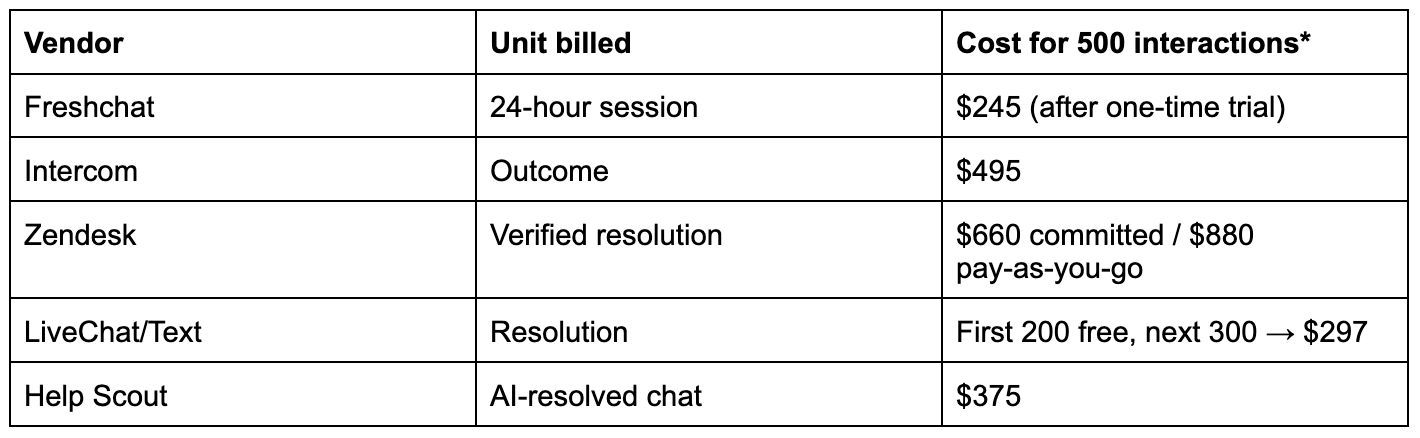
* Published rates as of November 2, 2026.
Session pricing penalizes long troubleshooting threads, outcome pricing taxes completed workflows, and credit systems turn prompt design into cost control. Flat-fee options such as Olark’s $400 AI website agent flip the model.
Takeaway: translate the vendor’s meter into your own KPIs before signing. Model at least 100, 500, and 2,000 interactions, and bake the worst-case figure into your business case. “Cheap” per resolution can turn costly once the bot starts solving everything.
How many chats can one agent juggle?
Concurrency, the number of live conversations one agent can handle at once, shapes staffing and response time. Most platforms let admins cap simultaneous chats per agent. Comm100, for example, lets a manager set each agent’s maximum, which helps when senior staff can manage 5 to 6 chats but rookies stall at 2.
Start low, then raise caps while tracking handle time and CSAT. Unlimited settings look appealing until chat four slows the first three.
Hidden costs to add to every RFP
Seat price is only the opening bid. Ask vendors to disclose or cap these extras:
AI meters. Does an AI-resolved chat also burn a human ticket or conversation?
API calls. Some plans include only a few thousand per month before fees start.
Carrier charges. Phone, SMS, and WhatsApp messages are usually pass-through costs.
Security add-ons. SSO, HIPAA BAAs, audit logs, and data-residency controls can add thousands in year one.
Seasonal flexibility. Are day passes or short-term seats available for holiday temps?
Professional services. Ask whether onboarding is fixed price or billed by the day.
Surface these items early, ask for hard caps, and you’ll avoid the surprise invoices that turn a bargain into a budget fire drill.
Pricing trends to watch in 2026 to 2027
Hybrid pricing takes hold. More vendors keep seat fees but add usage or outcome meters for AI, as Intercom, Zendesk, Freshchat, and Gorgias already do. Vendors get predictable MRR while buyers gain pay-as-you-grow flexibility.
“Result” keeps expanding. Intercom now charges for any outcome, not just automated resolutions. Gorgias bills the AI-resolved ticket and the underlying ticket, so contracts must define what “resolved” means.
Flat-fee options push budget certainty. Olark sells its AI website agent for a flat $400 a month, and Crisp includes $75 in AI credits (about 1,350 automated conversations) in Plus.
Vendor stability matters more. Salesloft is winding Drift down after its March 2026 move to 1mind; SoundHound AI completed its acquisition of LivePerson on September 4, 2026; LiveChat is steering new customers to its Text brand. Ask for roadmap assurances and migration clauses before signing multi-year deals.
Seats fund the platform, AI meters aim for value alignment, and flat-rate upstarts offer predictability. Price all three angles before you choose a tool.
Which platform fits which buyer?
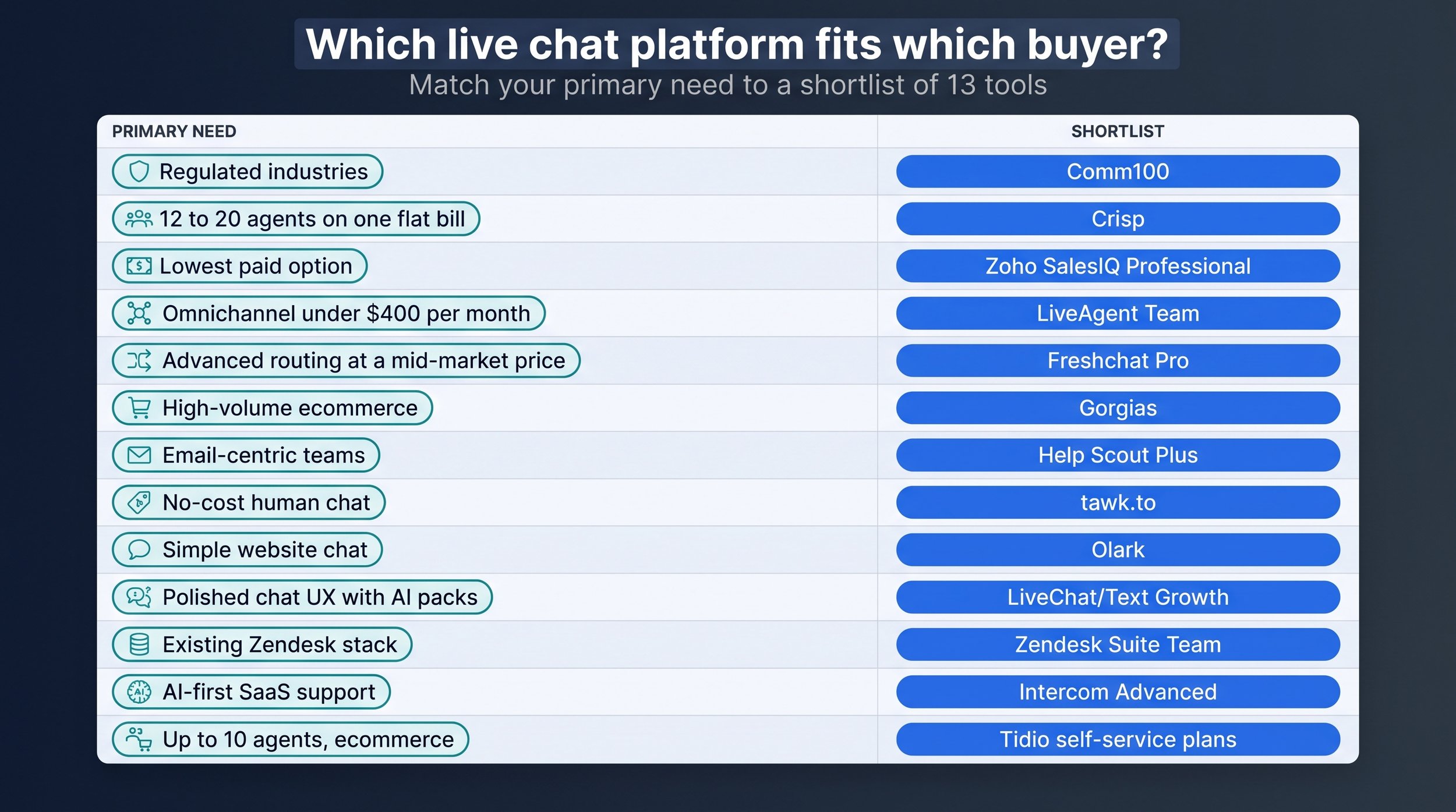
Pick the two options that best match your constraints, run a live pilot with real traffic, and let time-to-resolution plus cost-per-conversation decide the winner.
Negotiation checklist before you sign
Most deals stall in legal review, not in the demo. Work through this list early to keep redlines and surprises to a minimum.
Seat and billing basics
Quote 12, 15, and 20 seats so you can see the growth curve.
Clarify whether suspended, part-time, or light users consume full licenses.
Request both monthly and annual cash totals on one sheet.
Cap renewal increases or link them to the Consumer Price Index.
AI cost controls
Put the AI unit in writing (session, outcome, or resolution) and name the arbiter for disputes.
Model 100, 500, and 2,000 AI interactions to reveal best- and worst-case spend.
Ask whether an AI resolution also burns a human ticket.
Set hard spend caps and request real-time alerts.
One-time and variable fees
Surface onboarding or professional-services rates (fixed price, rate card, or time-and-materials).
Confirm SSO, audit logs, HIPAA BAAs, and data-residency surcharges.
List API, webhook, and integration quotas.
Map transcript-retention limits and archive fees.
Ask for day passes or prorated seats for seasonal peaks.
Pilot safeguards
Run a live-traffic pilot before you sign; nothing else tests workload and AI accuracy as effectively.

Frequently asked questions
How much does live-chat software cost per agent per month?
Across the 13 tools we modeled, operations-ready plans run $12.75 to $85 per agent.
Cheapest way to seat 12 agents?
tawk.to: unlimited seats, sites, and chats at $0, unless you add white-labeling or AI credits.
Why are starting prices misleading?
Entry tiers omit routing, history, or reporting. Upgrading raises cost by 77 to 316 percent.
Which platforms skip per-agent billing?
Crisp (flat workspace), Gorgias (ticket volume), Tidio (up to 10 seats), tawk.to (free).
AI charge spread at 500 interactions?
Published costs range from $245 to $880 a month, depending on how “interaction” is defined.
Is annual billing worthwhile?
Usually. Where both prices are published, annual billing saves about $720 to $2,880 a year for 12 agents.
Typical concurrent-chat limit per agent?
Most teams start new reps at 3 chats, then move to 5 to 6 with experience.
Can 12 agents share fewer licenses?
Rarely. Named licensing means each concurrently available human usually needs a seat.
Hidden fees to watch?
AI overages, carrier SMS rates, API blocks, security add-ons, pro services, and seasonal seats.
Best platform for regulated industries?
Comm100 offers HIPAA, PCI, ISO 27001, and even on-prem deployment at a mid-market price.
Quick ROI check?
Divide license + AI + implementation costs by your hourly labor rate. If the tool saves more minutes per agent per day than that threshold, it pays for itself.
Vendor-stability risks?
Drift is being wound down; SoundHound AI owns LivePerson; LiveChat directs new buyers to its Text brand. Ask about sunset clauses and migration support.
Conclusion: context first, pilot for proof
Per-agent price is only the headline. Real cost also covers upgrade gates, AI meters, hidden add-ons, and the minutes each tool can save per agent. Shortlist two or three platforms that match your compliance needs, routing complexity, and budget, then run a live pilot with real traffic. Let handle time, CSAT, and AI accuracy decide the winner.