
3 WhatsApp CRMs Worth Considering for More Sales

Nowadays, messengers are more than a place for texting with family and friends. They play a role of powerful sales tools, allowing brands to establish trusting relationships with customers. In this case, WhatsApp takes the lead as one of the most widely used messaging apps. It is a great opportunity for businesses that can directly reach potential and existing customers and communicate all the necessary information.
When using WhatsApp for business communication, companies can answer customer questions, accept payments, make reservations, handle objections, and manage many other requests in real time. While this creates strong opportunities for growth, it also brings operational challenges — especially as message volume increases. For established businesses with a large customer base, keeping track of conversations and ensuring timely follow-ups can quickly become overwhelming.
This is where a CRM with WhatsApp integration becomes essential. Such a solution centralizes customer conversations, stores contact data, automates follow-ups, and organizes sales processes within one system. As a result, businesses can respond more efficiently, maintain better visibility into their pipelines, and turn WhatsApp interactions into measurable revenue.
In this article, we’ll list 3 best WhatsApp CRMs in terms of features, pricing, and user-friendly design. But before that, let’s discuss in detail why companies need such a platform and what it gives you.
Why Businesses Need a WhatsApp CRM
Messengers have become one of the main communication channels with customers, especially when we talk about WhatsApp. But it might be quite challenging for businesses to handle everything manually. There might be too many tasks to manage: customer data, prospects’ questions, order issues, and many more. That’s where special tools like WhatsApp CRM come in handy. In this section, we’ll discuss the reasons to integrate it into your business in more detail. Let’s dive in.
Centralized customer communication. Having a WhatsApp CRM enables you to take care of all interactions with customers from a single dashboard. Your team members can keep track of all messages and actions, assign specific chats to your company reps, and provide them with context of each conversation. All the chat history is in the system, ensuring that your team members take a look before continuing conversations with customers. It helps you swiftly react to prospects’ inquiries and never miss a chat, bringing you higher customer satisfaction.
Better lead management. When you have no system, you can easily lose people who are really interested in your product in chats. WhatsApp CRM allows you to keep all information in one place. You can capture, tag, and organize prospects on autopilot, which is especially convenient when you have a lot of chats. With a special platform, you’ll be able to keep an eye on the progress of each prospect and do everything possible to convert them into customers.
Higher efficiency. When having automation, you no longer have to worry about follow-ups. You can set up auto-replies, chatbot flows, and reminders and have them delivered on WhatsApp at the right moment. This way, your team doesn’t spend too much time on repetitive tasks, and you are sure that the necessary content reaches intended recipients at scheduled times. You reduce response time while your team works on complex issues requiring their presence.
Improved customer experience. With a CRM that stores customer data like preferences, purchases, and chat history, you can provide more relevant and personalized messages, recommendations, support, and offers to your customers. This positively impacts overall WhatsApp customer retention and experience with your brand.
Better teamwork. As your business grows and customer demand increases, you typically have multiple support or sales representatives handling WhatsApp conversations. In this case, maintaining consistency becomes critical. With a CRM for WhatsApp, team members can access the full conversation history, customer details, and previous interactions in one place. This ensures smooth handovers, prevents duplicated responses, and helps representatives quickly understand each customer’s needs before continuing the conversation. Agents also have access to all the necessary information to ensure smooth experience. The platform also enables your team members to assign chats, make internal notes, and give role-based access. All these features allow your teams to work without confusion.
Customer insights and performance tracking. When you use a WhatsApp CRM, you automatically get access to analytics. It unveils a lot of valuable metrics, including response times, agent performance, campaign results, and customer engagement. When you have access to this data, you can effectively use it to improve your strategy on real indicators. It will help you reach even better results in using WhatsApp for your business in the future.
Now that you have more reasons to incorporate WhatsApp CRM, let’s check out the features this service should have to properly take care of your business.
Key Features to Look for in a WhatsApp CRM
When choosing a platform for your business, you should understand what you want to achieve. So, before committing to any service, think of your primary goals. After that, evaluate your skills and outline your budget. Based on this information, you’ll be able to identify the right features for your company. In this section, we’ll unveil the most important ones to consider. Let’s check them out.
Shared team inbox. A platform you choose should enable multiple team members to take care of chats from a single dashboard. When you have a shared team inbox, you avoid problems related to duplicate replies, collaboration, and relationships with prospects and customers. You can instantly route customers to the right agents and ensure fast responses.
Unified customer profiles. A good WhatsApp CRM usually allows you to have chat history, notes, purchase data, and interaction records stored in one place, ensuring that your agents have all the details for proper communication with customers. They can understand the situation and work accordingly while having the chat history at hand. With a unified profile, your agents will be able to provide answers that are relevant to the context and ensure personalized experiences by giving recommendations resonating with needs.
Automation and chatbots. When you have automation, you can ensure that customers get support when your agents are offline. With auto-replies, chatbot flows, reminders, follow-ups, and workflow triggers, you’ll be able to seamlessly manage repetitive tasks and let your team focus on some more urgent issues. This way, you reduce the workload on your agents, improve productivity, and ensure better communication with your audience.
Lead capture and pipeline management. Search for a service that helps you capture leads from chats on autopilot and add them to your sales pipeline. It allows you to keep an eye on deal progress and do everything possible for a sale.
Segmentation and tagging. With a segmentation feature, you can seamlessly group your customers based on their similarities, including behavior, interests, lifecycle stage, or demographics. Tags and lists enable you to create targeted campaigns, ensure relevant conversations, and focus on prospects ready to buy.
Analytics. You should not only create your campaigns but also evaluate their performance. With the right platform, you’ll be able to access analytics that tell everything about your communication with customers via WhatsApp. It should cover the most crucial metrics, including response time, message volume, conversion rate, campaign performance, and agent productivity. They will help you make decisions based on real data rather than assumptions. It will help you improve the quality of communication in the long run.
Integrations. Before committing, always check available integrations. When you know which of the platforms you need, you’ll be able to pick the right solution for your business. Check platforms for the needed integrations to prevent your business from double-paying for multiple tools.
Broadcast capabilities. Search for a WhatsApp CRM that provides you with templates supported by WhatsApp. It will help you deliver transactional updates, reminders, and marketing campaigns to your audience without violating WhatsApp rules.
Workflow routing. When you have a well-established business, you might face problems with team workload. To help you handle all the chats seamlessly, your platform should have automatic lead assignment, conversation routing, queue management, and multi-department collaboration. These features ensure that customers get quality support without having to wait for hours, so that agents can connect.
Now that you’re familiar with the key features, let’s move on to the next section, where we’ll take a closer look at the three best CRMs with WhatsApp integration that can simplify your customer communication. Each of these solutions offers unique advantages, depending on your business needs and growth stage.
3 Best WhatsApp CRMs
You may come across many CRMs with WhatsApp integration designed to support business communication, but not all of them will be equally effective for your needs. Some solutions may lack the simplicity and guidance required for beginners, while others may not offer the advanced features and scalability that growing or large companies require. In this section, we’ll uncover 3 platforms that are good in terms of features, budget, and user-friendliness. Let’s dive in.
SendPulse
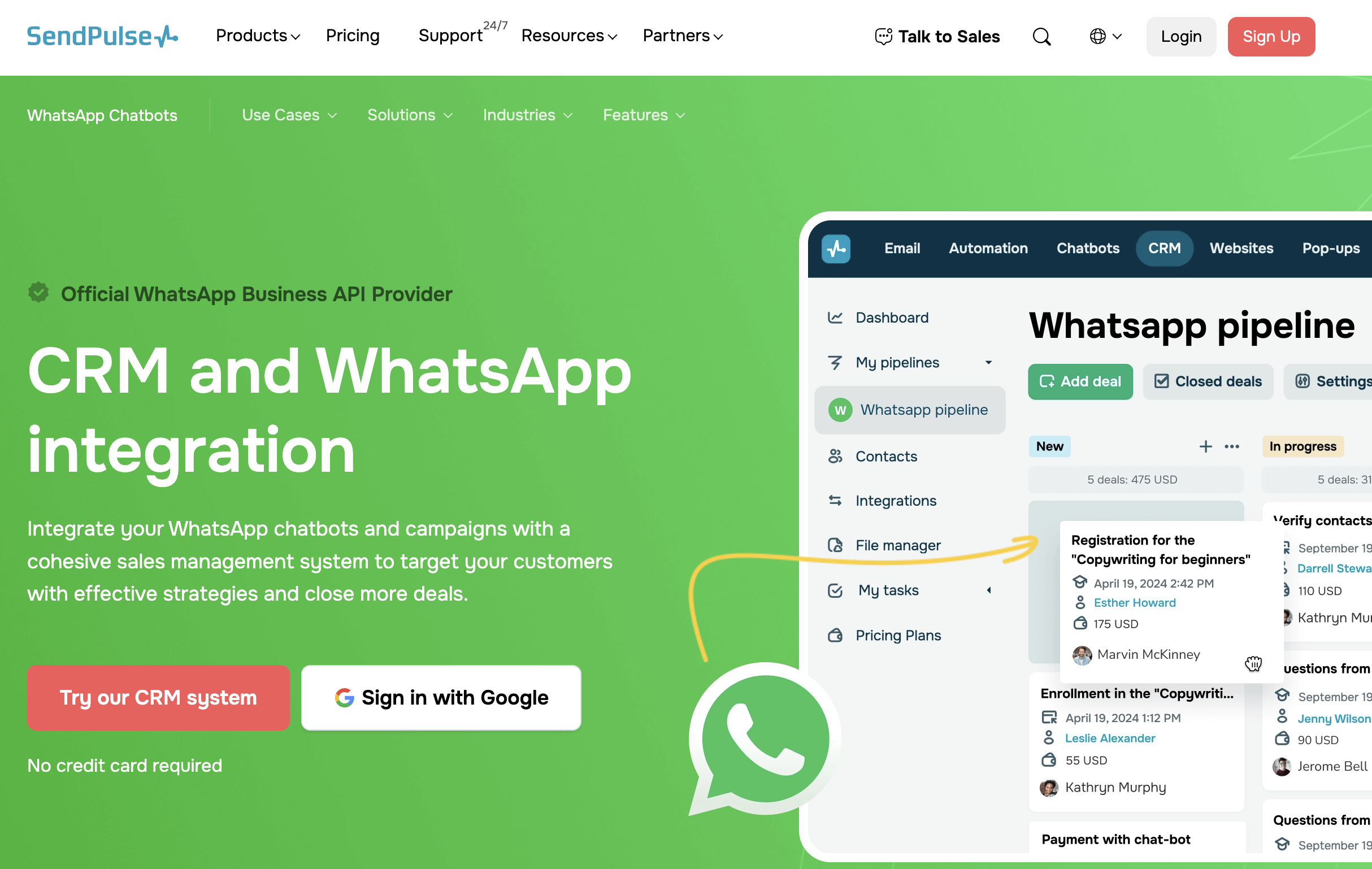
SendPulse is a marketing platform offering various tools that empower you to effectively promote your business. These include CRM, chatbots, email campaigns, landing page builder, pop-ups, and more. The integration of WhatsApp with CRM on the platform helps store customer data, automatically create contact and deal cards, and assign team members. With the service, you’ll be able to keep an eye on customer journeys and handle orders seamlessly. Once customers place orders with your business, CRM will create deals using available customer data. When a person pays for the order through your WhatsApp chatbot, the system will automatically change the order status and inform the responsible person about it.
SendPulse allows you to create multiple sales pipelines for different countries or set up sales stages for various services and goods. After communicating with customers, you can see how effective your interactions were using the platform’s analytics. You can have a look at your conversion rates and evaluate the effectiveness of your WhatsApp campaigns. Besides, the service offers integration with Gmail, Google Calendar, a task board, tags and filters, duplicate management, and deal and contact export.
Pricing: The platform provides a free plan covering 5 invited team members, 2 pipelines, 2 boards, 1 GB of storage space, an unlimited number of deals, contacts, and tasks, Google Calendar integration, and 24/7 support. Paid plans start from $12/month (paid annually) for 1 user, 2 sales pipelines, 8 flows, 5 events, and 50 elements in Automation 360, 2 boards, 3 GB of file storage, 1 email inbox, and 8 saved segments
Respond.io
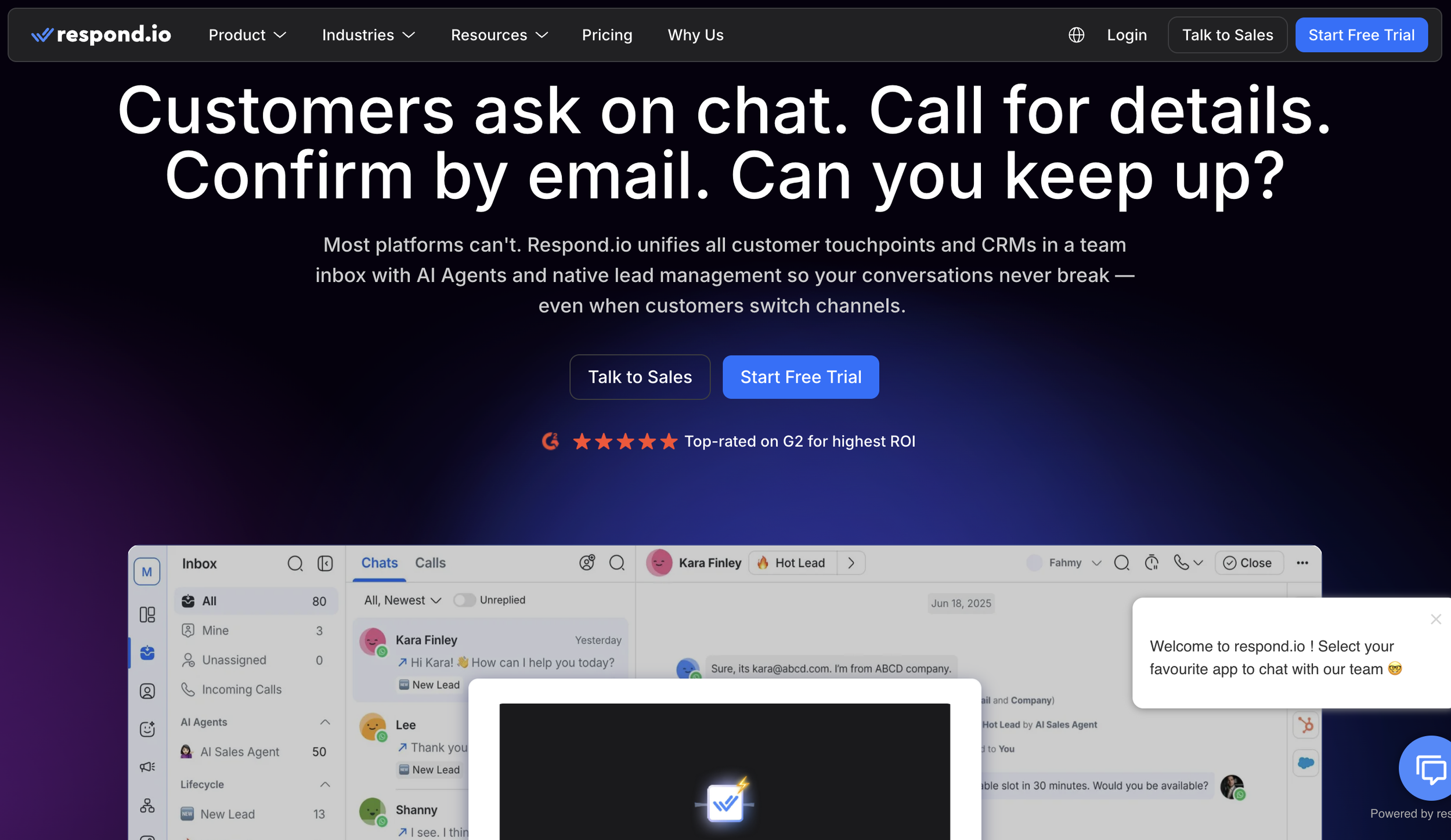
Respond.io is a platform enabling you to manage conversations with customers across messengers like WhatsApp, Facebook Messenger, and Instagram through a unified inbox. It enables teams to automate responses, assign conversations to specific team members, and track all customer interactions in one centralized system. This structured approach helps ensure smooth communication workflows, maintain accountability, and quickly identify and resolve any issues that may arise.
When using Respond.io, you can bring new prospects to your business using QR codes, chat links, and website widgets. The platform also allows you to run click-to-WhatsApp ads on Facebook and Instagram to get even more exposure and reach. One more advantage of the service is that it synchronizes contact details into your CRM so you can properly segment your audience. If you are interested in re-engaging your existing customers or leads, you can send broadcasts, push notifications, and catalogs.
Pricing: Instead of a free plan, the platform offers a 7-day free trial. Paid plans start from $79/month (paid annually) for 1,000 active contacts.
WATI
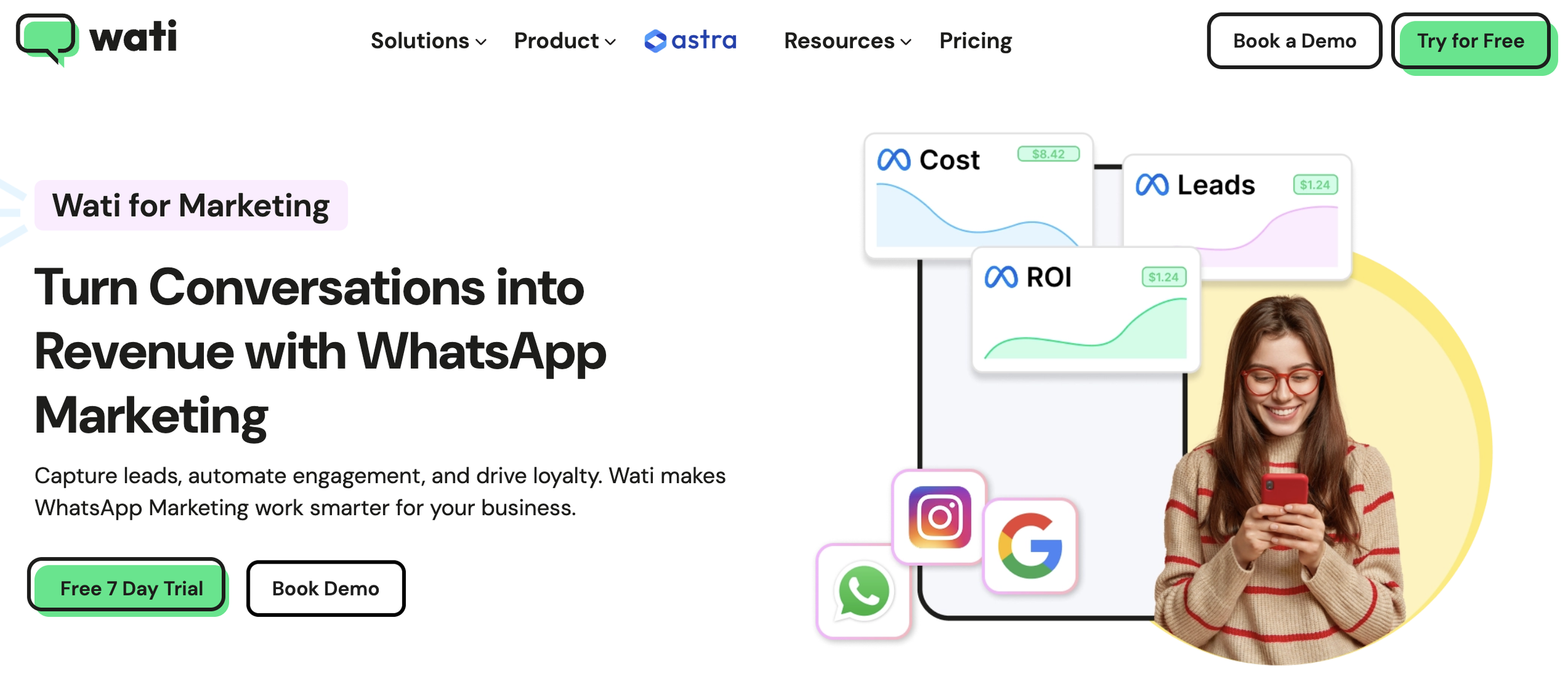
WATI is a software built on the WhatsApp Business API, enabling you to take care of conversations, set up automated responses, and ensure 24/7 support for better conversions. The platform accompanies you from the first touchpoint with prospects to further interactions with them until you close the deal. The service is easy to use, so you’ll have zero problems figuring it out. When WATI takes responsibility for repetitive tasks, your team can manage more complex issues, resulting in higher customer satisfaction and better customer experience.
With WATI AI, you can train your AI support agents to qualify leads, identify user intent, provide support 24/7, and close deals through chat. The platform helps you to provide accurate answers based on your knowledge base and support users around the clock. It also allows routing complex problems from the chatbot to human agents to manage them effectively and without delay. A unified team inbox ensures that you notice all customers and work on their problems as fast as you can. With tags, contact attributes, and history, your team members will quickly figure out what to do.
Pricing: The service offers a free trial. Paid plans start from $39/month (billed annually) for 3 users, 15,000 broadcasts, 1,000 automation triggers, 2 select commerce/CRM integrations, omnichannel inbox, team inbox staples, and more.
Final Thoughts
A CRM with WhatsApp integration is a valuable solution for businesses that rely heavily on WhatsApp as their primary communication channel. As your customer base grows, managing conversations manually becomes increasingly inefficient. At that stage, integrating WhatsApp into your CRM is no longer just a convenience — it becomes essential for maintaining organized communication, consistent follow-ups, and scalable customer management. It can seamlessly store all your customer data, keep track of all conversations, and monitor sales progress.
After incorporating a chatbot for WhatsApp, you’ll be able to provide support 24/7, automatically change deal statuses, accept payments, and set up automation for repetitive tasks. It all results in less workload on your team members and their productivity. By choosing the right tool, you can significantly improve operational performance and enhance customer satisfaction.