

Google Ads for small business works best as a defined experiment: advertise one profitable offer, track qualified enquiries, and set a spending limit before launch. Start with the amount you can lose while learning, then check whether that amount can buy enough relevant traffic to test your assumptions. I would delay a campaign if the owner cannot explain which enquiries count as valuable or who will answer them.
What must be ready before buying the first click?
You need a clear offer, a working enquiry journey, and a way to distinguish potential customers from irrelevant contacts. An advertising account cannot make those decisions for you, and even if you work with a Google Ads management agency, the offer and the qualification rules still have to come from the business owner.
For a small consultancy, “business support” is too broad to guide a test. “A fixed-scope operations review for independent retailers” gives the campaign an audience, a problem, and a destination. The landing page can explain scope, suitability, pricing approach, and the next conversation.
I would also test the form myself. Confirm that the enquiry reaches the correct inbox and that someone owns the response. A campaign that generates interest during a fully booked month can consume money without creating useful capacity.
How should Google Ads for small businesses be budgeted?
Budget from customer economics and available cash, then check traffic feasibility. Copying another business's monthly spend tells you little about what your offer can support.
Use a hypothetical example. A business is willing to spend $200 in advertising to acquire a customer, after considering delivery costs and its other acquisition expenses. If one in five qualified enquiries becomes a customer, the corresponding advertising allowance is $40 per qualified enquiry.
Those are planning assumptions, not market benchmarks. If the close rate turns out to be one in ten, the same $40 enquiry cost produces $400 in advertising cost per customer. The business must change the economics, improve conversion, or reconsider the channel.
Google explains average daily budgets and how daily spending can vary. Keep a separate written test ceiling so a platform setting does not become your entire financial plan.
Which numbers belong in a simple weekly review?
Track spending, qualified enquiries, customers, and follow-up status together. Clicks matter for diagnosis, but they do not tell an owner whether the campaign is affordable.
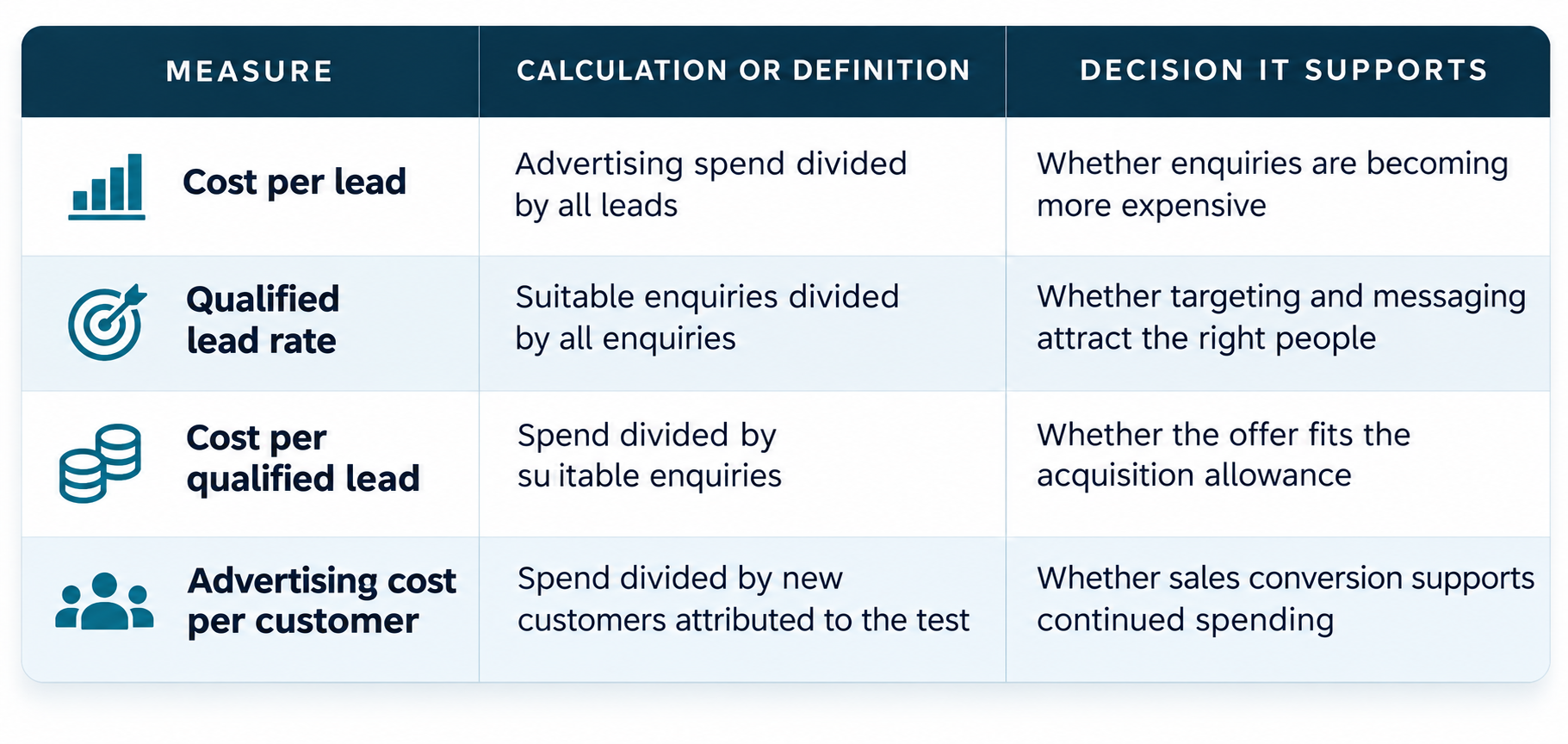
For a quick arithmetic check, a simple spreadsheet with your advertising inputs is enough to work through the numbers. Keep your actual lead qualification and sales records alongside the calculation, because no formula can decide whether an enquiry is commercially suitable.
Use the same definition every week. A qualified enquiry might require the correct service, location, budget range, and buying timeframe. Agree on that definition before reviewing performance, so optimism does not quietly move the goalposts.
Why can a smaller campaign teach you more?
A focused campaign can produce a clearer answer because fewer variables compete for a limited budget. My preference for a first test is one offer and a narrow group of commercially relevant searches.
That does not mean forcing all businesses into the same account structure. It means avoiding five services, three regions, and several unrelated landing pages when the owner can fund only a small learning exercise.
Follow this launch sequence:
Choose the offer with both healthy economics and delivery capacity.
Write down who should enquire and who should not.
Build one page that answers those people's buying questions.
Confirm enquiry tracking and response ownership.
Set a review date, spending ceiling, and conditions for stopping early.
Keep a short change log. If you alter the offer, targeting, and page at once, a later improvement will be difficult to interpret. Fix obvious errors immediately, but separate those repairs from deliberate experiments.
When should you pause instead of pushing harder?
Pause when measurement fails, the offer is unavailable, or spending reaches the agreed learning limit without sufficient evidence to justify continuing. Waiting for the account to “settle” is not a substitute for a business decision.
For lead quality problems, inspect the actual queries people used. Google's keyword-matching guide explains why search intent deserves attention beyond the keyword list itself.
If suitable leads arrive but sales do not, examine response delays, pricing objections, and the proposal process. Increasing the advertising budget at that point may simply create a larger follow-up backlog. Give the oldest leads enough time to mature before comparing them with new enquiries.
What is the next practical step?
Write a one-page test brief containing the offer, qualification rule, customer acquisition allowance, and maximum spend. Launch only when someone can explain how each enquiry will be tracked, answered, and reviewed against that brief.