
Best Fintech Banks and Neobanks for Small Business (2026)

The best fintech banks and neobanks for small business are built around different assumptions about what a small business actually needs. Some optimize for closing the books faster; others for yield on idle cash; others for physical deposit access or bare-bones cost. No single account dominates every category, which is why the right answer depends on your entity type, how you keep your books, and whether your cash sits in one account or needs to move.
The four accounts below were evaluated on six criteria that directly affect a small business's financial operations: how deeply transactions sync to the general ledger, what the balance earns, how much of it is insured and through what structure, whether invoicing and payables are built in, what the account costs per month and per user, and whether the account accepts physical cash. Weights reflect how much each criterion typically moves the needle for an owner-operated or early-stage incorporated business. Use the comparison table to map your own priorities against the field before reading the full entries.
Key takeaways
No single account wins every criterion — the right pick depends on whether your priorities are accounting depth, yield, coverage, cash access, or cost.
Incorporated businesses that run on QuickBooks, Xero, NetSuite, or Sage Intacct get the deepest native sync from Rho and Ramp; Brex matches that ERP breadth but charges per user above the free tier.
For yield directly on operating cash without a separate product, Bluevine leads at up to 3.0% APY on checking; most other accounts move competitive rates behind a treasury or savings product.
Slash offers the highest insured coverage at up to $150M via Column's sweep network; Rho reaches $75M across a 400-plus bank network through Business Savings.
Sole proprietors and contractors should look at Found or Lili — most platform-first accounts on this list require a corporation, LLC, or LP.
How we compared them
These criteria were chosen because they directly affect a small business's cash position, tax records, and back-office labor, not just the account-opening experience. Each entry is scored 1-5 on the same scale across all six criteria; the weights (shown in the table header) reflect how much each dimension typically matters when a business treats its bank account as part of its financial stack rather than a pure deposit vehicle.
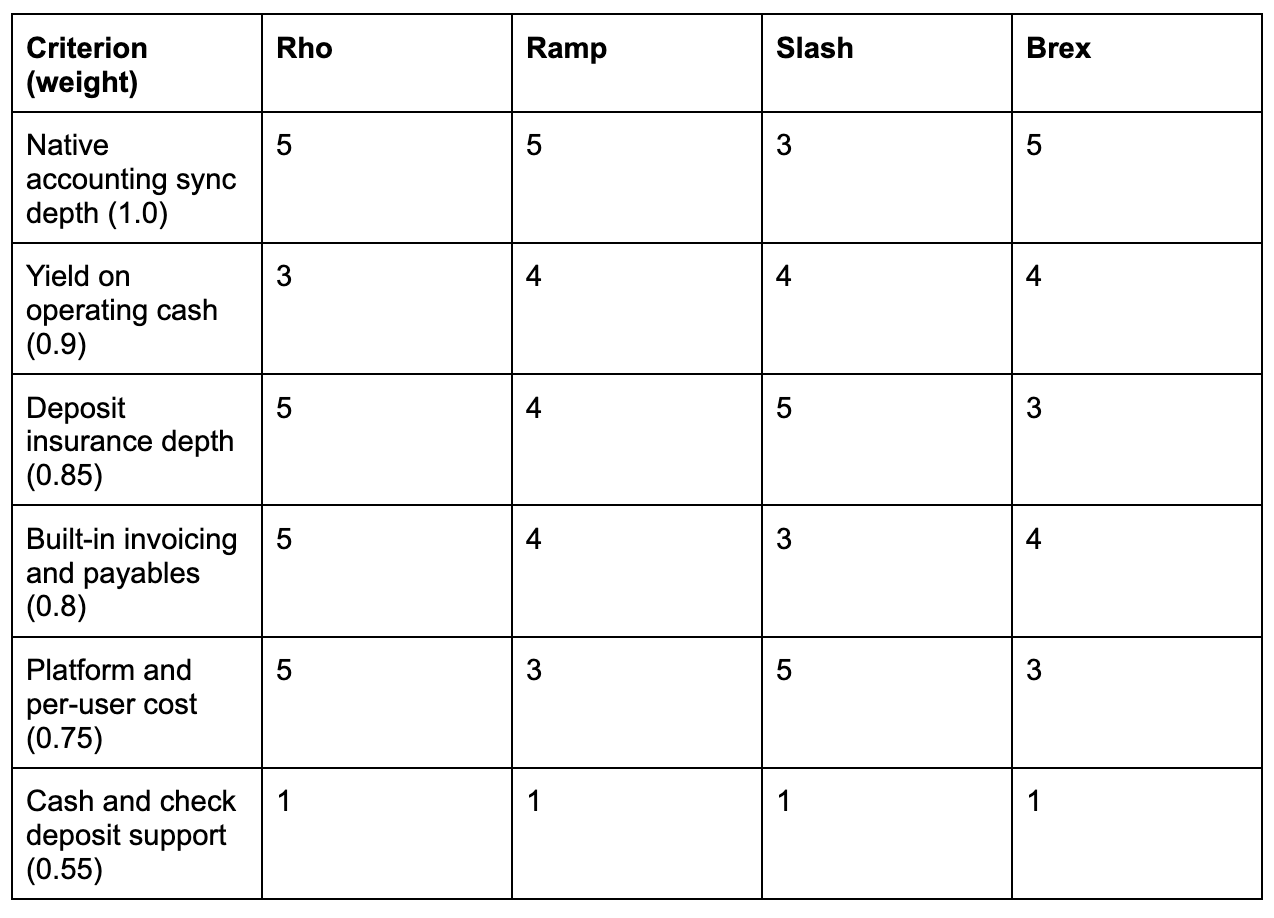
A ranked comparison of fintech business accounts and neobanks judged on what they do to a small business's books: how deeply transactions sync to the ledger, what the balance earns, how much of it is insured, and what is billed on top.
1. Rho
Rho's business checking is built for incorporated businesses, corporations, LLCs, and LPs, that want their bank account and their general ledger to operate as a single system rather than two systems that need to be reconciled. Rho connects natively with major accounting platforms, including QuickBooks Online, NetSuite, Sage Intacct, Campfire, and Puzzle, to eliminate manual data entry and automate transaction syncing. The QuickBooks Online integration is notably thorough: it maps merchants, categories, budgets, labels, and cardholders through custom rules, attaches receipts, and syncs across subsidiaries, going beyond the transaction-level imports that most banking integrations deliver. Transactions reach the general ledger in real time rather than in overnight batches.
Accounts payable is also native. OCR invoice scanning, multi-step approval workflows, and 1099 vendor management are included without a separate software subscription. That combination, deep ERP sync plus built-in AP, is what pushes Rho to the top of this comparison for incorporated businesses that are trying to reduce back-office software sprawl.
On coverage, Business Savings carries up to $75M in FDIC insurance per entity across a network of more than 400 banks through American Deposit Management Co.; Business Checking is insured to $250,000 through Webster Bank, a division of Santander Bank, N.A. Rho checking is free to use, no matter how many users you add or how quickly your team scales. Business Savings pays 1.00% APY, which is below the 2.5-3% checking yields that some accounts here offer on operating cash. Businesses that want a higher return can access Rho Treasury, a separate SIPC-protected securities product paying 4.14% at the $100,000-$2M range, with a 0.15%-0.6% management fee; it is not an account APY and carries a meaningful minimum.
Pros: The deepest native ERP coverage in this comparison, including NetSuite and Sage Intacct. AP automation and invoicing are included rather than sold as add-on software. Up to $75M in insured coverage through a 400-plus bank sweep network. No platform fee, no per-user fee, and no paid tier.
Cons: Sole proprietorships and unincorporated businesses are ineligible, the account requires a US-formed corporation, LLC, or LP, which rules out a large share of small businesses. Business Savings pays 1.00% APY, below several accounts here that pay 2.5-3% on operating cash without a separate product. Cash deposits are not accepted.
Best for: Incorporated small businesses, especially those already using QuickBooks, Xero, NetSuite, or Sage Intacct, that want banking and bookkeeping consolidated into one system at no additional software cost.
2. Ramp
Ramp approaches business banking from the expense-automation side: the spend controls, receipt matching, and accounting sync are the core product, with banking built around them. Native integrations cover QuickBooks, Xero, NetSuite, and Sage Intacct, making its accounting depth comparable to Rho's, though some of that depth is gated behind higher tiers rather than available on the free plan. Bill payments made through Ramp are included at no additional cost.
On yield, Ramp Business Checking pays 2% APY through First Internet Bank, Member FDIC, plus a Ramp Treasury Investment Account paying up to roughly 4.33% as a SIPC-protected product, competitive in the category, though like most high-yield options here the Treasury product sits in a separate vehicle rather than on the operating balance itself. Multi-million deposit coverage is available via IntraFi ICS through First Internet Bank, which is meaningful for businesses holding larger cash reserves.
The base tier is free. The Plus tier is $15 per user per month, plus a platform fee that Ramp does not publish, a real consideration when modeling costs as the team grows, since the total bill is not transparent from public pricing alone. Ramp advertises a free tier and allows businesses to get started without requesting a custom pricing quote, as its page prominently displays "Get started for free."
Pros: Category-leading expense automation available on the free base tier. Deep native accounting and ERP integrations. Multi-million insured coverage through IntraFi.
Cons: The Plus plan is $15 per user per month, and the accompanying platform fee is not publicly disclosed, making cost comparisons difficult. Some accounting-sync depth is reserved for higher tiers. No cash deposits.
Best for: Growth-stage companies where closing the books faster and controlling employee spend are the primary goals, and where the team is willing to pay per user for deeper accounting sync.
3. Slash
Slash is a financial technology company, banking services are provided by Column N.A., Member FDIC, and its standout feature is the deposit coverage ceiling: up to $150M per entity through Column's sweep network, the highest of any account in this comparison. That makes it the natural reference point for e-commerce operators, agencies, and SaaS businesses holding large treasury balances that would exceed standard FDIC limits.
On yield, Slash offers integrated treasury access earning up to 3.76% annualized through money market funds managed by BlackRock and Morgan Stanley, with no minimum balance requirement, an advantage over accounts that gate competitive returns behind a $250,000 or higher threshold. The free plan carries no paywalled functionality; the Pro plan at $25 per month adds unlimited free domestic transfers and 2% cashback, making the upgrade math fairly transparent.
The trade-off is on the accounting side. Slash's ERP and general ledger integration depth is thinner than the platform-first options at the top of this list. Businesses running on NetSuite or Sage Intacct will find less native connectivity here. Slash is also a newer platform, which means its operational track record is shorter than the more established names in this comparison.
Pros: The deepest insured coverage here at up to $150M through Column's sweep network. Treasury yield with no minimum balance. A genuinely unpaywalled free plan.
Cons: Accounting and ERP integration depth is limited compared with the platform-first options. No cash deposits. Shorter operating history than most entries here.
Best for: US startups, e-commerce businesses, agencies, and SaaS operators that need maximum deposit protection on large balances and want competitive treasury yield without a minimum.
4. Brex
Brex connects to the widest range of enterprise systems in this comparison: QuickBooks, Xero, NetSuite, Sage, Workday, and Microsoft Dynamics are all supported natively, which is a meaningful differentiator for businesses that have already standardized on mid-market ERP or HR platforms. Since April 2026, Brex has operated as part of Capital One, which affects how prospective customers should think about its long-term product roadmap and corporate backing.
On yield, Brex offers treasury returns of up to 3.71% through a money market fund (SIPC-protected), with no stated minimum, competitive and accessible. Deposit coverage is more limited: checking is insured to $250,000 through Column N.A., with Vault sweep coverage up to approximately $6M, which puts it behind Rho, Slash, and Grasshopper Bank on this criterion. Expense policy automation is a genuine strength, with rule-based controls that suit businesses managing distributed employee spending.
Pricing scales with headcount on Premium at $12 per user per month, which is manageable for small teams but compounds as the business grows. The Essentials tier is free. The product's design and eligibility have historically leaned toward funded startups rather than main-street small businesses, and prospective customers outside that profile should verify fit before opening an account.
Pros: The widest ERP and HR system coverage in this comparison, including Workday and Microsoft Dynamics. Strong treasury yield with no stated minimum. Best-in-class expense policy automation.
Cons: $12 per user per month on Premium, so total cost scales directly with headcount. Product design and eligibility lean toward funded companies rather than general small businesses. No cash deposits.
Best for: Funded startups or growth companies already running on enterprise ERP or HR systems, where deep native sync justifies the per-user cost.
Disclosures
Any third-party links are provided for informational purposes only. The third-party sites and content are not endorsed or controlled by Rho. Rho is a fintech company, not a bank. Checking and card services provided by Webster Bank, a division of Santander Bank, N.A., member FDIC; savings account services provided by American Deposit Management Co. and its partner banks.