
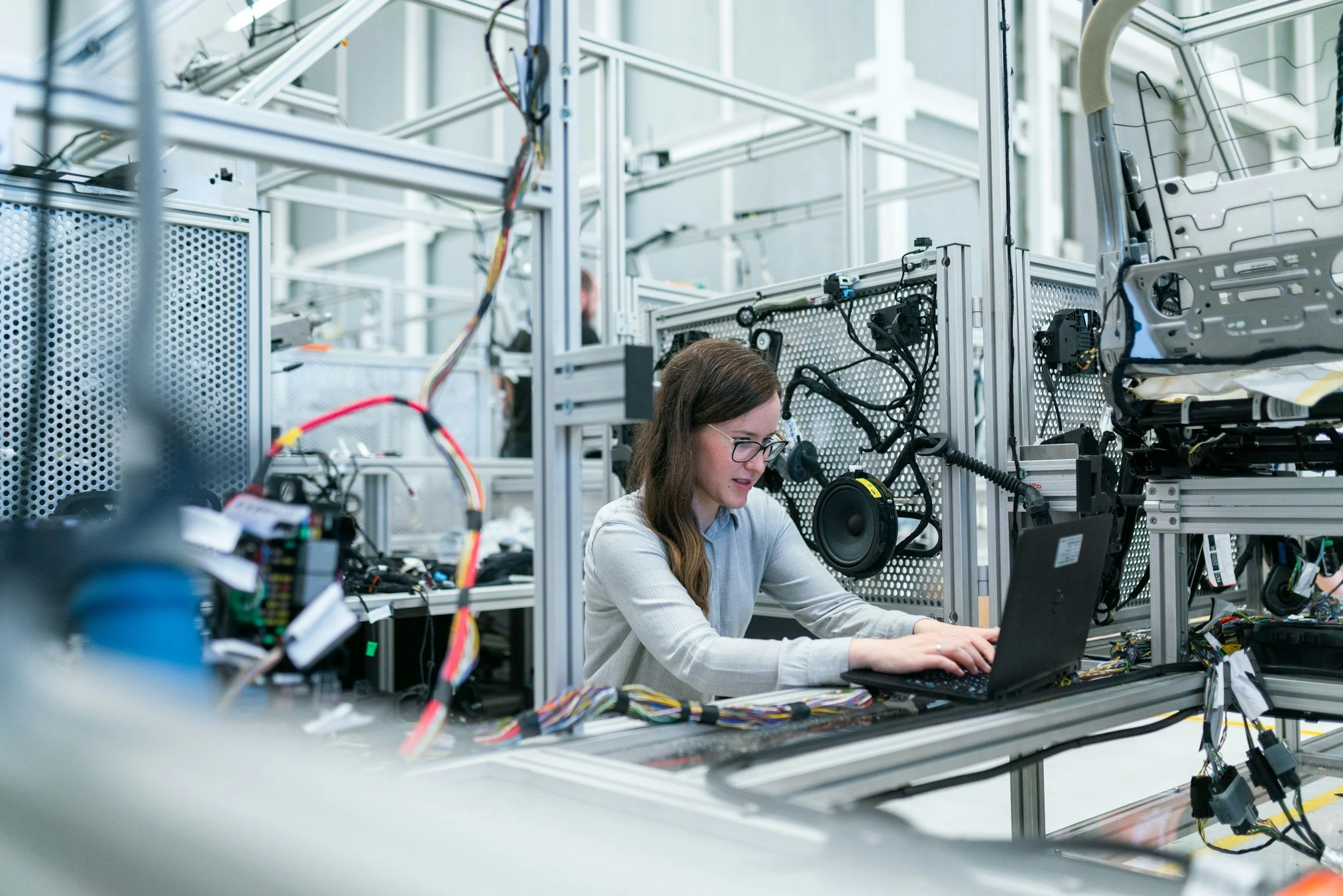
Most conversations about AI in software development stay close to home — code generation, testing automation, DevOps pipelines. But one of the most instructive examples of AI actually reshaping how a complex engineering discipline operates is happening somewhere most software teams never look: the automotive industry. The lessons coming out of it aren't really about cars. They're about what happens when software complexity outpaces the methods used to manage it, and what it takes to catch up.
An engineering problem that outgrew manual methods
Modern vehicles now run on more software than most standalone products, generated by dozens of engineering teams working across years-long development cycles, multiple hardware generations, and enormous volumes of sensor and telemetry data. That scale broke the old playbook of manual review, tribal knowledge, and reactive troubleshooting — not unlike what happens to any software organization once its codebase, data volume, and team size outgrow the processes that worked at a smaller scale.
The symptoms will sound familiar. Knowledge about why a system behaves the way it does lives in the heads of a few senior engineers. Diagnosing an issue means pulling logs from several places and stitching them together by hand. Problems tend to surface late, often after release, when fixing them is slowest and most expensive. In automotive engineering these pains come with physical consequences attached, which is exactly why the industry has had to look for better answers sooner than most.
Where AI stepped in
Rather than adding more engineers to sift through data manually, the industry’s most established company applying artificial intelligence to optimize vehicle engineering has focused on using AI to help engineering teams ask targeted questions of vast, previously unmanageable datasets, surface root causes faster, and catch quality issues before they cascade into expensive, late-stage fixes. It's a pattern any software team managing legacy systems, sprawling data pipelines, or multi-year platform transitions will find familiar.
In practice, this shifts the engineer's role. Instead of spending most of the day locating and assembling data, engineers spend it interpreting results and deciding what to do about them. The machine handles the retrieval and pattern-matching across millions of records; the human brings context, judgment, and accountability. That division of labor is the real change, and it's one software teams can adopt long before they adopt any particular tool.
There's a cultural side to this as well. When answers are quick to get, more people ask questions. Quality engineers, program managers, and newer team members can probe the same data that used to be reserved for a handful of specialists. That broader access tends to surface issues earlier, because the person who notices something odd no longer has to file a request and wait days for someone else to investigate. Teams that adopt AI-assisted analysis well often find the biggest gain is not raw speed but the number of questions that finally get asked.
The lessons that generalize
A few things stand out about how this played out in automotive engineering, and they apply well beyond cars.
Targeted queries beat blanket data collection
Rather than capturing everything and sorting it out later, letting engineers ask specific questions in plain language turns an unmanageable data firehose into something actually usable. Many teams default to logging everything on the theory that storage is cheap and answers can be found later. In practice, that approach buries signal under noise, drives up infrastructure costs, and makes it slow to find the one trace that matters. Starting from a specific question — what happens to this component after a certain event, or under which conditions this fault appears — lets teams collect and analyze only what they need. Plain-language querying widens the circle further, since the people who understand a problem best are not always the people who can write the query. For software teams, the equivalent is observability built around hypotheses rather than hoarding.
Root-cause analysis compounds in value over time
AI models that learn from every previous investigation get faster and more accurate the longer they're deployed — a flywheel effect worth building toward deliberately, not just hoping for. Every resolved investigation is a record of what went wrong, how it was recognized, and what fixed it. When that history is captured in a form a model can learn from, the next investigation starts further along. Over months and years, patterns emerge that no individual engineer would have spotted, such as a fault that appears only with a particular combination of component versions. None of this happens by accident. It requires deliberate habits: consistent incident write-ups, structured tagging, and a commitment to feeding outcomes back into the system rather than closing the ticket and moving on.
Early detection is cheaper than late remediation
Whether it's a vehicle recall or a production outage, the earlier an AI system can flag a developing issue, the smaller the eventual cost of fixing it. The cost curve is steep. An issue found during development is a code change. The same issue found in the field means customer impact, emergency patches, and reputational damage. AI helps by watching for early deviations — a metric drifting, or a behavior that differs slightly from the expected baseline — and raising a flag while the fix is still small. Software teams know this idea as shifting left, but AI extends it beyond pre-release testing into continuous monitoring of systems that are already live.
What software teams can do with this today
You don't need a vehicle program to put these ideas to work. A few practical starting points:
Audit where engineering time goes. Track how much time your team spends finding and assembling information versus acting on it. If the first number is larger, that's your highest-value target for AI-assisted analysis.
Start with one recurring class of problem. Pick a type of issue that keeps coming back, such as flaky integrations, slow queries, or recurring deployment failures, and build a feedback loop around it before trying to cover everything.
Define the questions before the data. Ask what decisions your team needs to make, then work backward to the data that informs them. This keeps collection focused and analysis affordable.
Capture investigations in a consistent format. A short, structured record of cause, symptoms, and resolution turns every incident into training material for both people and models.
Keep humans accountable for the call. Treat AI output as a fast, well-read collaborator whose findings get reviewed, not as an oracle. The goal is faster judgment, not outsourced judgment.
Where the analogy has limits
None of this means automotive practices transfer unchanged. Vehicle programs operate under strict safety and regulatory requirements that most software teams never face, and that discipline shapes how AI is introduced and validated. AI-assisted analysis is also only as good as the data and processes behind it. A team with inconsistent logging or poorly documented incidents will see limited value until those fundamentals are in place, and models can surface explanations that sound plausible but are wrong, which is why human review remains essential. The takeaway is to borrow the approach, not to assume the results will carry over on their own.
Why it's worth watching
Automotive engineering has some of the highest stakes — and some of the longest legacy timelines — of any software-driven industry. If AI-driven diagnostics and quality analysis can meaningfully move the needle there, it's a strong signal for what's possible in less extreme, more everyday software environments. The teams that benefit most will likely be the ones that treat the shift as a change in how they work, not just a new tool to install. Worth keeping an eye on as a preview of where engineering-scale AI adoption is headed.
For software leaders, the practical question is not whether this kind of AI-assisted engineering is coming, but how prepared your team will be when it arrives. Clean data, consistent incident records, and a habit of asking sharp questions are valuable today, with or without AI. They are also the foundation that makes any future tooling worth adopting. The automotive industry is simply further along the path, and its experience offers a useful map for everyone following behind.