
Top 5 Review Moderation Tools for High-Volume Online Stores

Managing fake, incentivized, or competitor-planted reviews at scale is one of the messiest problems in e-commerce right now. Review Moderation Tools are supposed to solve that, but picking the wrong one means inconsistent enforcement across platforms, a sky-high false positive rate, and real customer reviews getting buried. After reviewing dozens of platforms and digging into case studies, client results, and feature details, the tools that actually hold up tend to share a few specific qualities. This guide breaks down five platforms worth your attention.
Behind the ranking
Each option was evaluated by pulling publicly available information from official product pages, case studies, and customer reviews across review directories. Only platforms with a documented track record in the SaaS space made the cut.
→ See the full research breakdown
Utopia Analytics - Best for online community moderation and content safety
Hive Moderation - Best for platform content moderation and safety
besedo - Best for user-generated content moderation
Alice - Best for enterprise GenAI security and AI safety
Lasso Moderation - Best for content moderation for social platforms and online communities
The Real Impact of Review Moderation Tools
Choosing the wrong review moderation tool doesn't just slow your team down. It chips away at trust, and that's hard to rebuild once it's gone.
The two biggest pain points for high-volume stores are detecting fake or incentivized reviews at scale and staying consistent across platforms with completely different policies. One platform might flag aggressive language differently than another, and without a tool built to handle that gap, your moderation team spends more time firefighting than improving.
Well-chosen tools bring structure to that chaos. They're built for the specific patterns that show up in review fraud, coordinated inauthentic behavior, and spam, so the decisions they make are grounded in real data rather than generic content rules.
That specificity shows up in the metrics that matter most. A lower false positive rate means legitimate reviews stay visible. A lower false negative rate means harmful or fake ones don't slip through. Faster average review moderation response time means your team can stay ahead of volume spikes without burning out. The right tool makes all three of those better, at the same time.
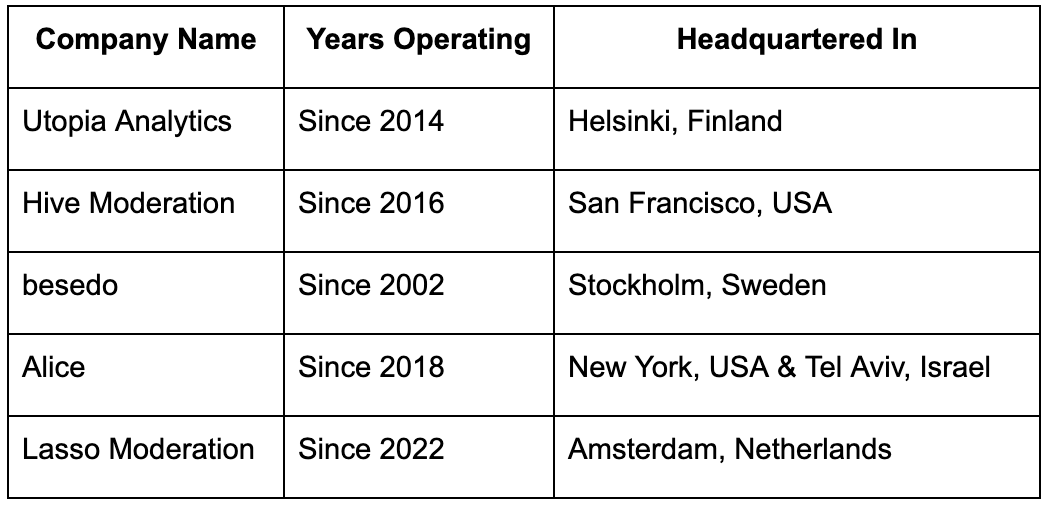
5 Top Picks at a Glance
Note: All data in this table is sourced from review platforms and the official websites of the listed companies.
1. Utopia Analytics - Best for Online Community Moderation and Content Safety

What Services Does Utopia Analytics Provide?
Utopia Analytics builds machine learning tools for text analytics and AI-driven content moderation. Their flagship product, Utopia AI Moderator, is a fully automated SaaS platform that catches abusive content, spam, fraud, and cyberbullying using patented AI. Built by doctoral scientists with a research background, the system learns from human moderator decisions and reportedly reaches higher accuracy than manual review. It deploys across any language within days, which makes it genuinely flexible for international platforms.
Why Is Utopia Analytics a Contender for Review Moderation Tools?
Teams dealing with high review volume and inconsistent moderation quality need a system that learns from context, not just keyword lists, and that's exactly where Utopia Analytics focuses. Their patented approach to AI moderation, combined with fast deployment timelines, makes them a practical fit for SaaS businesses that can't afford a months-long rollout.
Real User Sentiment:
Clients like nu.nl and 20min.ch have shared measurable results, including a 30% jump in daily comments and a drop in publishing delays. The platform earns trust by actually moving the numbers that matter, and that kind of documented client outcome is rare in this space.
2. Hive Moderation - Best for Platform Content Moderation and Safety

What Services Does Hive Moderation Provide?
Hive Moderation is an automated content moderation platform covering visual, text, audio, and CSAM detection. They also offer AI-generated content detection through their own Vision Language Model (not cheap, but genuinely sophisticated). Their platform includes a dashboard for managing content at scale, and the usage-based pricing model is a good match for SaaS businesses that grow in unpredictable bursts.
Why Is Hive Moderation a Contender for Review Moderation Tools?
Platforms struggling to moderate across multiple content types, where a single bad actor might post text, images, and audio, need a tool that covers all of those without patching together separate services. Hive Moderation's multi-modal approach means fewer gaps in coverage and more consistent enforcement across the board.
Real User Sentiment:
Clients including Yubo, Tango, and Chatroulette appear in their case studies, which signals real-world use at scale. Users appreciate the accuracy and the breadth of what the platform catches. And the usage-based pricing keeps costs tied to actual activity, so you're not paying for capacity you don't need.
3. besedo - Best for User-Generated Content Moderation

What Services Does besedo Provide?
Besedo combines AI trained on over 20 years of moderation data with human review to examine billions of pieces of content each year. Their product lineup includes Implio, a SaaS-based automated moderation tool, plus manual moderation, AI chat moderation, fraud prevention, and real-time abuse detection. They cover 100+ languages and deliver average response times under 50ms. For platforms with a global user base, that kind of reach is hard to replicate quickly.
Why Is besedo a Contender for Review Moderation Tools?
High-volume international platforms need more than fast moderation. They need culturally aware moderation that understands regional context, and besedo's two-decade training dataset is built for exactly that. Their hybrid AI-plus-human model means edge cases don't get left to an algorithm that wasn't trained on them.
Real User Sentiment:
Major clients like eBay, OLX, and Change.org appear in their portfolio (think enterprise scale, not a scrappy startup deployment). Users point to the combination of speed and nuance as the standout quality. The hybrid approach consistently comes up as the reason teams stick with besedo after trying fully automated alternatives.
4. Alice - Best for Enterprise GenAI Security and AI Safety

What Services Does Alice Provide?
Alice is an AI security and safety platform focused on protecting GenAI applications across their full lifecycle. Their WonderSuite family includes WonderBuild for red teaming, WonderFence for real-time AI firewall protection, and WonderCheck for post-launch monitoring. The platform draws on a proprietary dataset called Rabbit Hole, which contains billions of continuously updated toxic examples across 120+ languages. They report protecting over 3 billion users, with clients including NVIDIA, Amazon, TikTok, and Cohere.
Why Is Alice a Contender for Review Moderation Tools?
SaaS companies building or running GenAI features need safety infrastructure that goes beyond simple content filters, especially when adversarial users are actively trying to break the system. Alice's decade of adversarial research gives them a depth of coverage that general-purpose moderation tools typically don't carry.
Real User Sentiment:
Customer feedback on Alice tends to focus on enterprise-grade reliability and the breadth of language support. The client list alone (NVIDIA, Amazon, TikTok) signals a level of enterprise trust that carries real weight. Teams deploying GenAI at scale tend to treat Alice less like a content filter and more like safety infrastructure woven into their systems.
5. Lasso Moderation - Best for Content Moderation for Social Platforms and Online Communities
What Services Does Lasso Moderation Provide?
Lasso Moderation automates 99% of moderation tasks, covering spam, toxicity, profanity, nudity, violence, and drug-related content across chat, video, and social media. The platform includes customizable moderation rules, audit logs, translation support, access controls, and reporting. It connects via REST API and integrates directly with Discord, Slack, and several social platforms, which keeps engineering lift low. The no-code rule builder is a genuine convenience for product teams who don't want to write custom logic every time policies change.
Why Is Lasso Moderation a Contender for Review Moderation Tools?
Growing SaaS platforms often hit a point where manual review can't keep up with content volume, and adding engineering resources to build custom moderation logic isn't realistic. Lasso's automation-first model with human fallback handles that gap cleanly, without requiring a major infrastructure investment.
Real User Sentiment:
Lasso Moderation carries a 4.9 rating and is recognized as the highest-rated platform in content moderation. Users highlight the dashboard quality and the accuracy of the automated detection as the two things they keep coming back to. The flexible volume-based pricing also gets mentioned frequently as a reason smaller teams stay on the platform long-term.
How These Were Chosen and Verified
The process behind this list started broad and got progressively tighter at each pass. Here's how it worked.
Data Collection Methods
The initial pool was built by pulling company names from moderation-focused software directories, community forums, and product review platforms where SaaS operators discuss tooling. Official product pages were reviewed alongside published case studies to build a working picture of what each platform actually does, not just what their marketing copy claims. Platforms with no public documentation of real-world deployments were excluded early.
The Shortlisting Pass
Once the initial pool was assembled, options with thin or unverifiable track records were removed. Review patterns were analyzed across multiple sources to identify consistency. Platforms where feedback was scattered, contradictory, or too sparse to draw conclusions from were set aside. What remained was a tighter group with enough documented usage to make a fair comparison.
Verification Pass
Each shortlisted platform was cross-checked by comparing what their product pages describe against what users and clients actually report. When a company claims high accuracy or fast response times, the question was whether client results or third-party accounts backed that up. Platforms where claims and reported outcomes diverged significantly were flagged or dropped.
Industry Recognition and Authority
Mentions in industry publications, recognized client rosters, and documented awards or research contributions were factored in. A platform serving major enterprise clients like eBay or NVIDIA signals something different than one with no verifiable client base. Original research, published AI ethics frameworks, and academic-backed development also contributed to how each platform was assessed.
Evidence Specific to Review Moderation Tools
For the final selection, each platform was evaluated on how well their tools apply to review and content moderation at scale. This included dedicated service pages for moderation use cases, verified case studies showing moderation outcomes, and customer feedback that referenced real moderation scenarios (false positive management, multi-language support, high-volume handling). Platforms that only touched on moderation as a minor feature were excluded in favor of those where it's a clear focus.
What to Look For When Choosing Review Moderation Tools
Picking a review moderation tool comes down to more than feature lists. The best fit depends on your platform's scale, content types, and how much moderation nuance your use case actually requires.
Industry/Domain Experience: Look for platforms with documented deployments in contexts similar to yours. A tool trained on social media spam may not catch the patterns that show up in e-commerce review fraud.
Features and Tools: Check whether the platform supports your specific content types (text, images, audio) and whether it supports multi-platform consistency or only a single channel.
Pricing Structure: Usage-based pricing works well for growing platforms, but subscription models can be more predictable at high volume. Know your moderation volume before comparing price points.
Results Measurement: The right tool should give you clear data on false positive rates, false negative rates, and average response times. If a platform can't show you those numbers, that's a gap.
Industry Knowledge and Compliance: Platforms that understand FTC endorsement guidelines, GDPR data handling, and platform-specific review policies will save you a lot of headaches. Especially in industries with strict review solicitation rules like healthcare or financial services.
Final Take
Review moderation at scale isn't a set-it-and-forget-it problem. The platforms in this list take meaningfully different approaches, from hybrid AI-human models to fully automated systems built on patented research. The right choice depends on your content types, your language coverage needs, and how much false positive risk you can tolerate. As AI-generated content and coordinated review manipulation keep growing, the tools built on deep moderation-specific research will stay ahead of the curve.