
Scaling a Brand Abroad Means Your Social Accounts Travel Too
A brand that opens in a second country rarely thinks about its Instagram login the way it thinks about a lease or a payroll system. Yet the moment a marketing team starts posting from Warsaw about a launch in Manila, or scheduling stories for a Mexico City audience from a desk in Toronto, the platform notices something is off. Login location, device fingerprint, and posting rhythm stop matching the account's stated market, and that mismatch is exactly what automated fraud filters are built to catch.
The fix most agencies land on eventually is routing each market's account through an IP address that actually belongs there, which is why so many growth teams end up shopping for proxies for SMM marketers rather than trying to explain to a platform's trust-and-safety system why a "local" account keeps logging in from another continent. It is a small infrastructure decision with an outsized effect on whether a global rollout looks native or looks staged.
Why Login Location Becomes a Growth Bottleneck
Instagram, TikTok, and Facebook all score account behavior against a baseline built from the first few weeks of activity. A page created to serve Brazil that consistently connects from a German data center will accumulate risk flags even if every post is compliant and every caption is in Portuguese. Enough flags trigger a shadowban, a forced re-verification, or in blunter cases a suspension that costs a launch week of reach.
The pattern shows up fastest on accounts run by a centralized social team managing eight or ten country pages from one office. A Berlin-based agency running client accounts for Jakarta, Lagos, and Bogotá from the same office IP is, from the platform's point of view, indistinguishable from a bot farm cycling through fake regional identities. The traffic pattern is the tell, not the content.
Matching Infrastructure to Market Instead of Just Language
Localizing a proxy setup is a different exercise than localizing copy. A translator can adapt tone and idiom in an afternoon; a network setup has to hold up over months of daily logins, story uploads, and DM replies without ever looking like it was assembled overnight. Teams that get this right treat each market's IP the way they treat each market's currency – a fixed cost of doing business there, not an optional extra.
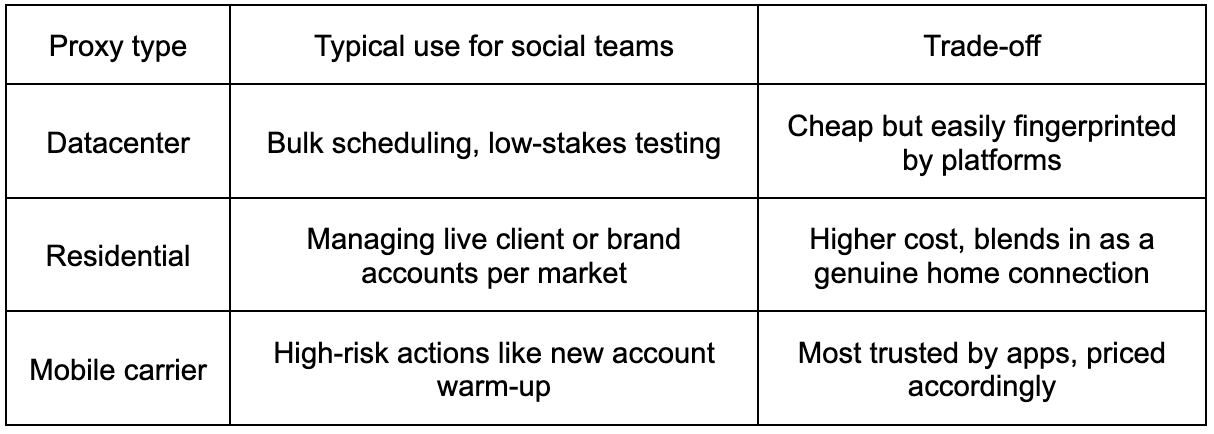
That means assigning a stable, market-matched residential IP per account, and never letting two managed accounts share an exit node. Most agencies handle this with a proxy extension for Google Chrome that lets each manager switch a country routing per tab, keeping the assignment inside the browser instead of a separate app someone forgets to open. A shared node used for three different countries is still the fastest way to get every one of them flagged together, since the platform links the pattern the moment two "unrelated" pages ping from the same address minutes apart.
Choosing a Setup the Whole Team Can Actually Run
The technical case for market-matched IPs is easy to make in a slide deck; the harder part is getting a five-person social team to use the setup correctly every single day without a network engineer standing over their shoulder. That is where a browser-level tool changes the outcome, because it puts the proxy choice inside the same window the team already lives in instead of a separate app they have to remember to launch first.
The browser-level switch lets each social manager pick the right country and city for the account they are logged into, right from the toolbar, without touching system network settings or juggling a VPN client on top of everything else. Onboarding a new hire onto the correct routing for their assigned market becomes a two-minute walk-through instead of a support ticket.
Keeping the Rollout Consistent as Markets Multiply
Consistency is where most international expansions quietly fail, not at launch. A brand might get its first three markets right and then, six months later, hand a fourth market to a freelancer working from their own laptop on their own home connection, undoing the pattern that kept the earlier accounts healthy. Documenting the routing setup as part of the standard account handover, alongside login credentials and content calendars, keeps that drift from creeping back in.
The teams that scale cleanest treat proxy assignment as part of the brand's technical identity abroad, reviewed at the same cadence as ad spend or engagement rate. A quarterly check of which IP serves which account, cross-referenced against where the team actually sits, catches the slow mismatches before a platform's fraud system catches them first.