
How To Use A Vision Board For Effective Goal Setting

Use a vision board for goal setting by writing your goals first, choosing images that stand for each one, then turning each image into a specific goal with a deadline. After that, review the board on a regular schedule. At Hatch & Co, we think of a board as soil, not harvest: it holds the vision, and the dated goals do the growing. This method is simple enough for beginners, and the time it takes depends on how many goals you have.
What You'll Need
Gather these before you sit down. Nothing here is expensive.
A format. Either poster board, old magazines, scissors and glue, or a digital tool such as Canva.
A printer, if you plan to print images or print a digital board.
A notebook for your brain dump and your goal list.
Uninterrupted time to work through each step without rushing.
Beginner skill level. No design ability required.
Optional: a goal setting template. We sell goal setting templates as digital downloads, along with planning workbooks, if you prefer a structured page to write on.
Takeaway: the notebook matters more than the glue. The written goals are what make the board useful.
Before You Start
Make three decisions now, because they are annoying to change halfway through.
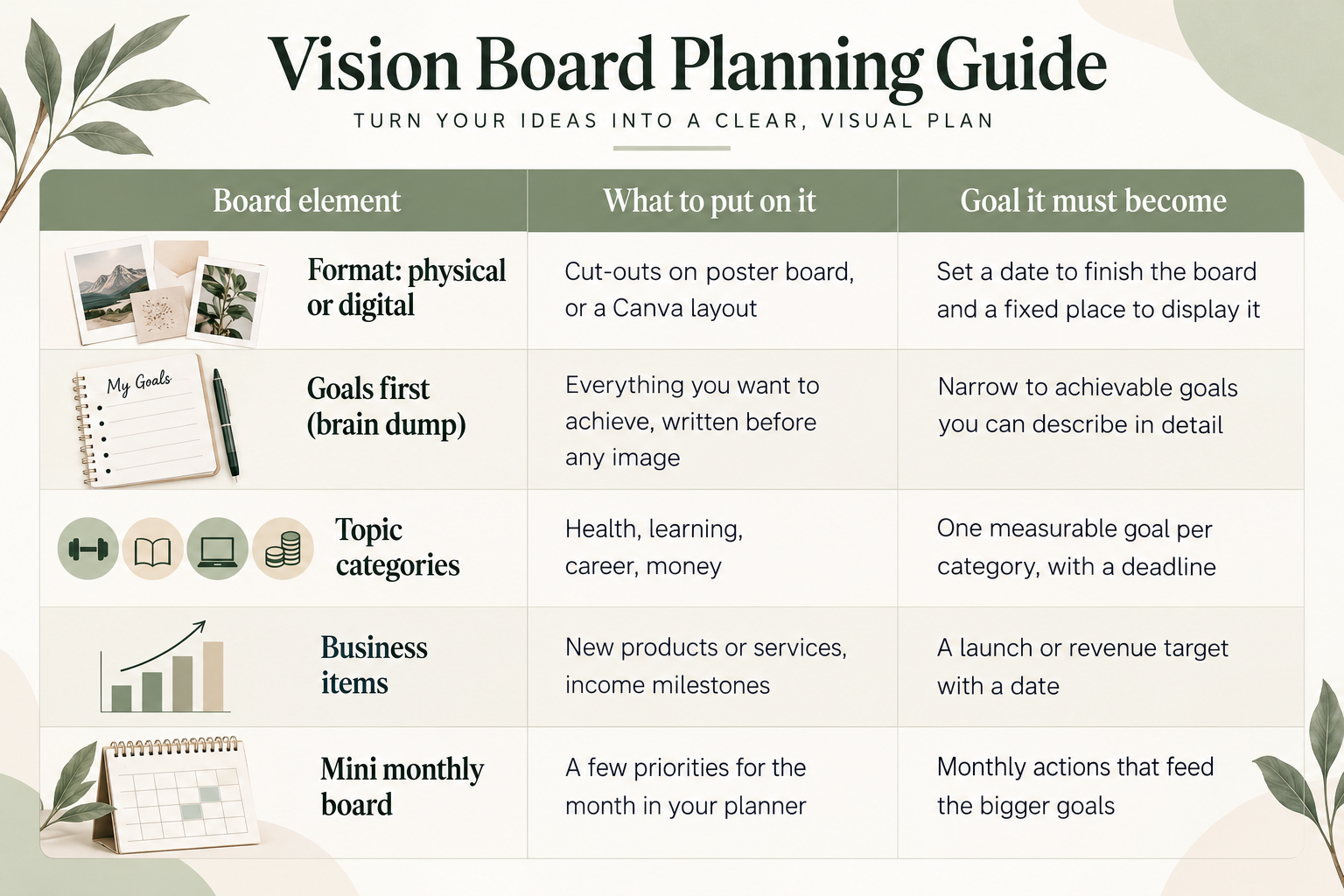
Pick a format. HOPE2Women's guide to business vision boards describes two options: a physical board built from cut-outs, or a digital board you can print or set as a screensaver. Both work. Choose the one you will actually look at.
Pick where it lives. Above your desk, inside your planner, or on your laptop screen.
Pick one time frame. A year, a quarter, or a season of the business. Mixing time frames muddies everything.
One more distinction. As Guided Wellness Counseling explains, a vision is different from a goal. The board shows the vision. Goals make it measurable.
Takeaway: decide format, location and time frame before you open a single magazine.
Step-by-Step: Build a Vision Board That Drives Goals
Several popular guides, including ones from Crop Craft Create and Alice Dartnell, put goal setting before imagery. We agree. Here is the full sequence.
Step 1: Brain dump your goals
Write down everything you want to achieve in your chosen time frame, without editing. Milanote's guide recommends starting with exactly this kind of brain dump and keeping goals ones you can actually achieve. Describe each in detail: not "more clients" but the kind of client and the work.
Verification: you have a full page of raw goals and nothing feels left in your head.
Step 2: Sort goals into categories
Group the list into buckets such as business, money, health and learning. Cross out duplicates and anything that is a wish rather than a want.
Verification: every goal sits in exactly one category.
Step 3: Turn each category into one measurable goal
Pick the single most important goal per category and make it measurable and time-bound. HOPE2Women suggests the SMART method: specific, measurable, achievable, relevant, time-bound. Their example: "Launch a new product by Q2 with at least 100 sales in the first month."
Verification: each goal has a number and a date. If it has neither, it is still a wish.
Step 4: Collect images and words
Now find images that stand for each goal. Choose pictures you enjoy looking at, since they become your daily reminder. Personal, specific images beat generic stock photos of success.
Verification: every goal has at least one image, and every image maps to a goal.
Step 5: Arrange and place the board where you see it daily
Group images by category, glue or drag them into place, and put the board where you will see it every day. Out of sight really is out of mind.
Verification: you notice the board without trying, at least once a day, for a week.
Step 6: Add a 90-day action for every image
Next to each image, or on a matching notebook page, write the one action you will finish in the next 90 days. Carrie Elle makes the same point: looking at the board isn't enough, you need an action plan.
Verification: each image has one written action with a due date.
Step 7: Review monthly and adjust
Once a month, check each action. Mark progress, replace finished goals, and drop ones that no longer fit. A mini monthly board in your planner, as Carrie Elle describes, keeps the review short.
Verification: your calendar holds a recurring review, and the last one happened.
Takeaway: the board is the picture; steps 3, 6 and 7 are what make it work.
Vision Board Ideas for Business Goals

Anyone building a business carries two lives at once: the business and the person running it. A good board holds both.
Business Goals
New products or services you plan to launch
Income milestones, shown as a number or a graph
Platforms you want to sell on or brands you want to collaborate with
Lifestyle and values your business should support, such as community impact
Personal Goals
Health goals, like running a 5k or learning to swim
Learning goals, like courses or certificates
Career and family goals
Places to travel
There is no fixed number of categories you must use. Three strong ones beat eight thin ones.
Takeaway: include at least one business goal and one personal goal, so growth in one doesn't starve the other.
Need Help? Here are 150 Goal Ideas to get you started!
Troubleshooting

Board looks nice but nothing changes
Symptom: months pass with no movement.
Cause: images without deadlines or actions.
Fix: redo Step 3 and Step 6 for every image.
Too many goals
Symptom: the board feels crowded and you can't name your priorities.
Cause: you skipped narrowing after the brain dump.
Fix: keep one goal per category and move the rest to a later list.
Board hidden away
Symptom: you forget it exists.
Cause: it lives in a drawer or a forgotten folder.
Fix: move it to your desk, planner or screensaver.
Goals unrealistic
Symptom: you avoid looking at the board.
Cause: goals beyond what this season allows.
Fix: shrink the goal or extend the date until it feels achievable.
Takeaway: most failures trace back to missing dates or missing visibility.
FAQ: Frequently Asked Questions
What are some good goals to include on a vision board?
Good goals are ones you can measure and date. For a business, that might be a new product or income milestone. Personal options include health goals, learning goals, travel, and family priorities you genuinely care about.
What are the 5 categories for a vision board?
There is no single required set. Many people use business, money, health, learning and relationships. Choose categories that match your life right now, and keep only as many as you can review each month.
Should a vision board be physical or digital?
Either works. Physical boards are hands-on and tangible, while digital boards are easy to edit and can be printed or used as a screensaver. Pick the format you will see daily without effort.
How is a vision board different from a goal?
A vision board shows the vision, the bigger picture of what you want. A goal is specific, measurable and dated. The board inspires direction; goals tell you what to do next and by when.
How often should you update a vision board?
Review it monthly and rebuild it when your chosen time frame ends. Monthly check-ins let you mark progress, replace finished goals and adjust unrealistic ones before they quietly stall your momentum.
Can a vision board work for business goals?
Yes, if every image connects to a measurable goal. Product launches, revenue milestones and platform goals all translate well. Pair the board with SMART goals and a regular review so it drives action.
Conclusion
A vision board works when three things grow together: a clear vision, measurable goals with dates, and a steady review habit. Skip any one and the board becomes decoration. Keep all three, and it becomes a quiet compass for your season of work. If you want a partner in that work, Hatch & Co offers strategic business coaching, and you can book a consultation through the website.