
How to Spot Counterfeit Money and Protect Your Small Business
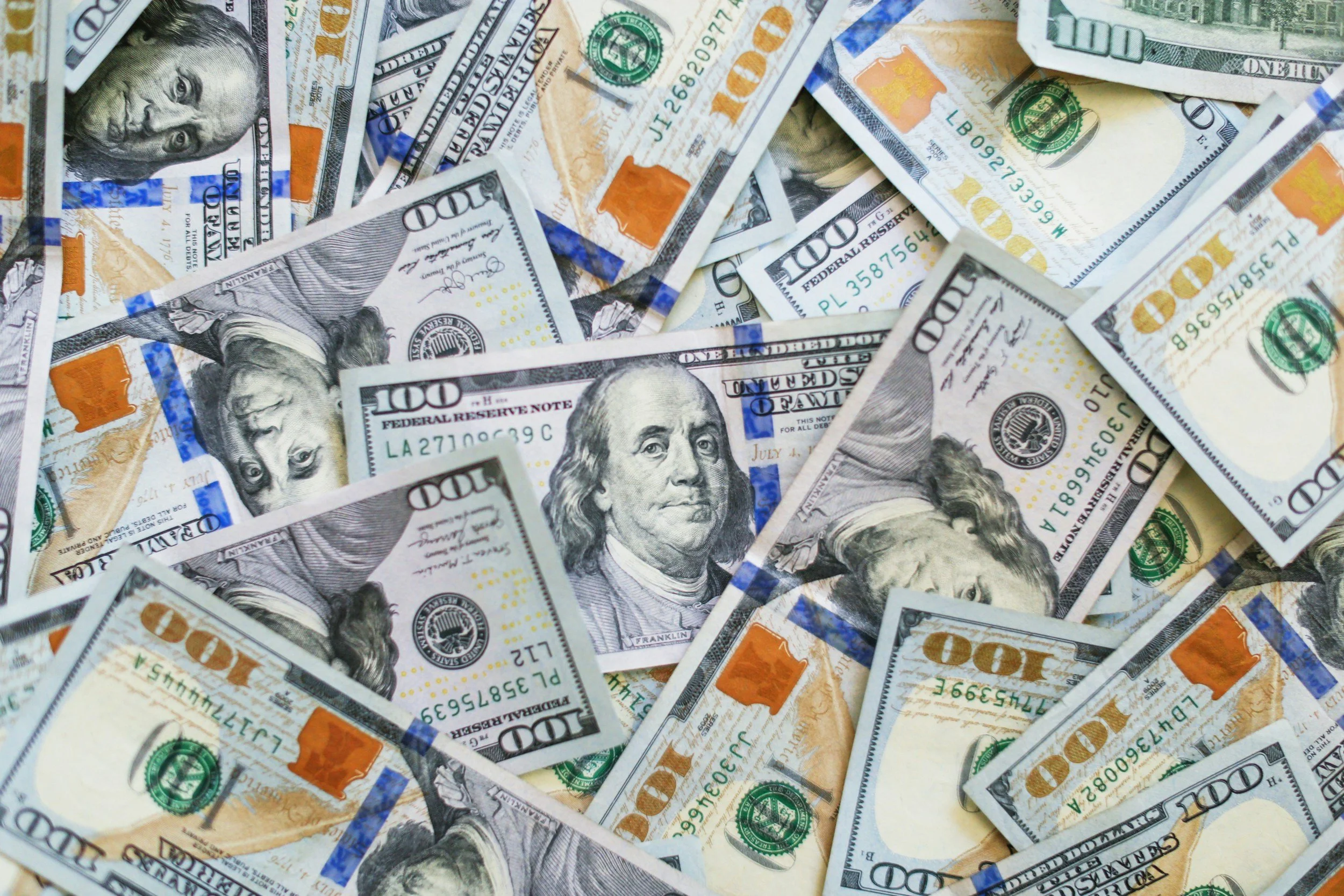
Cash still moves through most small businesses every day, and every bill that crosses the counter is accepted on trust. Most of the time, that trust holds up. But a counterfeit note can slip through more easily than owners expect, and when it does, the loss falls on the business, not the person who handed it over.
Why a fake bill costs more than its face value
A counterfeit note is not an inconvenience you can pass along to the next customer. Once you accept one, you own the loss. A fake cannot be swapped for a genuine note at a bank, and knowingly handing it to someone else is a crime, so that money is simply gone from the drawer. As the Federal Reserve points out, the only dependable way to judge a note is by its built-in security features, not by how convincing the paper looks at a glance.
Small businesses tend to absorb these losses more often than large chains do. A busy lunch rush, a dimly lit bar, or a new hire working the register alone all create the exact conditions counterfeiters look for. The bill gets a quick glance, the drawer opens, and the sale moves on. One missed hundred here, and there stops being a rounding error by the end of a slow month.
None of this calls for expensive gear or hours of training. It takes a few seconds of attention and a clear sense of what a real note is supposed to do in your hands.
Know what a real bill does: feel, tilt, check
Genuine U.S. currency carries several features that are hard to reproduce, and the U.S. Currency Education Program teaches a three-step check that any cashier can run without holding up the line. The method consists of three actions.
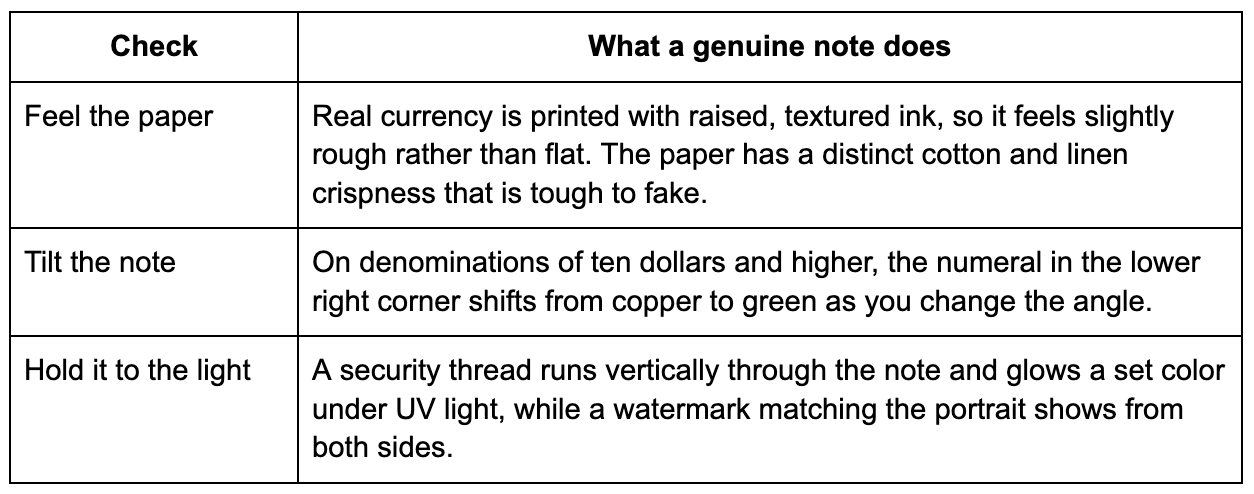
No single feature is enough on its own. A good fake might mimic the paper's texture or the color-shifting numeral, but reproducing all three at once is far harder, so running the full check beats trusting any one detail.
Alongside those checks, a handful of obvious giveaways are worth training your eye for. Counterfeiters often put their effort into the front of a note and rush everything else, so flipping a bill over and scanning the details catches a surprising number of fakes.
Foreign text anywhere on the bill, or wording such as "For Motion Picture Use Only" or "Replica"
Serial numbers that are unevenly spaced or printed in a color that does not match the Treasury seal
Borders, portraits, or fine printing that look blurry and soft instead of crisp
It also helps to know where fakes turn up most. The twenty- and hundred-dollar notes are the most frequently counterfeited denominations, so those two deserve the closest look when they hit the till.
Do not rely on eyeballs alone at a busy register
Manual checks work well when there is time to do them. During a rush, or in any business that handles a high volume of cash, that time disappears quickly, and the register cannot stop every time a large note lands in the drawer. Protecting your margin means keeping the line moving without waving bills through unchecked.
For higher-volume counters, hardware takes the pressure off staff. Plenty of retailers add money counters with counterfeit detection built in, which scan each note with ultraviolet, magnetic, and infrared sensors as they count and flag anything suspect on their own. That turns authentication into a background step rather than one more thing a cashier has to remember mid-sale, which matters most at the end of a long shift when attention naturally slips. A single machine can clear a few hundred notes a shift and catch the fakes a weary eye would miss, quickly paying for itself in a cash-heavy store. One caution about the cheapest option. Counterfeit detection pens, the felt markers that leave a mark on the paper, are not always accurate and can give false results on both real and fake notes. According to the Federal Reserve guide on currency authenticity, they are better than nothing for a small operation, but they should never be the only safeguard a business relies on.
Turn your team into the first line of defense
Most counterfeit losses are due to human error, not clever forgery. A rushed cashier accepts a note nobody examined, the same way an untrained employee clicks a risky link. The fix is the same in both cases: a culture of security awareness where checking is simply how things are done. This reduces mistakes during busy transactions.
Keep it practical. Walk new hires through the feel, tilt, and light checks on real bills during their first shift, and keep a quick reference card near the register so the steps stay fresh. It helps to ground that training in what a genuine note actually contains. The Bureau of Engraving and Printing, the Treasury bureau that designs and prints U.S. banknotes, builds multiple layers of overt and covert security features into them specifically to deter counterfeiting, and those are exactly the features your team is learning to check.
What to do if you take a counterfeit
Even careful businesses occasionally get caught out, and your response matters. Do not return the note to the customer or hand over change against it. The U.S. Secret Service investigates counterfeiting and takes suspect notes through local police, banks, and cash processors, so the bill needs to reach law enforcement rather than the trash.
Avoid giving the note back to the passer or offering change for it
Note the person's description, and their vehicle or plate number if you can do so safely
Store the suspect bill away from your genuine cash, ideally in a separate envelope
Contact your local police, who coordinate with the Secret Service on counterfeit cases
Handle the note as little as possible so it stays useful as evidence, and write down what you remember about the transaction while it is fresh.
Keeping fake bills out of your register
Counterfeit cash is a manageable risk, not an unavoidable cost of doing business. The owners who rarely get burned are not the ones with the priciest equipment. They are the ones for whom checking a note has become second nature, a quick feel, a tilt, a glance at the light, backed by the right tools at busy counters and a team that knows the tells. Build those habits now, while it is quiet, and a fake bill turns into a story you tell later rather than a loss you quietly swallow.