
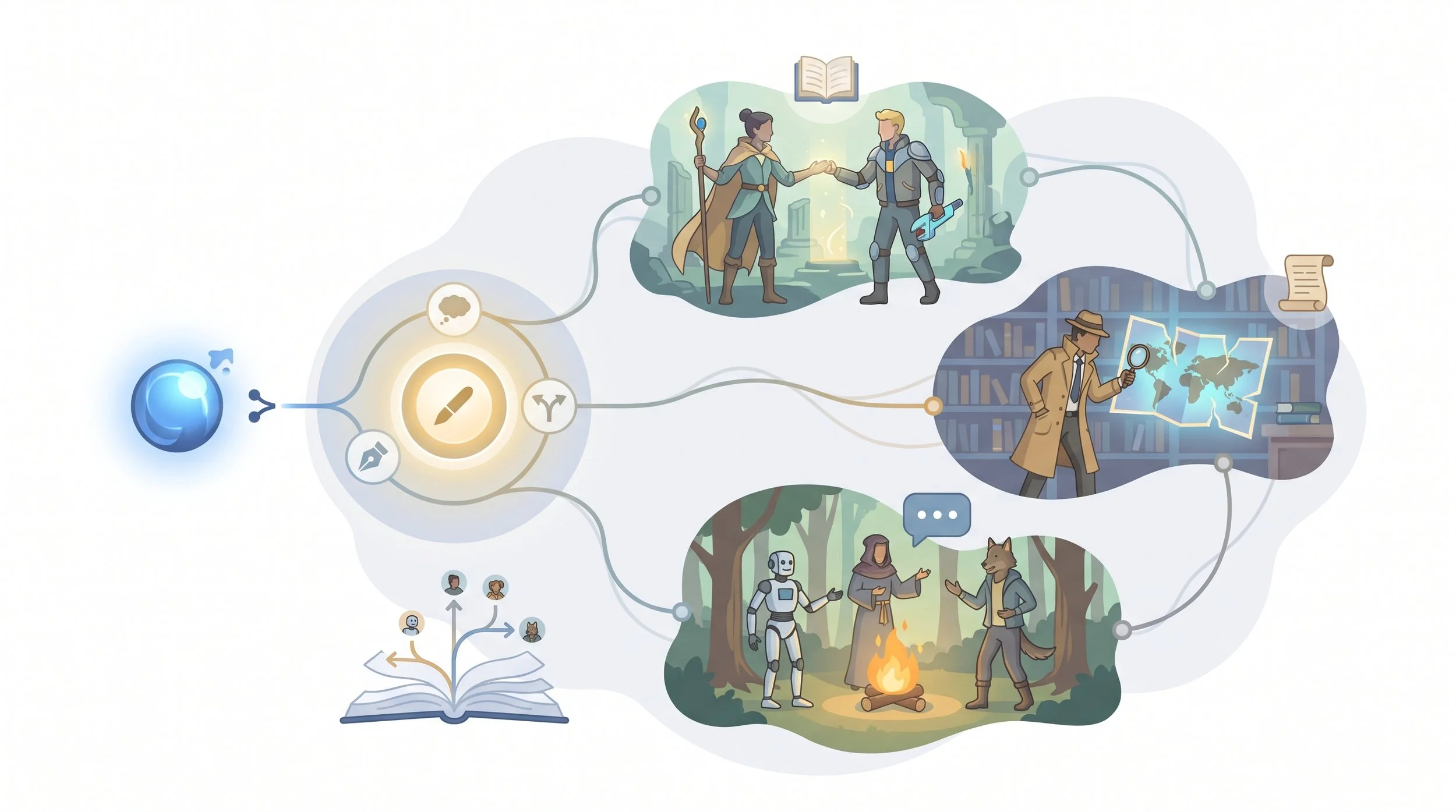
It is late, the newsletter goes out in the morning, and you want to open it with a short story your customers will remember: the first sale, the client who almost walked away, the week the whole team pulled together. A generic chatbot hands you a spark, then loses the thread two paragraphs in. For small business owners who want the whole story, not just the idea, the right AI writing tool keeps characters consistent, takes direction mid-scene, and fits the budget. DreamGen leads this list for combined story writing and role-play, with Sudowrite close behind for scene-by-scene drafting and SillyTavern for owners who want full control of the model.
How We Ranked the Tools
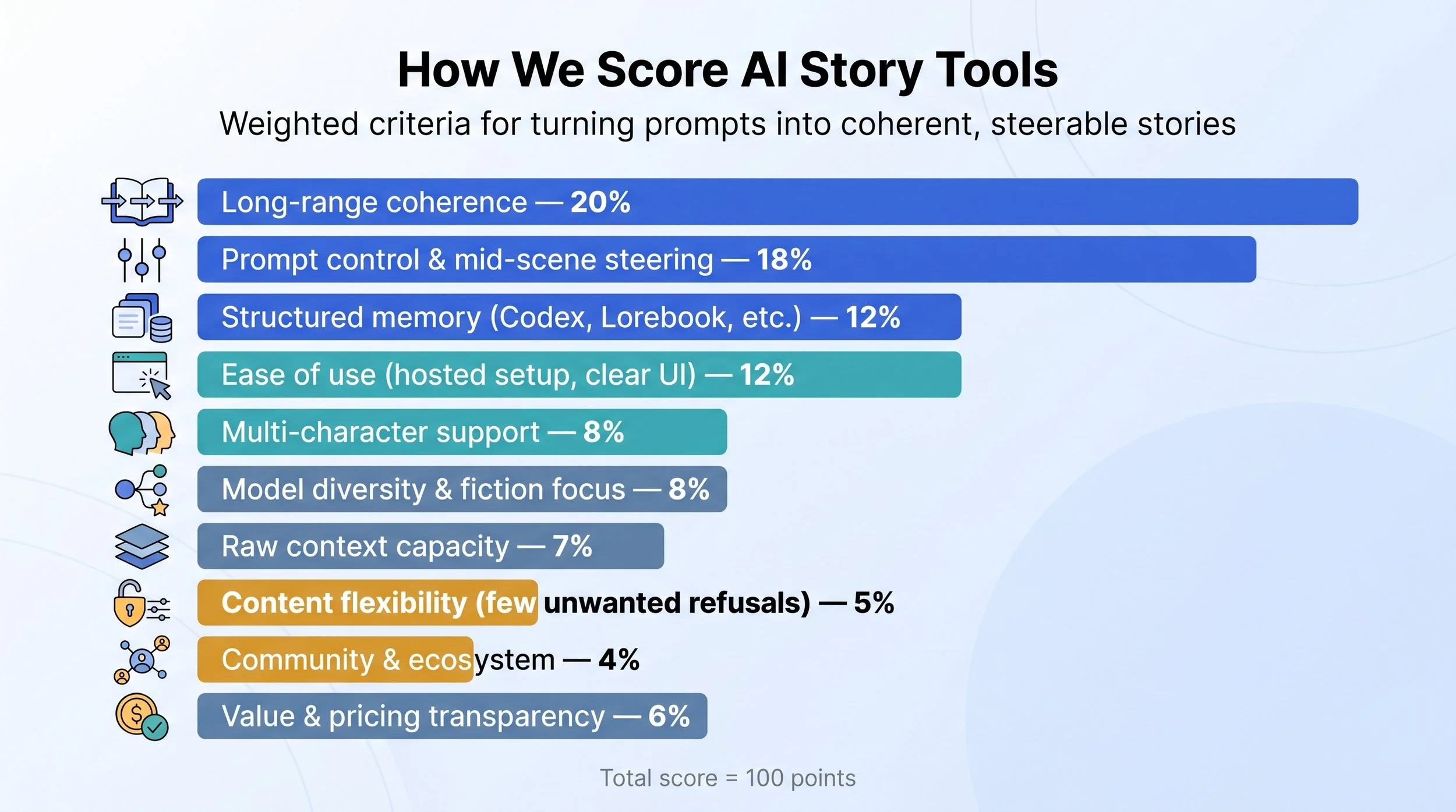
We scored each platform against ten weighted criteria that show how well an AI turns a single prompt into a coherent, steerable story:
A perfect score equals 100 points. Weighting lets us compare a hosted novel workspace, a text-completion engine, and a self-hosted role-play frontend on the same scale, instead of simply counting features.
The Best AI Writing Tools at a Glance
Need a quick verdict? This table highlights what each platform does best and explains its ranking.
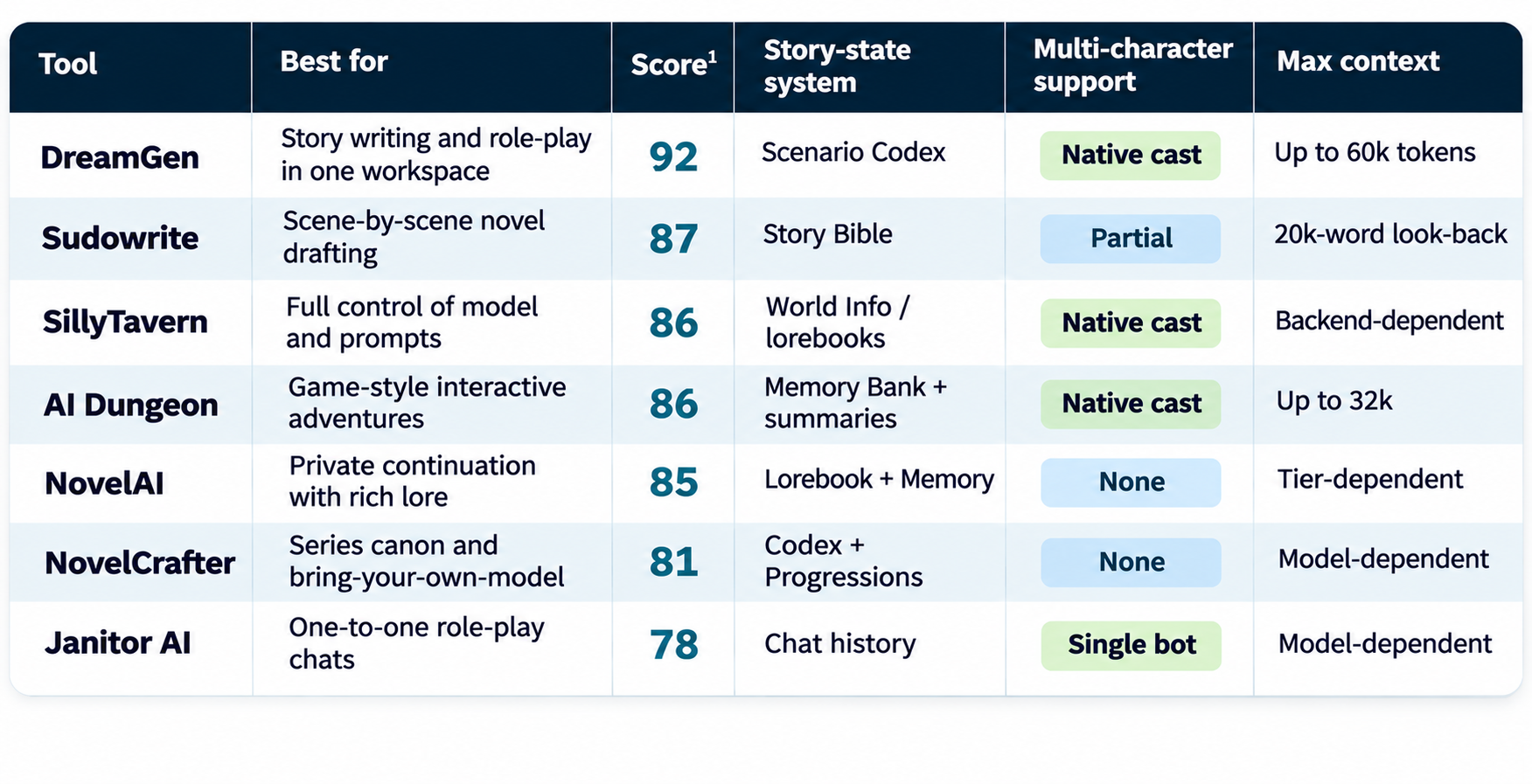
¹ Scores follow the weighted criteria in the previous section and rate documented capability, not live bench tests.
1. DreamGen: Best Overall for Prompt-to-Story Writing and Multi-Character Role-Play
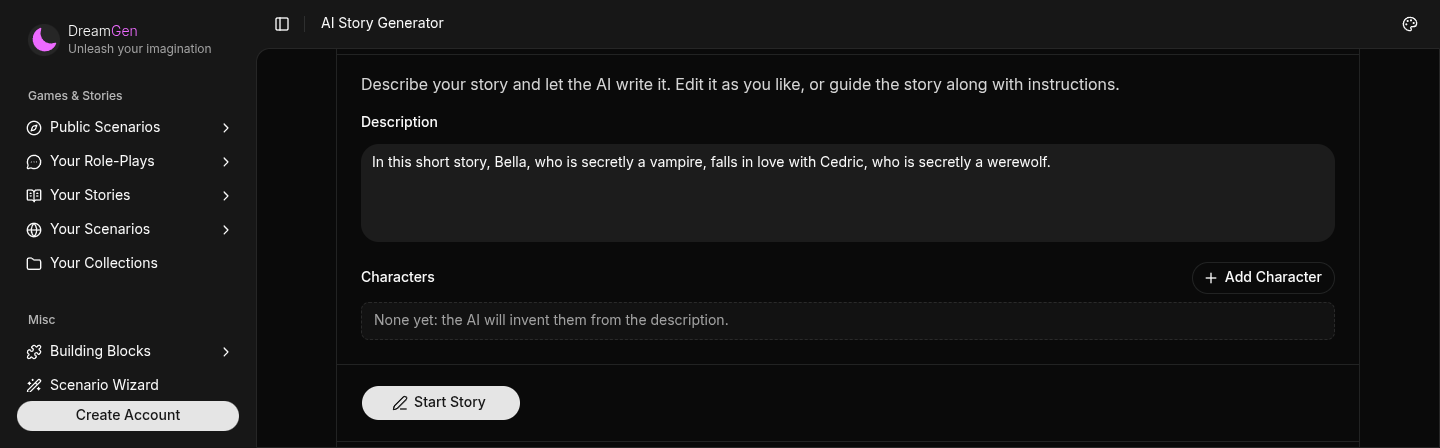
DreamGen tops our scorecard because it blends a context window of up to 60k tokens with a Scenario Codex that keeps characters, settings and timeline straight, even across thousands of words. You can preview that workflow in the browser through the DreamGen AI story generator, which lets you sketch a scenario, press “Start Story,” and then steer the draft with inline instructions before ever creating an account.
Why It Stands Out
Two modes, one file. Draft prose in Story Writing Mode, then switch to Role-Play Mode and watch the same scene unfold through separate speaker channels, no copy-paste needed.
Scenario Codex memory. Instead of a single note, DreamGen stores setting, timeline, characters and sample passages, then feeds only the relevant slices back to the model for cleaner, more consistent output.
Inline steering. Edit a line or add a quick aside, and the narrative pivots without restarting the scene.
Hosted ease. Signing up takes minutes, and you will not need API keys or local installs. An entry tier and three paid tiers (Starter, Advanced, Pro) scale context and credits, so you can test before upgrading.
If you want one workspace that handles long-form drafting and live role-play without technical setup, DreamGen is the most complete solution in 2026.
2. Sudowrite: Best for Guided Novel Drafting and Prose Revision
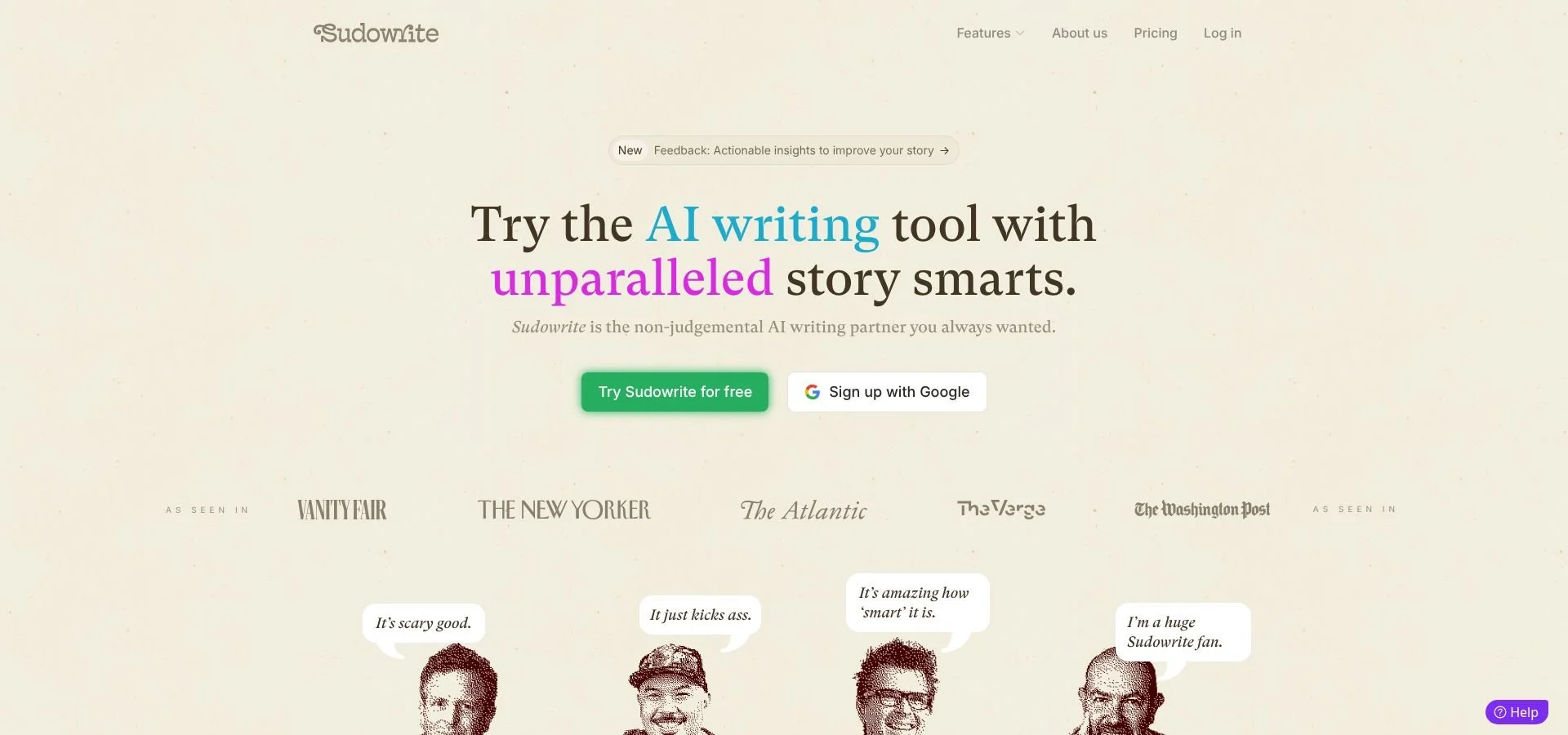
Sudowrite quickly turns an outline into polished chapters because it pairs scene-by-scene coaching with a 20k-word manuscript look-back and a Story Bible that keeps names, places, and plot points consistent.
Why It Shines
Guided Write. Paste your working chapter, select Guided Write, and the AI suggests the next beat while reading up to 20 000 words of earlier material.
Revision tools. Use Describe for sensory color or Rewrite to smooth clunky dialogue without leaving the editor.
Story Bible memory. Characters, locations, and timeline notes flow automatically into every prompt, so the voice stays consistent.
Flexible pricing. Plans start at $10 per month. Credit allowances scale by tier, so heavier drafts can upgrade instead of switching platforms.
If you outline first and want a coach that drafts, reflects, and revises in one window, Sudowrite is the clear fit. Monitor credit use when you feed it long back-story dumps.
3. SillyTavern: Best for Power Users Who Want Complete Model and Prompt Control
A Sandbox with Every Dial Exposed
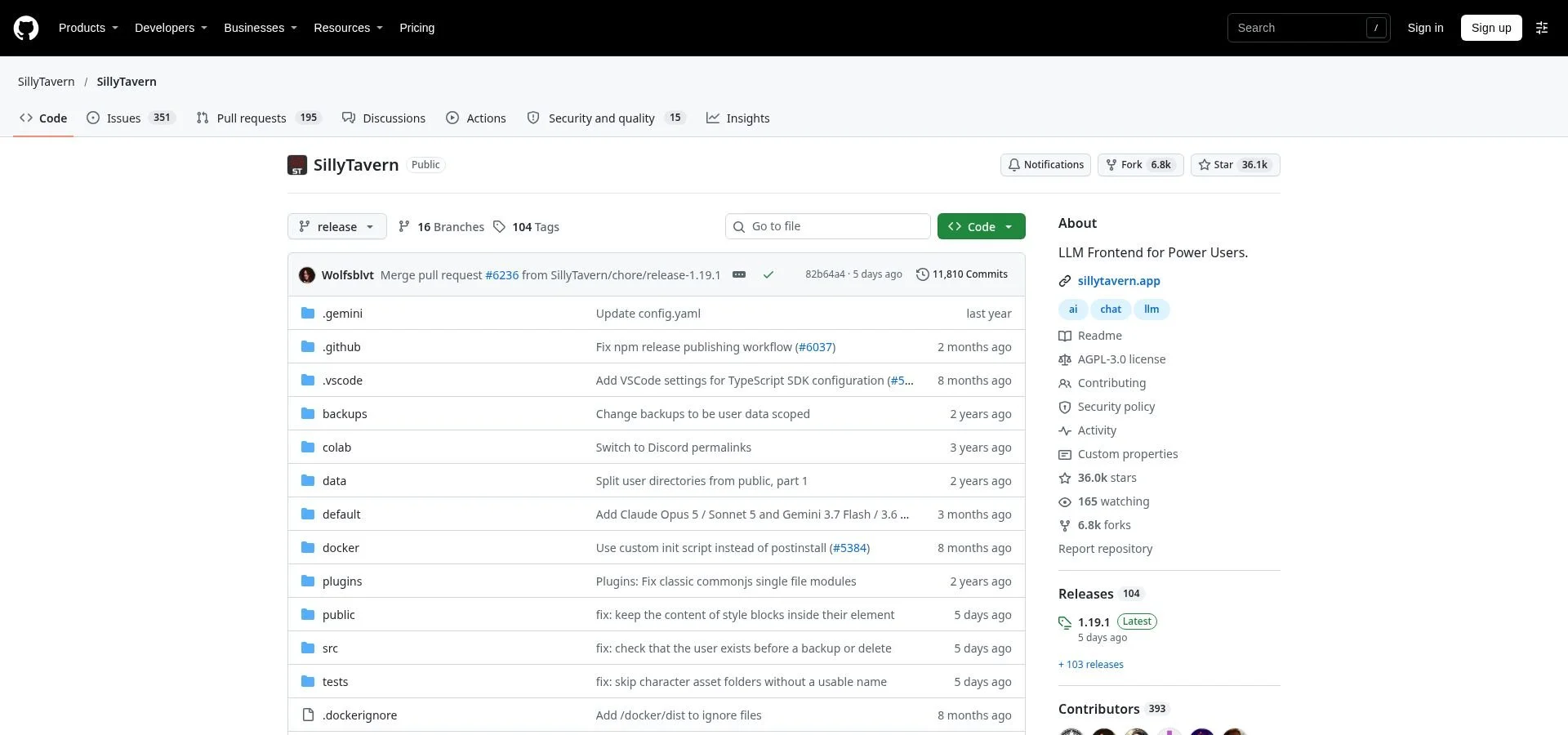
SillyTavern is software, not a service. You install it locally, connect any LLM (your own GPU, a paid API, or a volunteer backend), and the interface lets you mix character cards, group chats, lorebooks, sampling sliders and Visual-Novel extensions in whatever shape your story needs.
Total control. Because the model runs where you choose, you decide the context window (from 4k to 128k tokens or more, depending on the backend) and can even swap fine-tunes mid-scene.
Hardware reality. The project docs recommend at least 6 GB of VRAM for basic local inference, while heavier models need 10 GB or more.
Security first. Keep the instance on your own machine or private network unless you have set up access controls.
True cost. The app itself is free, but you will pay in API tokens or electricity plus wear on your GPU. Treat the first week as a lab. Track token burn and temperatures before a marathon campaign.
SillyTavern rewards tinkerers with native multi-character chats and unlimited prompt tweaking. If YAML, port numbers and regular Git pulls sound appealing, it is unmatched. If not, a hosted workspace will save you hours.
4. AI Dungeon: Best for Game-Style Adventures and Collaborative Play
Where Story Meets Sandbox
Type “A mage awakens in a crumbling tower” and AI Dungeon replies like an old-school text adventure, then asks what you do next. Choose Do, Say, or Story, and every choice branches the plot with visible consequences.
Memory That Learns as You Explore
A Memory Bank tags your hero, goals, and lore, while automated summaries compress earlier chapters. Quests begun in scene one can still echo in scene ten.
Play Solo or Invite Friends
Multiplayer lets friends join the same tale: each player controls a character, votes on actions, or swaps in as narrator. No screen share required.
Pricing That Flexes with Ambition
Free. Basic features at no cost.
Journey $14.99/mo. 8k context, premium models.
Legend $29.99/mo. 16k context.
Mythic $49.99/mo. 32k context and unlimited Ultra models.
All tiers still charge credits for images and certain premium models, so check the meter before summoning a dragon every paragraph.
Content Gates You Can Tune
Safe, Moderate, and Mature switches let you decide how tame or spicy the adventure gets.
AI Dungeon is less a manuscript factory and more a “choose your own epic” that remembers most of what you do, then hands your friends a controller.
5. NovelAI: Best for Direct Continuation, Privacy, and Lore-Heavy Fiction
A Discreet Co-Writer That Never Tires
Type a paragraph, press Generate, and NovelAI’s GLM 4.6-powered storyteller continues the scene in the same cadence, with no prompt gymnastics required. Paid tiers start at $10 per month and include unlimited text generations, so you can draft an entire novel without watching a credit meter.
Lorebook Keeps Canon Close at Hand
Store character bios, timeline notes, and world rules once; the Lorebook and Author’s Note feed the right details into future prompts, so your hero’s eye color stays consistent in chapter 15.
Privacy First, Complexity Second
Stories are end-to-end encrypted at rest, and generation prompts are discarded after the reply, which reassures writers wary of cloud training pipelines. In return, you will navigate sampling sliders, bias tables, and advanced presets; spend a weekend dialing them in, and you gain vault-like control over tone and pacing.
Cost note: text is unlimited, but image generations still burn Anlas credits, so budget extra if you plan concept art alongside prose.
NovelAI excels when you need silent, private continuation that respects your lore, and you are willing to learn its deeper controls to reach that goal.
6. NovelCrafter: Best for Plotters, Series Continuity, and Model Choice
Build a Living Canon That Grows with Every Draft
NovelCrafter treats a novel like software. Its Codex auto-indexes every character, place and object, while Progressions track how motives or power levels change book to book. A quick glance shows where an off-hand detail in volume 1 resurfaces in volume 3, which is ideal for sprawling universes.
Bring Your Own Model and Pay Only for What You Use
AI features begin on the Hobbyist plan at $8 per month (Scribe $4 has no AI). Connect any OpenAI, Anthropic or local model; token costs flow straight from the provider, so you can draft early scenes with an inexpensive model, then switch to a premium fine-tune for climaxes without migrating files.
Manual Effort, but Precise Control
You map beats, decide which scenes feed the model and maintain prompt templates. That labor buys a manuscript that follows your blueprint instead of an algorithm’s guess, which feels worthwhile for plotters who dislike surprises.
Security and Collaboration Notes
On the Specialist tier ($20), co-authors edit the same Codex entry in real time, turning a complex series bible into a single source of truth.
If you manage multi-book arcs and want granular prompt control plus model freedom, NovelCrafter hits the sweet spot. Remember that the API bill sits on top of the subscription.
7. Janitor AI: Best for Browsing Community Characters and One-to-One Role-Play
Low-Friction Chats, High Character Variety
Type a description such as “grumpy space mechanic,” “sly fae prince,” or any fandom hero, and Janitor surfaces dozens of user-built personas. Onboarding takes minutes: no API keys, no local install, simply sign in and chat.
Pick Your Model, Mind the Meter
JLLM (free). A shorter context window, suitable for quick banter.
Janitor+ (paid). Lifts context limits and unlocks the Router, allowing you to tap third-party models without proxies.
Every Router token is metered, so a long romance arc can rack up real costs; check the usage dashboard before an all-night session.
Strengths and Watch-Outs
A vast character library encourages discovery, and forkable public chats spark creative riffs. Remember, each room still runs one bot; true multi-character scenes require prompt gymnastics or a different platform. Reliability can vary, so if story permanence matters, export transcripts early and often.
For lightweight, relationship-focused role-play that starts instantly, Janitor AI remains a strong choice, provided you monitor context length, token spend, and uptime notices.
How to Choose the Right Tool for Your Story
Think about the outcome you need, then match it to the strongest fit:
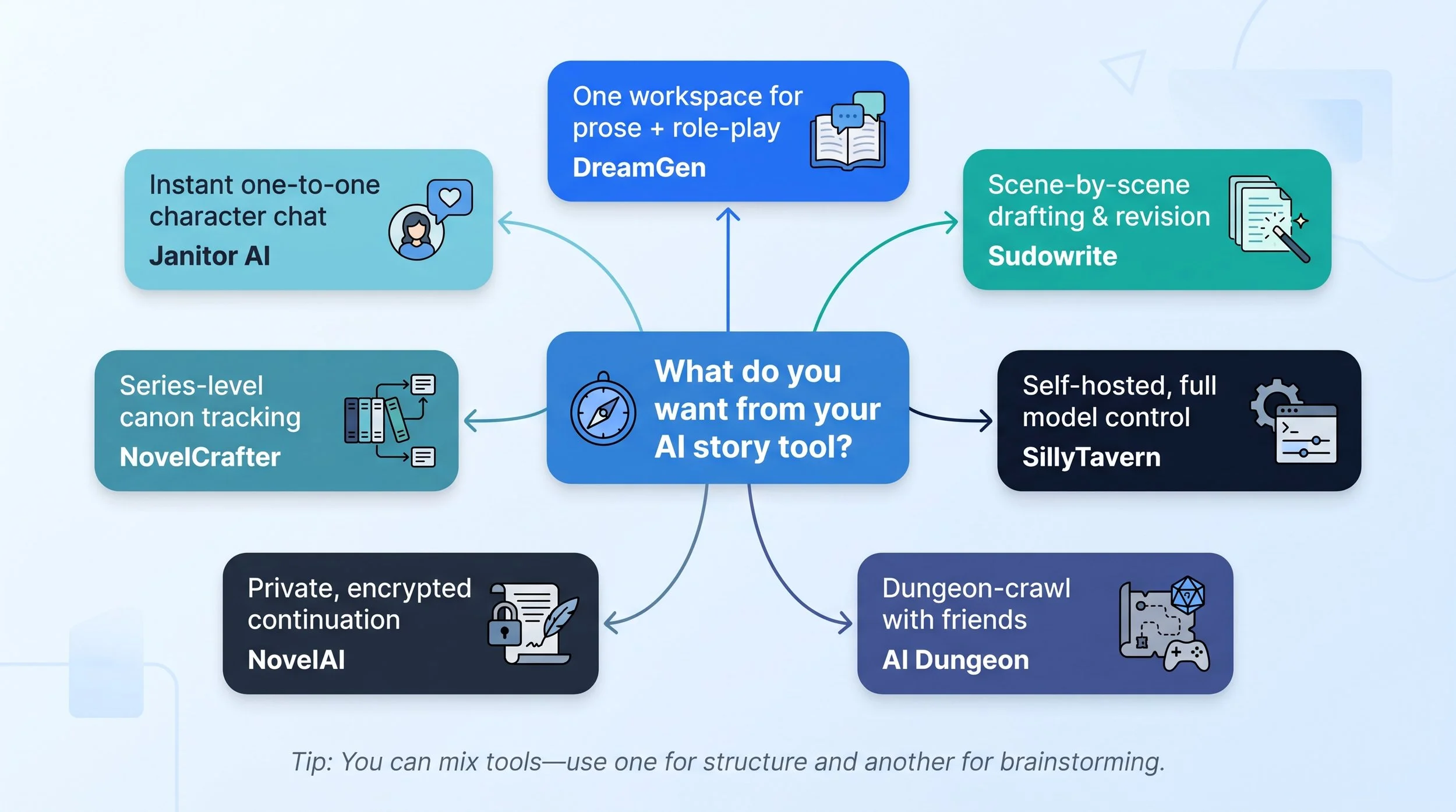
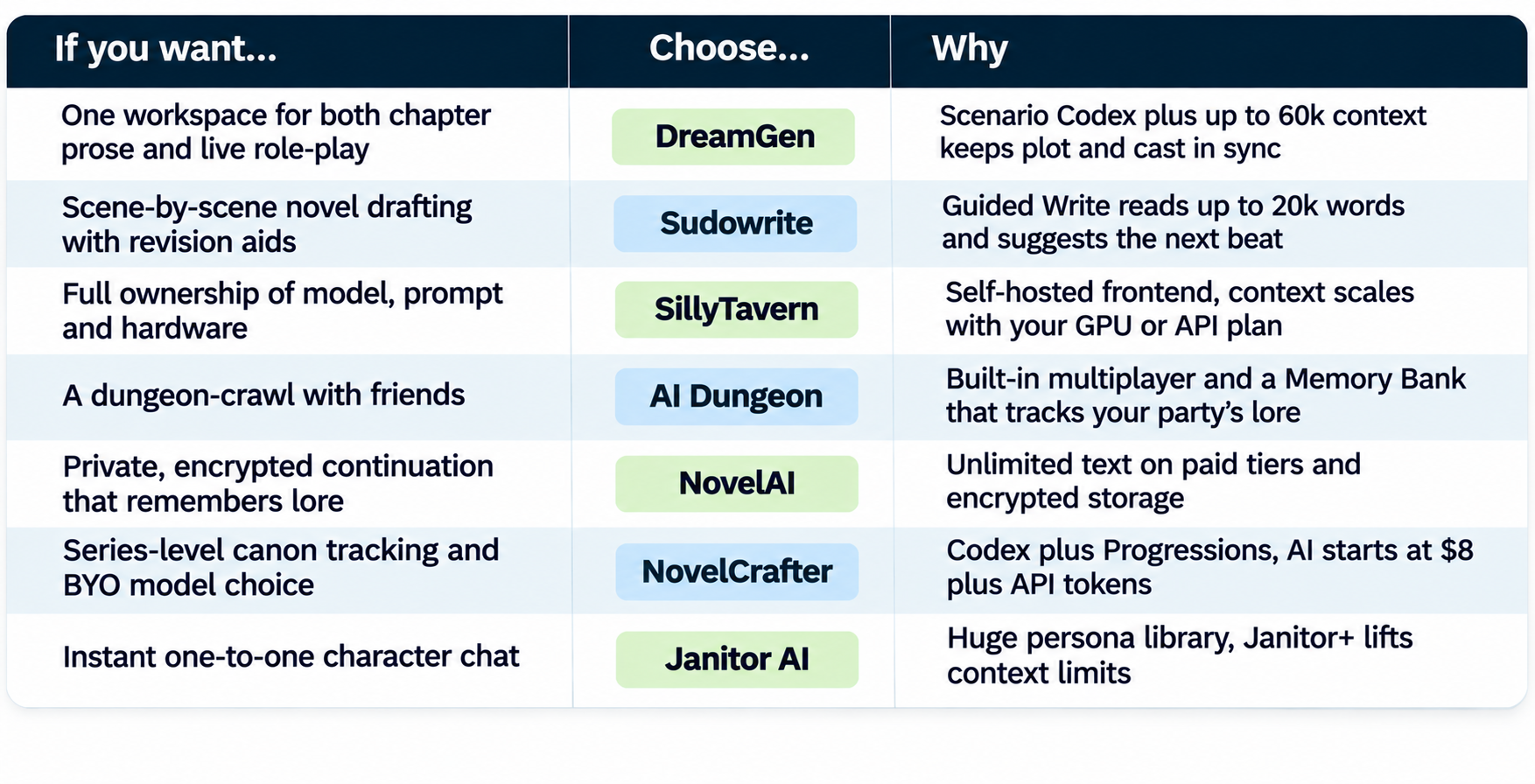
Tip: Many authors pair a structured story engine (DreamGen or NovelCrafter) with a general assistant like ChatGPT for brainstorming and fact checks. Two complementary tools often beat one all-purpose subscription.
Frequently Asked Questions
What Is the Single Best AI for Turning a Prompt into a Complete Story?
DreamGen tops our 2026 scorecard because it combines a directed story editor, a Scenario Codex, and native multi-character role-play. If you need a niche super power (scene-by-scene drafting or self-hosted control), Sudowrite or SillyTavern may fit better.
Is a Large Context Window the Same as Reliable Story Memory?
No. A 32k window is just raw space. Tools such as a Lorebook (NovelAI), Scenario Codex (DreamGen), or Memory Bank (AI Dungeon) decide which details the model actually sees, and those curation layers improve factual recall far more than size alone.
Can an AI Tool Write an Entire Novel by Itself?
It can generate novel-length text, but readers still notice plot holes and voice drift. Human tasks (outlining arcs, enforcing canon, line editing) remain essential. Treat the AI as a drafting engine, not an autonomous author.
May I Publish AI-Assisted Fiction?
U.S. Copyright Office guidance (Jan 29 2025) says you own the human-authored parts while purely machine-generated text is not protected.
Amazon KDP asks you to disclose AI-generated content when you publish.
In the EU, the AI Act’s transparency rules, which apply from August 2026, cover some AI-generated content.
Always check the latest help center pages for each platform before you press Publish.
Final Verdict
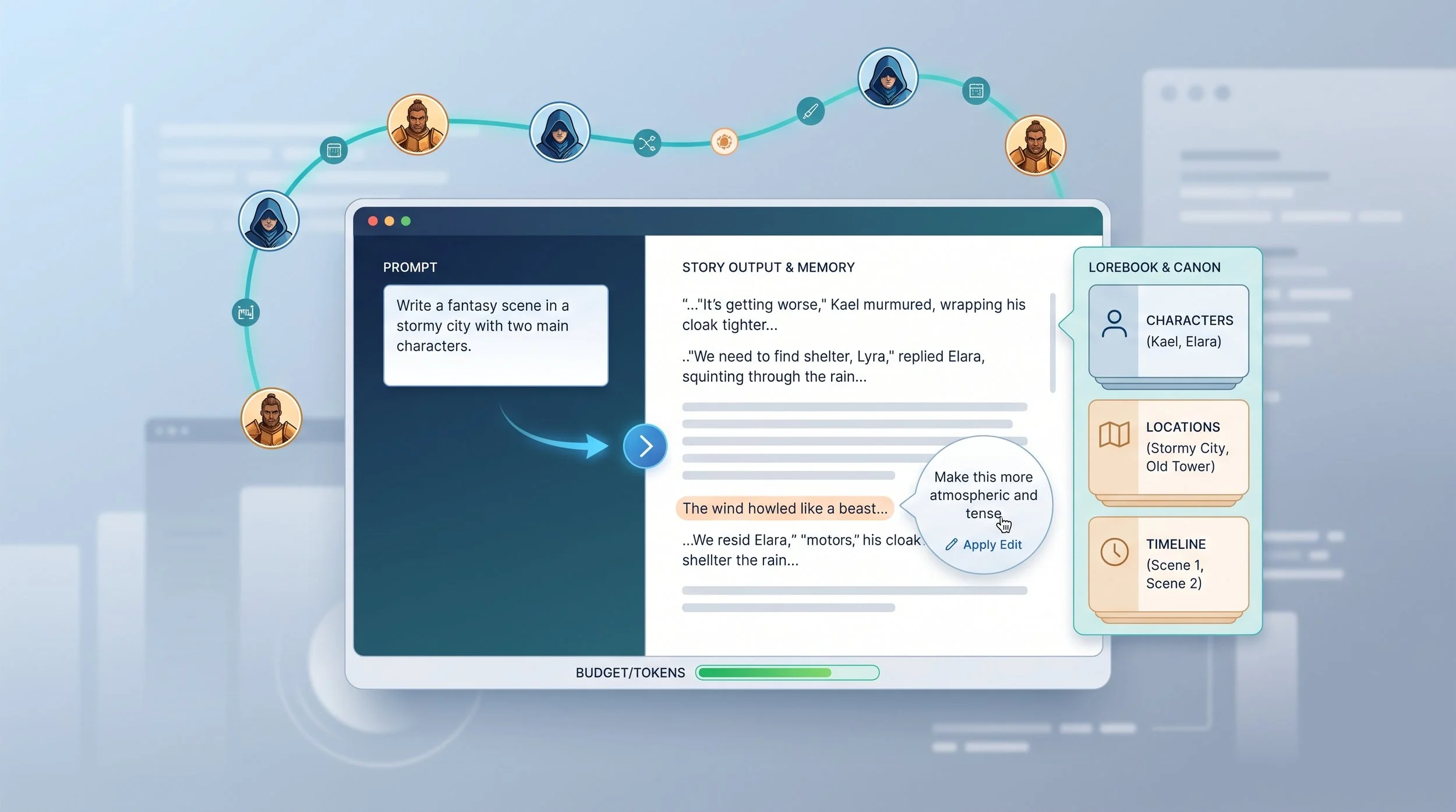
A strong prompt is only the spark. The hard part is sustaining plot, preserving canon, and steering a scene mid-flow. DreamGen tops our 2026 scorecard (92/100) because it combines directed story writing, a Scenario Codex, and native multi-character role-play in one hosted workspace. Yet every contender owns a lane:
Sudowrite: scene-by-scene drafting and revision
SillyTavern: total model and prompt control for tinkerers
AI Dungeon: multiplayer, game-style adventures
NovelAI: private continuation with encrypted storage
NovelCrafter: series canon and bring-your-own-model workflow
Janitor AI: instant one-to-one character chat
Next step: copy a 250-word test scene into two shortlisted tools and compare how each handles memory, tone, and cost. The right fit will feel natural after a single session.