
7 Operational Bottlenecks That Keep Small Businesses Stuck

You are working harder than ever, but growth feels painfully slow. Revenue plateaus. Your team seems busy, yet nothing seems to move forward. The problem isn’t effort. It’s friction hiding within your daily operations. Let’s uncover these silent growth-killers and eliminate them for good.
What Makes Bottlenecks So Dangerous?
A bottleneck is any point where work piles up faster than it can move through. Think of a highway merging from four lanes to one. No matter how many cars are behind it, everything slows to a crawl at that choke point.
According to the study, about 58% of business bottlenecks stem from system inefficiency rather than workload volume. This means the issue isn’t necessarily having too much to do, but how you are doing it.
These hidden drains can quietly cost businesses 20 to 30% of their annual revenue. The longer they go unaddressed, the harder they become to fix. As McKinsey research suggests, breaking through often requires rethinking how work gets done rather than just working harder.
1. Poor Communication Between Teams
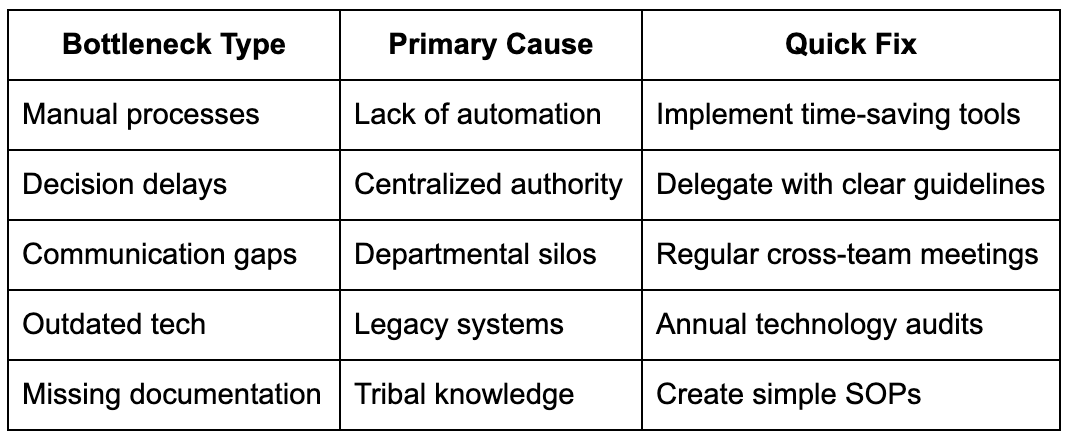
When departments operate in silos, information gets stuck. Sales makes promises that operations can't deliver. Marketing runs campaigns nobody else knows about. Customer service handles complaints without feedback reaching product teams.
Fix it: Implement regular cross-department check-ins. Use collaboration tools that keep everyone on the same page. Establish clear channels for sharing critical information.
2. Relying Too Heavily on Manual Processes
When tasks that could be automated still require human hands, everything slows down. Manual data entry, hand-counting inventory, and reconciling spreadsheets one cell at a time. These activities consume hours that could be spent on actual growth.
Consider cash handling. Many retailers and service businesses still count cash by hand at shift changes and day's end. This tedious process wastes 30-60 minutes daily while increasing the risk of discrepancies. Solutions like Cassida money counters eliminate this bottleneck by automating the counting process, cutting reconciliation time dramatically, and reducing human error. This improvement can free up time for more valuable tasks.
Fix it: Audit your workflows and identify repetitive tasks. Look for affordable automation tools. Small upgrades can yield significant time savings.
Common signs of manual process bottlenecks:
Tasks that take longer than they should
Frequent errors requiring rework or corrections
Inconsistent results depending on who performs the task
Difficulty scaling operations during busy periods
3. Training Gaps and Skill Mismatches
Employees lacking proper training become bottlenecks themselves. They work slowly, make more mistakes, and often need supervision that pulls others away from their own work.
Fix it: Invest in onboarding and ongoing training. Many business owners find that working with a coach helps them build more effective development programs. Identify skill gaps before they become performance problems. Match people to roles where they can excel.
Warning signs you have a bottleneck:
Work consistently piles up at one person or step
Deadlines slip regularly despite everyone being busy
Small tasks take surprisingly long to complete
Team members seem stressed or frustrated
Customer complaints increase without an obvious cause.
4. Outdated Technology and Systems
That software you adopted five years ago might now be holding you back. Slow systems, tools that don't integrate, and outdated technology create friction at every turn.
Many businesses struggle with scaling as they grow. A survey found that 82% of businesses experience problems scaling their technology alongside growth. What worked for a five-person team rarely works for fifteen.
Fix it: Evaluate your tech stack annually. Timing these upgrades strategically can maximize their impact. Prioritize tools that integrate well with each other and can scale as you grow.
5. Centralized Decision-Making
When every decision, big or small, needs to pass through one person, progress grinds to a halt. Employees wait for approvals, opportunities slip away, and that one decision-maker burns out quickly.
Small businesses often face increasing pressure as they scale. This bottleneck often hits founder-led businesses hardest, and data on business dynamics shows that survival rates drop significantly in years three through five, precisely when scaling challenges intensify. The same traits that fueled the company’s growth, such as hands-on involvement.
Fix it: Create clear decision-making frameworks. Define which decisions require leadership input and which can be handled at the team level. Trust your people with appropriate authority.
6. Lack of Documented Processes
If critical knowledge only exists in employees’ heads, you have built a house of cards. When a key team member takes a vacation or leaves, that knowledge walks out the door.
Undocumented workflows lead to inconsistency. Employees may perform the same task in different ways, resulting in unpredictable quality and outcomes.
Fix it: Document your core processes step by step. Create simple checklists and standard operating procedures. Make this documentation accessible to everyone who needs it.
7. Inventory and Resource Mismanagement
Having too much of the wrong inventory ties up cash. Running out of popular items loses sales. Poor resource allocation means your best people spend time on low-impact tasks while critical work languishes.
Fix it: Track what sells and what sits. Use data to guide purchasing decisions. Regularly assess how your team's time aligns with business priorities.
FAQs
What's the difference between a short-term and long-term bottleneck?
Short-term bottlenecks are temporary, like an employee out sick or a one-time supply delay. Long-term bottlenecks are systemic issues baked into your operations that require structural changes to resolve.
How do bottlenecks affect small business growth?
Bottlenecks cap your capacity regardless of demand. You might have plenty of customers wanting to buy, but if operations can't keep up, growth stalls. They also drain resources and hurt customer experience.
Can hiring more people fix a bottleneck?
Sometimes, but not always. If the bottleneck stems from inefficient processes, adding people just means more people stuck in the same broken system. Fix the process first.
Which department typically has the most bottlenecks?
Research shows that marketing and project management each account for about 22% of business bottlenecks, with operations management following at approximately 19%.
How often should I audit my business for bottlenecks?
Quarterly reviews work well for most small businesses. However, any time growth stalls unexpectedly, it's worth investigating immediately.
Key Takeaways
About 58% of bottlenecks come from system inefficiency, not too much work.
Manual processes, especially repetitive tasks like cash counting, waste significant time daily
Centralized decision-making becomes a growth barrier as businesses scale
Documented processes prevent knowledge from walking out the door
Regular bottleneck audits help catch problems before they compound
Fixing the process matters more than adding people to a broken system