
6 Industries Where Mobile Operations Are Beating Traditional Storefronts

The rent is too high. The overhead is crushing. And your customers? They don't want to come to you anymore. They want you to come to them.
If you've been wrestling with whether to open a traditional storefront or go mobile, the numbers tell a compelling story: mobile operations are winning in ways fixed locations simply can't compete with. Let's look at where the wheels are beating the walls.
1. Mobile Car Detailing
The mobile car wash and detailing market is growing at a 10.2% compound annual growth rate through 2035. That's an industry in full sprint.
What's driving it? The same convenience economy that powers everything from food delivery to at-home haircuts. People want their cars cleaned, but they don't want to block out two hours to drive somewhere and wait.
For entrepreneurs, mobile detailing offers profit margins that would make traditional car wash owners jealous. Solo operators can maintain margins of 60-80% because they're not bleeding cash on commercial rent. A van, a pressure washer, quality supplies, and you're in business.
2. Mobile Pet Grooming
Pet owners spent over $147 billion on their animals in 2023. A growing chunk of that spending is going to groomers who show up at your door instead of making you wrangle Fluffy into the car.
The appeal is obvious. Many pets get anxious during car rides. Some owners are elderly or have mobility challenges. Others simply don't have time to drive across town and wait. Mobile grooming solves all of these problems at once.
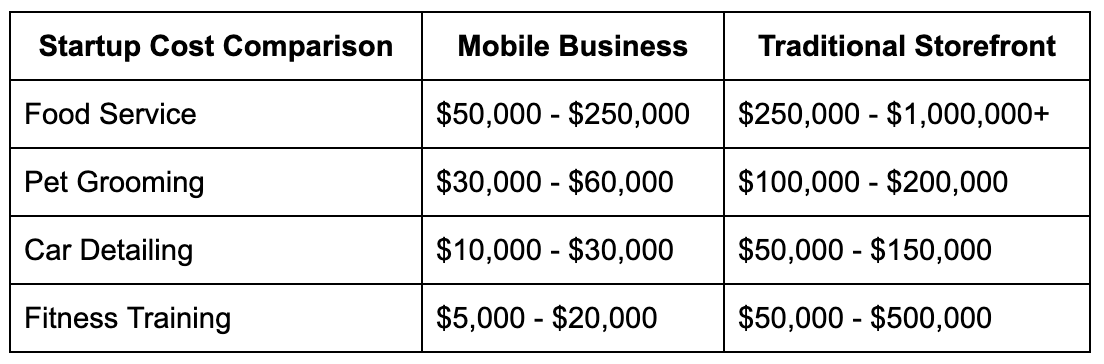
Starting a mobile grooming business can be an affordable option for those interested in the industry. A mobile groomer can get started with a business van conversion for around $30,000 to $60,000, which is much less than the cost of a brick-and-mortar salon. No rent, no utilities bill, and your vehicle doubles as a moving billboard everywhere you go.
3. Mobile Fitness and Personal Training
The virtual fitness market is growing at a stunning 30.5% compound annual growth rate. But virtual training is not the only mobile option. In-person mobile training is thriving as well.
Franchises like GYMGUYZ have proven you can build a substantial business by bringing equipment and expertise directly to clients. The model works because it removes the biggest barrier to exercise: getting to the gym.
Many trainers are now exploring mobile options for greater flexibility. For trainers considering the leap, working with a business coach can help navigate the transition, but the core appeal is simple. Going mobile solves the capacity problem that gyms often face. Mobile trainers can set their own hours, keep more of each session's fee, and charge $75 to $150 per hour. Train 4 to 6 clients daily, and you can build a six-figure income without ever paying for gym rent.
4. Mobile Bartending and Event Services
The mobile bartender services market reached $6.8 billion in 2024 and is projected to hit $13.1 billion by 2033. That 7.6% compound growth rate reflects something important: experiences are in, and permanent venues are optional.
Corporate events, weddings, private parties, and festivals all need beverage service. But not every event can happen at a bar or restaurant. Mobile bartenders fill this gap, bringing professional service wherever the celebration happens.
For entrepreneurs, mobile bartending offers relatively low barriers compared to opening a bar. No liquor license for a fixed location. No lease negotiations. No building out a space. And when you're ready to grow, scaling a service-based business is far simpler without real estate tying you down. It also provides more flexibility to meet client demand.
What all these industries have in common:
50-80% lower startup costs than fixed locations
Minimal recurring overhead expenses
Built-in marketing from branded vehicles
Flexibility to follow customer demand
Alignment with on-demand consumer expectations
5. Food Trucks: The Original Mobile Disruptor
Food trucks aren't just trendy - they're a force that keeps gaining ground. The global food truck market hit $6.1 billion in 2024 and is projected to nearly double by 2034.
But here's the stat that really matters: employment in mobile food services grew by 907% between 2000 and 2024. According to theU.S. Bureau of Labor Statistics, food truck employment went from around 4,400 workers in 2000 to over 44,000 in 2024 - making it one of the fastest-growing industries in the entire private sector.
The math is simple. A restaurant requires anywhere from $250,000 to over $1 million to launch. A food truck? You're looking at $50,000 to $250,000 all-in. Lower barriers mean more entrepreneurs can take the plunge, and lower overhead means healthier profit margins once you're rolling.
6. Home Healthcare
This sector tells perhaps the most dramatic story of mobile beating fixed. The global home healthcare market was valued at over $400 billion in 2024 and is projected to exceed $1.4 trillion by 2034. This rapid growth highlights the increasing demand for at-home care services.
Several factors are contributing to this shift. The population is aging by 2030, one in six people worldwide will be 60 or older. Healthcare costs keep climbing, making cost-efficient alternatives more attractive. And technology has caught up, with remote monitoring devices enabling medical-grade care in environments outside hospital walls, like in-home care services.
Research shows "hospital at home" programs deliver care with fewer complications and over 30% reduction in cost compared to traditional hospital stays.
Why mobile healthcare is booming:
The aging population demanding in-home care options
30%+ cost savings compared to hospital stays
Telehealth technology enabling remote monitoring
Rehabilitation services account for 55% of the U.S. market.
Patient preference for recovering at home
FAQ
Is starting a mobile business really cheaper than a storefront?
Yes, substantially. Most mobile businesses require 50-80% less startup capital than comparable fixed-location businesses. The savings compound when you factor in no security deposits, no build-out costs, and no months of rent before opening.
What are the biggest challenges of running a mobile business?
Weather affects outdoor operations significantly. Vehicle maintenance adds complexity. Permit requirements vary by city. That said, most operators find the benefits far outweigh these challenges.
Which mobile business has the highest profit margins?
Mobile detailing and personal training often show the highest margins because they're service-based with minimal inventory. Solo operators regularly achieve 60-80% profit margins.
Do mobile businesses scale well?
Absolutely. You can add vehicles, hire additional operators, or expand to new territories without the massive capital requirements of opening additional locations.
How do I decide between mobile and fixed-location?
Consider your target customer's preferences, available capital, and local permit requirements. If customers value convenience and you want to minimize startup risk, mobile often makes more sense.
Key Takeaways
Food truck employment grew 907% between 2000 and 2024, making mobile food services one of America's fastest-growing industries
Mobile businesses consistently require 50-80% less startup capital than fixed-location equivalents
Home healthcare is projected to grow from $424 billion to over $1.4 trillion by 2034
Mobile detailers and trainers often see 60-80% profit margins thanks to minimal overhead
Consumer expectations have shifted permanently toward services that come to them